
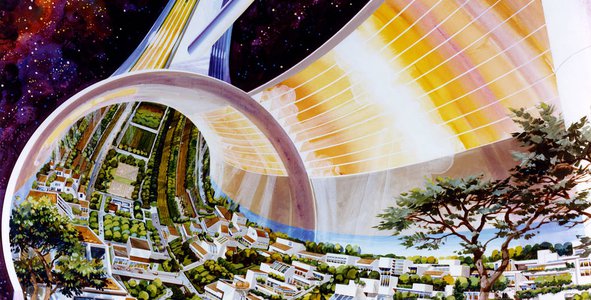
NASA is moving its data to the cloud, and Machine Learning/Artificial Intelligence (ML/AI) can offer an innovative means to analyze and use this massive archive of free and open data. Your challenge is to create an application using ML/AI techniques that allows users to input short text phrases, matches that input to NASA science data or imagery, and displays the results for the user in a creative and artistic manner.
The Challenge
Background
NASA is moving its data to the cloud and all of NASA’s science divisions (i.e., Earth Science, Astrophysics, Heliophysics, Planetary Science, and Biological and Physical Sciences) offer new Application Programming Interfaces (APIs) to access this data. Artificial intelligence, machine learning, and/or natural language processing can offer new ways to analyze and use this vast repository of data.
To celebrate this transition to cloud-based data storage, we’d like to enable a wide public audience to engage with NASA data in a creative and artistic manner.
Objectives
Your challenge is to create an application using ML/AI techniques that allows users to input short text phrases, matches that input to NASA science data or imagery, and displays the results for the user in a creative and artistic manner. Your app may use any type of NASA science data or imagery pertaining to Earth, the solar system, and beyond.
Think about the potential advantages and limitations of utilizing ML/AI algorithms. Can you use ML/AI to match the user input to the data or imagery, or perhaps change the colors/features or creatively distort imagery depicting the results? How will you train your algorithm?
Your goal is to engage the general public. How can you ensure your app is accessible to all and that your audience can share the results? Don’t forget to provide proper credit for the science data or tools your app employs.
Potential Considerations
You may (but are not required to) consider the following as you develop you application:
- You may gather data and imagery from NASA Science Mission Directorate APIs (see Resources tab at the top of the page).
- You could train the search engine algorithm using different possible user input; potential phrases such as names, places of birth, events, etc. may be a good place to start.
- Consider making it easy for users to post the results from your app on social media or copy the results into a presentation, including the proper credit for any data or tools used.
- Consider enabling your app with the capability to support multiple languages and/or the ability to fine-tune the results by discipline (e.g., Astrophysics versus Earth science), alter the features of the resulting images (e.g., dark versus light), filter the types of data used (e.g., airborne, satellite), etc.
For data and resources related to this challenge, refer to the Resources tab at the top of the page. More resources may be added before the hackathon begins.
NASA does not endorse any non-U.S. Government entity and is not responsible for information contained on non-U.S. Government websites. For non-U.S. Government websites, participants must comply with any data use parameters of that specific website.