Awards & Nominations
Artti has received the following awards and nominations. Way to go!

Artti has received the following awards and nominations. Way to go!
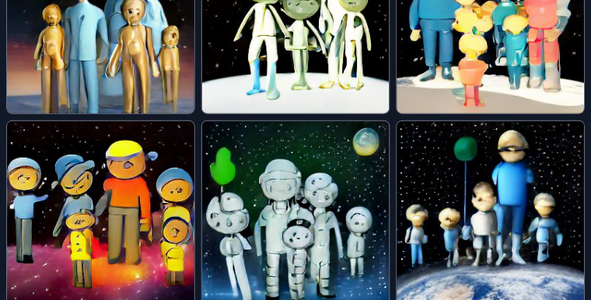
ML/AI advancement has led to many scientific breakthroughs in Healthcare, Language, and even Arts! With breakthroughs like Stable Diffusion and Dall-e, we've been able to generate text from images, and even images from the text! Artworks like the popular monkey face art, are now being stored as NFTs. We built an app called Artti, that helps you bring your dreams and imaginations about space to life and store them as digital assets like NFTs. It only needs you to put your “If I were in space, I would” wishes and it turns them into artistic pictures. While we wait for technology that’ll take people to mars, Artti helps you explore possibilities in space from images gotten from NASA
Artti is an android app that allows users to input texts and returns images that visualize the text. It uses an AI model trained on images and the corresponding text description to generate images based on text.

The project consists of three main parts:
The project was built with two programming languages, Python and Kotlin. Python was used to build the AI model and gather the data while Kotlin was used to develop the mobile app.


Artti hopes to be an app that explores imaginations and paints them in pictures, creates artistic AR/VR experiences, and stores them as NFTs.
To train the AI model, we used art images from European Space Agency and NASA
European Space Agency - Space Art: https://esahubble.org/products/art/
NASA - Space Art: https://www.flickr.com/photos/nasacommons/sets/72157633977913266/with/8973492146/
We also got inspired by NASA's Mars Rover Photos data to recreate what it's like to live on mars.
NASA's Mars Rover: https://api.nasa.gov/
Overall, it was thrilling, exciting, challenging, and fun. It was a time of immense learning and collaboration. We had a great time hacking. We chose this challenge because text-generating images have been trending for a while and we wanted to see how we could use them to generate space art and convert them to digital assets. We learned how to finetune and implement a SOTA model in less than 2 days!
When we chose this challenge, it took brainstorming sessions for us to figure out how the project can make an impact. We needed to first understand what the problem was and how we were going to approach it. We then did brainstorm how we could channel the idea to make an impact apart from just building something cool.
Some of the challenges we faced were:
So we decided to make use of the resources available to us, which was a ready-made Inference API from Crayon to generate images from text.
GitHub Project Link:
https://github.com/feranmi2002/Artti
Inference
Model Building
https://github.com/lucidrains/DALLE-pytorch/discussions/362
https://openai.com/blog/dall-e/
https://www.astroanimation.org/
Android App:
https://www.iconpacks.net/free-icon/rocket-12245.html
https://kotlinlang.org/
#art #AI #NFTs