
High-Level Project Summary
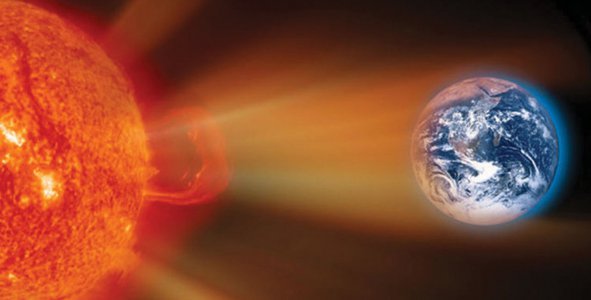
*CHALLENGE : is to develop a machine learning algorithm or neural network for the DSCOVR spacecraft to track the changes in the peak of solar wind speed so that DSCOVR can provide early warnings.*OUR DEVELOPMENT: we developed a machine learning algorithm with artificial neural network using back propagation method.*SOLUTION OF CHALLENGE: by training the artificial neural network , it become learned to recognize on the peak of solar wind speed, so it can track it , and provide early waning.*IMPORTANCE: the continues tracking of peak of solar wind speed provide early warning of next Carrington-like event to avoid its dangers on the earth as possible.
Link to Final Project
Link to Project "Demo"
Detailed Project Description
Project Operation:
The idea of operation is based on two major parts
- The first part is the design structure of artificial neural network, we have designed it to be 3 layers,The first layer is input layer that receive data from DSCOVR sensors like temperature , magnetic field, and solar wind speed. The second layer (hidden) used for processing. The third layer used for output. Each layer consists of number of nodes called neurons. These neurons are connected to the following neurons by weighted conductivity called omega (wij).
- The second part is the machine learning algorithm, we made our algorithm on the idea of back propagation of error. In this algorithm, the error between desired output and actual output is used to modify the weighted connections between nodes of the artificial neural network . By repeating and training , the connection weights becomes modified to produce output near the desired value. In our project , we designed artificial neural network consists of 3 nodes in input layer to read the temperature and magnetic field and solar wind speed. The hidden has 4 nodes. The output layer is one node. We trained it to differentiate between two classes of solar parameters, one class that due to solar wind storm ( Carrinton event) cause output to be 1. The other class due to stable state solar parameters, cause output 0. . After the ANN is learned, now it can make its decision based on both of real time input parameters and past its learned history, therefore the output of ANN will be near 1 for peak solar wind speed while near 0 for non-peak . So the DSCOVR can track the peak of solar wind speed and can provide early waning.ca
Tools: we use Mathematica Wolfram IDE for writing code
we hope to write the algorithm of ANN code by using python language and implement it by using embedded hardware system with real time .
Space Agency Data
we use the wind magnetic field data like (wi_h2_mfi_20220101_v04.cdf)
we used it to compare its changing values with time along many years
also we used it to take a small sample for training ANN
we open the cdf data file in byte mode by using mathimatica wolfram IDE
Hackathon Journey
We learned how to think, how to create and how to approve.
At frist we started collecting database about the challenge from recourses and we identified start point to development the algorithm.
We distributed of tasks as teamwork.
We would like to thank NASA for encouraging youth to be creative in science, and our country(Egypt) ,and our parents.


References
- NASA space Apps resources
- free download internet data resources
- Hardesty, Larry (14 April 2017).
MIT News Office. Retrieved 2 June 2022.
Tags
Software category and Hardware (embedded system) category