
High-Level Project Summary
We have ideated an interactive app that aims to educate people on solar effects on Space and Earth through solar and other space data (like sunspots, solar flares, CMEs, geomagnetic storms and aurorae) in a fun way through playful games, graphic and visual data representation, audio and visual systems and data archives with target demographics: kids, teens/adults, and researchers/STEM enthusiasts. The app tracks real time data from satellites like Parker Space Probe and uses all other means NASA has provided to enlighten people on all things never before appealing and obtainable, now at one's fingertips with a friendly user interface and catchy features - making the app attractive to all
Link to Final Project
Link to Project "Demo"
Detailed Project Description
Our project focused on ideating an app to make solar and space science fun and accessible: we call it Solarium. Once you open the app, it takes you to the home page, which is the main page. It will display the content of the app relevant to each user.
Contents of the app are varied and will include different features for different target groups (Kids, Teens/Adults and Researchers/STEM Enthusiasts). For example:
- Interactive games for kids
- Inbuilt graphic and video systems
- AR and audio experience
- The app and space weather
- Information corner
- Satellite data archives
CONTENTS OF THE APP:
INTERACTIVE GAMES FOR KIDS
Kids are the generation most curious and energetic. To have them learn about solar science along with other space science concepts, a myriad of interactive games and features are implemented in the app, some of which include:
- A Hurdle Race for all the ages:
Before the start of the game, the player will have to read a set text (either an article, paragraph, etc), the complexity and context of which will differ for each age group. The player will then begin the hurdle race. Each time the player reaches a hurdle, they are presented with a problem set (in the form of fill-in-the blank or a mcq). If the player answers the problem right, they move 5 steps ahead. If they answer it wrong, they move 2 steps back. The faster the players reach the finish line, the higher their score in the leader board.
- An RPG game based on the Parker solar probe:
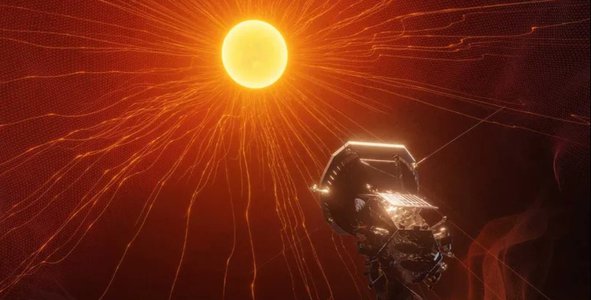
A game where the main character is in the Parker Solar Probe, and as the probe is launched from Earth and approaches the Sun, they have to solve various puzzles and encounter various obstacles and challenges. As the game progresses, the player also gets to know about the mission in detail and have fun at the same time. The game also offers scenic views of the sun, space and the probe itself.
- A fun space or sun fact every time they log into the app, which keeps them curious and interested in space science. Each day they log in gives them a streak, and the more consecutive days they do so, the more streak they get.
INBUILT GRAPHIC AND VISUAL SYSTEM
Solar and space-based data can get complex. With so many numbers and statistics, it becomes difficult for the general population to understand and reflect on the data. To provide data in an understandable way, some key points that will be introduced in our app are:
I. Mini Articles and (interactive) Quizzes (with leaderboards) for school going children as well as adults:
- Mini articles on topics ranging from solar cycle, sun structure, causes and things that affect space weather can be created. This will serve as an information library as well as a basis for participations to play interactive quizzes, the scores of which will be displayed in a public leaderboard.
II. Surveys and polls:
- Each time a person opens the site, a new, fun poll will open for them to answer before they proceed with their dealings on the website. The poll will be hypothetical and fun.
Example Question: Do you think NASA will ever create a space probe to touch the surface of the sun?
Yes or No
III. Interactive infographics can aid to present data in a user-friendly way.
AUGMENTED REALITY AND AUDIO EXPERIENCE
- Augmented reality is a key concept of today’s world. The app presents AR in the form of an augmented reality Sun tracker, allowing the user to see the position and surface conditions of the Sun (such as sunspots, solar path, its hourly intervals, its winter and summer solstice paths, rise and set times) as they use the elements of AR and motion sensors to detect the Sun.
- If the user desires, they could shift from a Sun tracker to a solar system tracker, extending the same features to the entire solar system.
- Audio is something that many in the world resonate to. The app designs a soothing audio/tune using the sunspot activity of that day and presents it along with a beautiful live aurora display, giving a true ASMR experience to aid in concentration and relaxation.
- Increased solar activity corresponds to higher pitches, lower solar activity corresponds to lower pitches.
- The app will receive live data to do so from the following website: Solar activity | SpaceWeatherLive.com, which uses data from satellites like SOHO (Solar and Heliospheric Observatory, located in the L1 point) and process the data to get melodious and soothing audio.
THE APP AND SPACE WEATHER
- The solar cycle is the cycle that the Sun’s magnetic field goes through approximately every 11 years.
- Every 11 years or so, the Sun's magnetic field completely flips ie. the Sun's north and south poles switch places. Then it takes about another 11 years for the Sun’s north and south poles to flip back again.
- The solar cycle affects activity on the surface of the Sun, such as sunspots which are caused by the Sun's magnetic fields. As the magnetic fields change, so does the amount of activity on the Sun's surface.
OUR PLAN:
The solar cycle we are currently in (for instance, in 2022 we are in solar cycle 25) will be displayed in the opening screen of the application.
The app will:
- Send alerts during solar maximum when the sunspot activity and consecutively other solar activities are at maximum, possessing higher risk of solar flares, CMEs and geomagnetic storms.
- Give a graphical depiction of the solar cycles, along with where we are at now.
- Base its aesthetic on which phase of the solar cycle we are in, acquiring warmer color shades in solar maximums and colder shades in solar minimum.
- Have pictures of the sun in different phases of the solar cycle preserved in the photo archives.
INFORMATION CORNER
With the growing interest in STEM education, specifically astronomy, people from all age groups are bound to have varying questions about space science. So, we have the following facilities to help make informative discussions a global network, a platform called “information corner”:
- Common channels for all people to discuss specific topics such as the Sun, black holes, galaxies, constellations, nebulae etc. with the general public.
- A FAQ center so that people can get in touch with scientists from NASA, ISRO, AEM, AEB, JAXA, CSA ASC, ESA etc. to answer their burning questions.
- An inbuilt space encyclopedia to offer knowledge on sun, solar phenomenon and other astronomical phenomena to the users.
- Data archives containing the information provided by satellites so that budding scientists and STEM researchers have access to raw data for research at all times.
- Photo archives of the Sun and other astronomical phenomena, which can be available to be used and processed, or simply admired by the common people. This will also supply sun-themed wallpapers for different devices.
- 360 Videos/ Pictures of the Sun at different stages of solar cycle. Pictures/ Videos can also be of coronal mass ejections, bursts of radiation, solar flare, Solar Energetic Particle Events (SEP Events) (as all affect space weather). Information can be taken and automatically updated through as well as daily solar updates can also be displayed from https://sdo.gsfc.nasa.gov/data/dashboard/
SATELLITE DATA ARCHIVES
A feature reserved mostly for the STEM enthusiasts and researchers; this includes:
- Interactive Timelines of the Parker space probe since launch to now: This is to inform and update the population at ease, with efficiency about the journey of the Parker space probe, and its different milestones and findings, in simple language for the population to understand. This website gives detailed information on the Parker space probe.
- Archives of raw data (to encourage research on such data) and the journey of different space satellites launched by different space agencies such as:
- Solar Orbiter by The European Space Agency observes and measures the composition of the solar winds and the magnetic activity at the sun's polar regions with close up pictures of the origins of all this activity.
- HELIOS-2 by NASA, the second spacecraft launched to investigate solar processes as part of a cooperative project between the Federal Republic of Germany and the United States.
- Aditya-L1, India's first dedicated scientific mission to study the Sun inserted in a halo orbit around the L1, which is 1.5 million km from the Earth towards the Sun.
Space Agency Data
Hackathon Journey
The Space Apps experience was an amazing and inspiring experience. It was enjoyable to work with different people from all over the world and have different and equally amazing ideas come into a single project. We've worked hard to accomplish our goal of making science, especially space science, fun and accessible to all.
We started off with brainstorming sessions and suggesting different ideas to inculcate in the project. After some research and a few changes and tweaks, we unified all our ideas to one project, leading to Solarium.
The major setback, however, was coordinating between the different time zones we had. We were initially to a rocky start due to all our varying personal times, but then worked upon common time periods that we all were free at. Soon enough, we were more productive and got a lot of work done in the 2 days of the hackathon.
Our team would really like to thank the organisers for giving such an amazing platform to work upon and present it in. We wish all the teams best of luck.
References


Tags
#app #sun #creative #solar #space #software