
High-Level Project Summary
Developed a way to re-use SLS core stage to store energy for a Venus surface lander for long periods of time. By keeping the fuel tank as a vacuum, after travelling from earth to Venus through space and leaving the now empty core stage open, we can let atmosphere into the tank over a long period of time, through the use of valves, driving a turbine to power the surface lander. This is important as it provides a temperature indifferent way to store energy and uses the dense atmosphere to our advantage and re-uses the otherwise disposed of core stage of the SLS.This solves the challenge as the energy is being stored potentially in the form of vacuums.
Link to Final Project
Link to Project "Demo"
Detailed Project Description
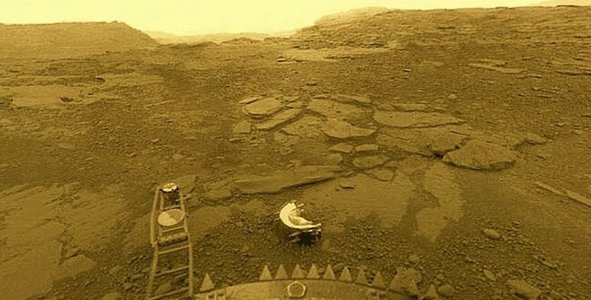
Our project is to land a surface lander on Venus in order to test samples of the surface and atmosphere of Venus before a larger mission so that the planet can be further understood and all its conditions. The aim is to land a craft to take images, drill into the surface and measure atmospheric conditions for 60 days. Our space lander design utilises the fuel tank from the core stage of a rocket used to launch currently (Our data is based on the SLS). This makes our design more resource and cost-effective, using already required parts. Throughout the space flight, the used fuel tank will, instead of being disposed of, will be opened up to induce a vacuum. This has the benefits of being lightweight, temperature indifferent, and more cost-effective.
Upon landing on the Venusian surface, when power is needed, the vacuum chamber intakes air through a valve due to the pressure difference. Taking advantage of the high atmospheric pressure of Venus, air will flow in, rotating the aluminium alloy Tesla turbine, producing necessary power. We chose to use the fuel tank as the vacuum box, as the fuel is pressurised safely to 900psi, which is similar to the pressure of the Venusian atmosphere (~1000psi), meaning the tank is already suited to the pressure it would have to withstand to hold a vacuum. In order to show that the fuel tank stores are already made to standards to withstand the heat and pressure of holding a vacuum on the surface of Venus. To calculate the stored potential energy of the Vacuum, we use the formula Work=Force x distance. If we use the force due to pressure in the atmosphere(9.5x10^6N m^-2). If we use a 1x1x1m vacuum box, the Work done = 9.5x10^6 J = 9.5 MJ. If we then assume 50% efficiency (out of an ideal maximum of 66%) for the turbine, that means for every cubic metre of vacuum, we can harness 4.75MJ of energy. The fuel tank of the SLS stage 2, it has a volume of ~3000m^3, allowing a total energy harness of 14250MJ of energy. Over the 60 days, it provides a constant energy supply of more than 2500W over the time, allowing for drilling, testing, and imaging operations.
However this would not perfectly evenly provide energy, but allow for more power-intensive drilling at the start of the operation as air rushes in through a valve. This valve would be carefully designed to allow fairly constant airflow to endure the 60-day journey, or longer if the journey is designed to be longer, and provide enough airflow to maintain consistent spinning of the turbine. In order to fit our drilling equipment, essential equipment for our mission to discover more about Venus, we added a nose cone to the top of the core stage fuel tank, and this will become our Venus lander. Parachuted down, the combined empty fuel tank, sealed via the robotic arm and solar power on the journey across, is set down onto the surface. The valve prevents air from escaping into the chamber too quickly, thus powering the operation from then on, allowing testing implements to be unfurled from the dome on top of the fuel tank and complete the mission. Additionally, the sulphuric acid in the atmosphere would cause the aluminium alloy of the core stage, turbine and core stage to corrode over time. This, however, would not be an issue as the aluminium oxide would act as a protective layer to the rest of the alloy and prevent any further corrosion for the duration of the sixty days. Another issue prevented would be lubrication of the turbine in a vacuum, or a partial vacuum, as conventional liquid lubricants would boil and evaporate and graphite powder requires the presence of water vapour. To solve this issue we would apply a solid film lubricant to the turbine and implement bearings to reduce friction. We also opted for a Tesla turbine in our design. This is due to their high efficiency, especially through small apertures, which matches the need for a smaller flow of air. This choice allows the design to work efficiently with the provided air flow.
Space Agency Data
Venus conditions we consideredfrom NASA:https://solarsystem.nasa.gov/news/1519/venus-resources/?page=0&per_page=40&order=created_at+desc&search=&tags=Venus&category=324
https://www.nasa.gov/exploration/systems/sls/fs/sls.html
https://solarsystem.nasa.gov/planets/venus/overview/#:~:text=Venus%20has%20crushing%20air%20pressure,below%20the%20ocean%20on%20Earth.
https://ntrs.nasa.gov/api/citations/19720012801/downloads/19720012801.pdf
https://mars.nasa.gov/resources/20001/mars-rover-power/#:~:text=The%20generator%20provides%20both%20electrical,warm%20including%20the%20scientific%20instruments. (power usage of a rover)
Hackathon Journey
For the four of us, this was our first time participating in Space Apps. But, with our shared interest in physics, engineering, and space, we thought the Venus challenge would be the most enjoyable and suitable for us. Only seeing the challenge for the first time on the day, may have slowed us down compared to other teams. Still, the mentors and experienced people who helped us along our way gave us great inspiration and motivation for us to go through a whole 10 different ideas, before finally settling for this one. Unfortunately, being situated in the hills has made us unable to return to UWA for the 2nd day, making us also ineligible for the popularity award. Still, we are sure that we will be able to produce something creative and hopefully innovative. Also, the pizza was really nice.
References
https://solarsystem.nasa.gov/news/1519/venus-resources/?page=0&per_page=40&order=created_at+desc&search=&tags=Venus&category=324
https://www.nasa.gov/exploration/systems/sls/fs/sls.html
https://solarsystem.nasa.gov/planets/venus/overview/#:~:text=Venus%20has%20crushing%20air%20pressure,below%20the%20ocean%20on%20Earth.
https://ntrs.nasa.gov/api/citations/19720012801/downloads/19720012801.pdf
Images:
https://www.spaceappschallenge.org/resources/apply-host/
https://www.refinery29.com/en-au/2022/01/10849906/venus-retrograde-end-january-2022-meaning
https://mgilmore.wescreates.wesleyan.edu/research/venus/
https://www.ndtv.com/world-news/is-there-oxygen-on-venus-nasas-davinci-mission-to-find-out-3043268
Tags
#vacuumbros #space #powerofnothing #turbine