
High-Level Project Summary
Our energy storage system will be in aircraft which is covered by solar panels. Also we will have a small station (two times smaller than our aircraft). The aircraft will be flying 47 km above Venus and its solar panels will absorb the Sun’s energy. When the energy storage of aircraft will be full, it will go a little down, so that it’ll be possible to send an energy through laser to the station.
Link to Final Project
Link to Project "Demo"
Detailed Project Description
Our plane will send the stored energy to the platform on the surface of the ground.
The American engineering firm PowerLight Technologies provides energy transfer with lasers. Its main products are power-over-fiber, which transmits energy in the form of laser radiation through optical fiber, and "laser beam," in which laser energy is transmitted through free space.
We will use optical power beaming in our apparatus. Optical power beaming is the process by where you convert electricity into laser light, send it some distance away and then turn it back into usable electricity. The beam is shaped and conditioned to be optimized for power, distance and efficiency and the entire system is packaged and controlled to be safe. For wireless power beaming, the beam can be sent in the air and is “caught” using specialized solar panels. Wireless power beaming can reliably send power over hundreds of feet and even miles to equipment and vehicles stationary or moving on the ground or even in the air.
Why this particular way of transmitting energy? Oddly enough, it is simply more powerful and efficient. Microwave energy transmission doesn't seem practical at any frequency.
Assuming 10 kW transmission, a 10 m transmitting aperture and a 10 m
receiving aperture, the average power available to the lander from one aerial platform is still less than 0.1W (-10 dBW).
The feasibility of moving equipment with the power system on was installed at high altitudes (65+ km), where solar energy is abundant.
However, the feasibility of flying such a scheme at lower altitudes (and the maneuvers required to move from one altitude to another) must be checked.
Space Agency Data
https://www.nasa.gov/sites/default/files/atoms/files/niac_2019_phi_brandon_powerbeaming_tagged.pdf
This document helped us a lot. We were literally praying on it. With its help we understood some things that are VERY related to our project, and in this document was nearly everything we’ve questioned.
https://www.nasa.gov/directorates/spacetech/niac/2019_Phase_I_Phase_II/Power_Beaming/
This article also helped us.
https://mars.nasa.gov/odyssey/mission/spacecraft/
We used this article to assume an approximate mass
https://2022.spaceappschallenge.org/challenges/2022-challenges/exploring-venus/details
And for the presentation we used text from “objectives” to state our goals.
Hackathon Journey
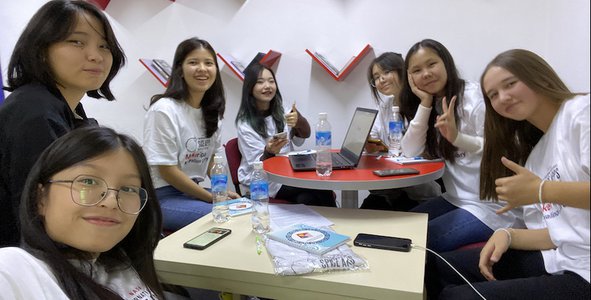
First of all, that was an incredible experience, we got deep into work in these 2 days. We searched for everything we could, did a big brainstorm. Two girls of our team are 14 years old. Other two - 15. The last one is 16 years old. There were too much information in a little period of time, but we can proudly say that we managed.
We learnt a lot about space itself, but more information we got in the theme of Venus, we looked for information about its climate, why it's not possible to use batteries for a long time there, why it's as popular option as Mars and so on and so forth.
We decided to participate in this challenge to challenge ourselves, the rest of the challenges also looked interesting, but this one seemed different for us, that's why we were eager to study it.
Our team came to the conclusion of our project after long discussion, everyone was giving their own ideas, we wrote pluses and minuses in each and after all came to our final conclusion. We had six ideas, but most of them were either impossible on Venus (for example conversion of CO2 into jet fuel) or very impractical (make a station with lot of fuel tank and just go with it).
We would also like to thank Maker Space for hosting us and giving lectures on the topics, related to space, which were amazing and to you, organizators of this challenge, thank you for giving us a chance to learn more about this interesting area and to check ourselves.
References
https://en.m.wikipedia.org/wiki/Venus
https://www.nasa.gov/sites/default/files/atoms/files/niac_2019_phi_brandon_powerbeaming_tagged.pdf
https://mars.nasa.gov/odyssey/mission/spacecraft/
https://www.nasa.gov/directorates/spacetech/niac/2019_Phase_I_Phase_II/Power_Beaming/
https://2022.spaceappschallenge.org/challenges/2022-challenges/exploring-venus/details
Tags
#venus #energystoragesystem