

High-Level Project Summary
In order to provide an energy store on the hostile surface of Venus, we sought to work with the environment rather than against it. To that end, we use the extreme air pressure to drive a wind turbine that would not work on Earth. With a huge gear attached to drive a flywheel to high speed, Earth's puny atmosphere, while maybe moving faster, couldn't push it round. That dense air, while moving slowly, gives our turbine enough torque to turn it. Once up to speed, the flywheel can then discharge electricity to a lander or rover. A simple column in design, like a round petrol pump, multiple units could be stationed across the surface to create a charging network, increasing any rover's range.
Link to Final Project
Link to Project "Demo"
Detailed Project Description
Project Description
Our project is a turbine powered flywheel energy storage solution combined into a single column, utilising a Savonius wind turbine design and a magnetic coupling to charge a vacuum-sealed flywheel.
Whilst the winds on Venus may be slow, the high pressure environment gives a much higher air density, significantly increasing the potential energy from a given windspeed compared to that on earth. Pairing a a turbine that works efficiently in this environment to a vacuum-sealed flywheel that is resistant to high temperature and pressure allows long term energy storage.
We chose a kinetic energy storage concept over that of a chemical battery due to the members of our team having a better understanding of physics than we do of chemistry.
Turbine and Gearing
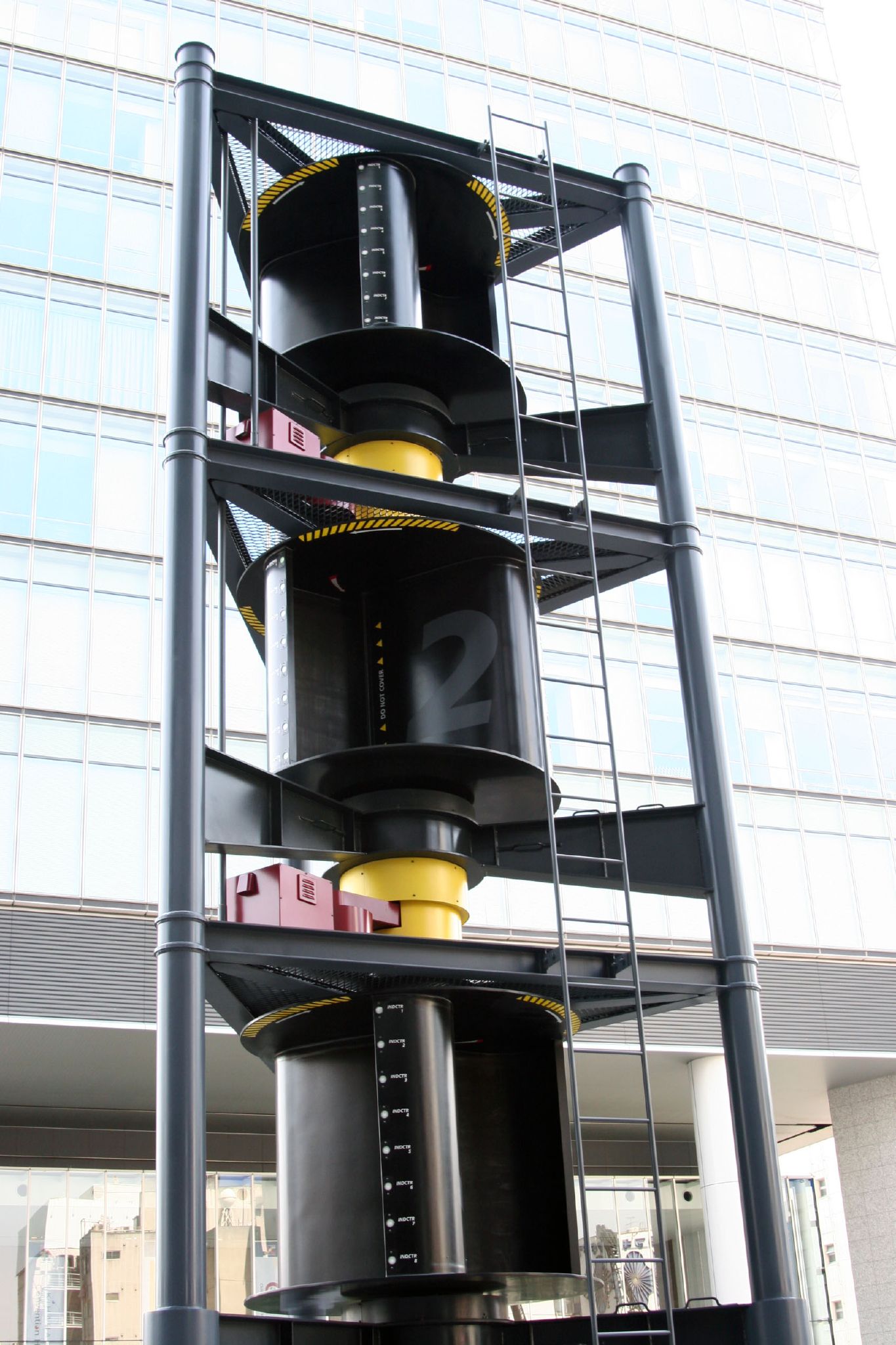
The turbine is a two-bladed Savonius design, which is ideal for an environment with low wind speeds and high air density. It is constructed from graphite reinforced stainless steel and runs on silicon carbide bearings, making it resistant to the temperature, pressure and corrosive properties of the surface environment. The turbine is 1m tall and has a diameter of 1m and works at an efficiency rate of 25%. At a wind speed of ~2m/s, this will give a rotation rate of approximately 230 rpm. We then marry this to through a titanium compound gearing system with an overall ratio of 4.35. This gives a potential rpm of ~1000 to the magnetic coupling.
Magnetic Coupling
To drive a vacuum-sealed flywheel, most solutions use a motor/generator unit that can both charge and discharge the flywheel. Since our solution does not initially have a source of electrical input, we devised of a magnetic coupling system that works through the vacuum wall to connect our turbine directly to the flywheel. The drive wheel and the top of the flywheel both have an array of alternating positively and negatively charged neodymium plates, which face each other through the vacuum wall. The magnetic coupling allows the drive wheel to operate independently of the flywheel at first, and is then positioned within range of the flywheel’s magnetic fields via a linear actuator that is controlled by a micro controller made of silicon carbide. Connected to an auxiliary lithium sulphur battery that is initially charged via
Flywheel and Generator
The flywheel is a hollow cylinder made of titanium, weighing 200 kg and features an electrical generator on the same shaft. They are housed inside a vacuum, suspended via a magnetic bearing system which at the top end, sits in-board of the magnetic coupling. With the magnetic coupling drive wheel spinning the Flywheel up to 1000 rpm, it gives us an estimated potential energy storage capacity of 436 w/hr. The generator is also controlled by the silicon carbide micro-controller.
SolidWorks models provided show an early phase mockup of the design.
Space Agency Data
Venus
https://solarsystem.nasa.gov/planets/venus/overview/
- NASA's overview on Venus provided us with the information we needed in order to come up with the idea behind the system, especially when deciding one what materials to use. Learning how truly toxic the atmosphere of Venus is, was a new subject for all of the team. I think its one of the planets that gets overlooked, perhaps due to how close it lies to the Sun, however the extremity of the environment proved a worthy challenge in coming up with a theoretical system.
G2 flywheel design
https://ntrs.nasa.gov/citations/20050217267
- The G2 design provided much of out inspiration when coming up with the theoretical design and implementation of our Flywheel, changing many of the electronics out however for a more mechanical design. Taking a similar tall cylindrical design for the housing, with the aim of low RPM, high torque in comparison to those found on Earth.
DAVINCI
https://ssed.gsfc.nasa.gov/davinci/
- DAVINCI was alongside G2 in our inspiration for our design, especially when it came to choosing specific materials for the inner workings rather than the housing.
Hurricane winds
- The information gathered from the ESA helped solidify the idea that our theoretical idea could be possible. Using the data outlined we based our system heavily on using Venus pressure and near constant wind to formulate the turbine design and gear ratio required to bring the flywheel up to generation speed.
Mechanical Memory
- A previous entrant to the NASA space apps challenge was where we had first figured that it might possible to work on a mechanical system to store large amounts of power, which in turn lead to the flywheel design submitted.
Flywheel Technology Development At NASA
https://www.sandia.gov/ess-ssl/EESAT/2002_papers/00018.pdf
- Flywheel research in space applications
Below are further links which had been possible avenues to go down, before deciding on a lander, although they were not used they provided great insight into the possibilities of space and where the future will take us, which is an exciting prospect and can only lead to benefitting humanity in the long term.
AREE
https://www.nasa.gov/exploring-hell-venus-rover-challenge
Magellan
https://www.jpl.nasa.gov/missions/magellan
Project VERITAS
Hackathon Journey
The Space Apps Challenge for our Team began with our Team Leader, Keir. It was Keir who discovered the Space Apps Challenge and presented the idea to the company we all work for.
Since that introduction though, the whole team have embraced the event, and challenge, meeting daily around our shared office, having coffee, lunch or just a quick break together to discuss possible solutions for this challenge. The learning started straight away, with several ideas put forward, only for us to research them, and realise they weren’t suitable. This set the tone – propose, discuss, reject or shortlist. Problems and setbacks were met with additional research, to learn about new materials or methods or processes.
Overall, we learned that Venus is tough! Which is nicely circular, in that this was why we chose this project – our initial thoughts on Venus were that it would be a challenge – it turned out to be more!
We'd like to thank Kieron Lea and Kate Hotson for organising our event, in particular Kate for staying with us this weekend! And we'd like to thank Paxton for laying on the facilities for this amazing challenge.
References
Graphite Resistance
https://www.gab-neumann.com/Corrosion-resistance-of-impervious-graphite
https://www.carbonandgraphite.org/index.php/home/physical-properties
Atmosphere
https://en.wikipedia.org/wiki/Atmosphere_of_Venus
https://www.nature.com/articles/ngeo2971#:~:text=At%20the%20surface%20of%20Venus,2%20(by%20volume)2.
Stainless Steel - Melting Point
Stainless Steel Grading
https://www.mchoneind.com/stainless-steel-grades-chart/
Magnets - Alnico
https://en.wikipedia.org/wiki/Alnico#Properties
Flywheel storage
https://en.wikipedia.org/wiki/Flywheel_energy_storage

Vertical-axis wind turbine
https://en.wikipedia.org/wiki/Vertical-axis_wind_turbine
Savonius Wind Turbine
https://en.wikipedia.org/wiki/Savonius_wind_turbine
https://upload.wikimedia.org/wikipedia/commons/5/55/Savonius_wind_turbine.jpg
https://img.archiexpo.com/images_ae/photo-g/88530-6466091.jpg

Wind Turbine Drive Train and Gearbox
https://ars.els-cdn.com/content/image/1-s2.0-S0094114X18319177-gr2.jpg

Venus Atmospheric Wind Speed
Flywheel discharge
https://www.stornetic.com/our-technology/enwheel
https://amberkinetics.com/product/
Viscous coupling unit
https://en.wikipedia.org/wiki/Viscous_coupling_unit
Marine Propulsion
https://en.wikipedia.org/wiki/Marine_propulsion
https://upload.wikimedia.org/wikipedia/commons/e/e2/Marine-propulsion-system.jpg
Helicopter rotor
https://en.wikipedia.org/wiki/Helicopter_rotor
Davinci
https://iopscience.iop.org/article/10.3847/PSJ/ac63c2
Lithium Sulphur batteries
https://trs.jpl.nasa.gov/bitstream/handle/2014/49376/CL%2318-1607.pdf?sequence=1
Titanium
https://www.cscaa.org/news/2015928/advantages-of-titanium-in-corrosion-resistance
https://en.wikipedia.org/wiki/Young%27s_modulus#/media/File:Stress_strain_ductile.svg

Info on AREE
https://en.wikipedia.org/wiki/Automaton_Rover_for_Extreme_Environments
Casing
https://drive.google.com/file/d/1JDaWhliQZb_afiEg8NzNlEdTrrbnBPJI/view?usp=sharing
Silicon Carbide
https://en.wikipedia.org/wiki/Silicon_carbide
Small Scale Wind Turbines
Curie Temperature
https://en.wikipedia.org/wiki/Curie_temperature
Landis Power Systems for Venus
Ceramic bearings
https://www.coorstek.com/en/materials/why-ceramics/chemical-properties-of-technical-ceramics/