
High-Level Project Summary
To overcome the high heat and pressure of Venus and its Venusian clouds, we designed a directional wireless charging system that partially exists outside of Venus’ atmosphere. Our system comprises satellites that act as transmitters, a rectenna array that converts the radio frequency power to direct current power, and a rechargeable battery to store the electrical power. Importantly, each part of the system works individually, which allows for manual adjustments for compensation by other parts in the event of a partial failure. For example, the rover will be able to utilize DC energy straight from the rectenna, thus enabling it to complete longer missions even if its battery fails.
Link to Final Project
Link to Project "Demo"
Detailed Project Description
Source of energy

Venus, being the second-closest planet to the sun in our solar system, is in a geographically favorable spot to gather and utilize solar energy. However, this cannot be achieved on the terrestrial level as the Venusian clouds decrease light levels, and the planet’s high temperature reduces the performance of photovoltaic cells.
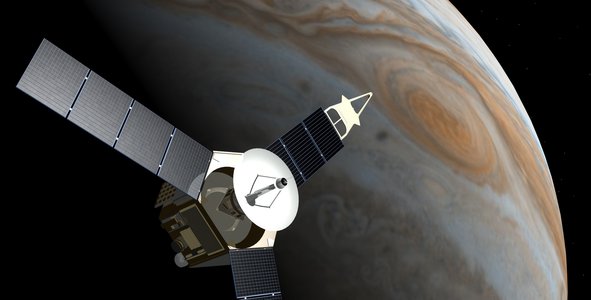
Hence, we designed satellites that orbit at a height of 34000km from Venus’ surface, where clouds and the atmospheric drag are no longer an impediment, and a coverage close to 50% is achieved. The satellites are equipped with photovoltaic cells that gather solar energy, and, to ensure a continuous supply of energy, light sensors are attached to the satellites to facilitate a constantly optimal orientation of the photovoltaic planes. The solar energy received is converted to direct current energy in the cells, then channelled to multiple klystrons to be converted into microwave energy.
Method of transmission

The klystron tubes are connected to a dish antenna composed of a parabolic reflector and a linearly actuated horn to focus the microwave beam, reduce diffraction, and increase the amount of energy received by the rectenna. With this transmit aperture, long-distance directional wireless charging can be achieved.
Energy collection and conversion

A rectenna array is mounted on the roof of the rover to receive the microwave beam. The rectenna array is formed by tens of thousands of MIM diodes made of a copper-copper oxide-copper complex. Importantly, copper and its oxide have high melting points (1,085 °C and 1,085 °C respectively), thus enabling it to withstand Venus’ high temperature.
The MIM diodes convert microwave energy back into DC energy and channel it into the rover’s rechargeable aerospace thermal battery. An alternate circuit with higher resistance carries the current straight to the rover’s running system so that in the event of a battery failure, the rover can still function as long as it receives microwave beams from the satellite.
Energy storage

Due to the high surface temperature on Venus, there is no primary or rechargeable battery system currently available that is resilient in the hostile conditions of Venus' surface.
Our molten salt-based batteries with Li alloys and metal sulphide cathode aim to provide higher specific energy (>100 Wh/kg) and energy density (>150 Wh/l), hence allowing more than 150 days in rechargeable mode at 475 Degrees Celsius. 20% of the LiCl-KCl eutectic blend with reduced cathode dissolution is used as the electrolyte of our batteries to increase the battery discharge capacity up to 95.6%, while a high energy FeS cathode is chosen as it has higher thermal stability compared to others. With our new multi-cell battery design, solid electrolytes acting as separators are placed in an electrolyte-binder 4 pellet design to minimize sulphide solubility and self-discharge rate. This 4 pellet design also showed approximately 13% enhancement in battery discharge capacity. In conclusion, our battery system shows better rechargeability and longer operational life and may be coupled with our wireless charging energy generation source for extended surface studies on Venus.
Rover structure


Taking into account the limited space of the aircraft, we were inspired by the James Webb telescope to design a foldable rover that can unfold itself upon landing on Venus. The wireless charging panels (i.e. the rectenna array) have hydraulic lifts at each side, the panels can be folded to decrease their size when it's in the rocket.
Protective measures
A) High temperature
Although our energy storage and generation systems are designed to adapt to the high-temperature working environment on Venus, several protective measures are still applied to protect fine fragile electronic equipment and devices. For the temperature-sensitive equipment, a sophisticated refrigerator using helium gas as a working fluid is designed. A high-efficiency pump is employed to circulate the refrigerant and cool the devices by conduction. Besides, our precooler uses three stages of the pulse-tube cooling system instead of the heritage two-stage system to further enhance the cooling power and effectiveness.
B) Entry and descent
Taking experience from the Martian entry, our rover will be equipped with a thermal protection system made of Phenolic Impregnated Carbon Ablator (PICA) to protect the system from the heat generated from atmospheric entry. As the system is fragile in nature due to its charging panels, multiple shock absorbers and airbags will be installed in order to reduce vibrations upon landing. Thrusters will be used to slow down descent and reorient the rover so it lands upright, with its charging panels facing upward to readily receive microwave energy.
Space Agency Data
- https://solarsystem.nasa.gov/planets/venus/overview/#:~:text=It%27s%20the%20hottest%20planet%20in,and%20thousands%20of%20large%20volcanoes: To learn more about the past missions to Venus
- https://www.jaxa.jp/countdown/f17/overview/venus_e.html : To understand the environmental and physical characteristics of Venus
- https://ntrs.nasa.gov/api/citations/20150016298/downloads/20150016298.pdf: To determine the feasibility of solar charging on Venus, and what barriers need to be overcome
- https://trs.jpl.nasa.gov/bitstream/handle/2014/53889/CL%2320-4439.pdf?sequence=1: To get inspiration for batteries that can survive in high heat
- https://www1.grc.nasa.gov/space/pesto/space-vehicle-technologies-current/high-operating-temperature-technology-hottech/: To learn about the HOTTech program
- https://webb.nasa.gov/content/observatory/ote/mirrors/index.html: To minimize space occupation of the rover in the spacecraft
- https://webb.nasa.gov/content/about/innovations/cryocooler.html: To identify a suitable cooling system
- https://mars.nasa.gov/mars2020/timeline/landing/entry-descent-landing/: To find a suitable thermal protection system for atmospheric reentry
- https://www.esa.int/Enabling_Support/Operations/Venus_Express: To gain insight on orbital insertions and data transmissions, which sparked the idea of a satellite charging system
Hackathon Journey
Long story short, it was a meaningful journey. Topics around space are always hard for a broad audience to get in touch with and pay close attention to. It seems very detached from our daily lives, but through this Space Apps Hackathon competition, we were given the chance to learn and understand how much of space is unknown to us, as well as appreciate how advanced modern technology is. While doing our research, we were amazed by how quickly space exploration technology has developed through the years. A video clip that featured the rate of depletion of the resources on Earth made us realize that we need to seek for backup resources to maintain the development of human civilization, which inspired us to choose this challenge.
We’re a team without any background about space. Designing something which currently does not exist was a fun but challenging experience. We had a blast brainstorming for ideas and combining them with feasible technology. We'll always remember the excitement we felt when we finally came up with this idea, and the thought that it may be feasible in the future was exhilarating. I can’t wait to see what we human beings will be able to explore and learn about Venus through this.
References
DATA & RESOURCES:
https://www.sjsu.edu/ae/docs/project-thesis/Liz.Hyde.S13.pdf
https://patents.google.com/patent/US3781647A/en
https://ieeexplore.ieee.org/stamp/stamp.jsp?arnumber=9662403
https://iopscience.iop.org/article/10.1149/MA2020-022227mtgabs/meta
https://ntrs.nasa.gov/api/citations/20150016298/downloads/20150016298.pdf
https://trs.jpl.nasa.gov/bitstream/handle/2014/53889/CL%2320-4439.pdf?sequence=1
https://webb.nasa.gov/content/observatory/ote/mirrors/index.htm
https://webb.nasa.gov/content/about/innovations/cryocooler.html
https://mars.nasa.gov/mars2020/timeline/landing/entry-descent-landing/
https://www.colorado.edu/faculty/moddel/sites/default/files/attached-files/grover13c.pdf
https://trs.jpl.nasa.gov/bitstream/handle/2014/53889/CL%2320-4439.pdf?sequence=1
https://iopscience.iop.org/article/10.1149/MA2020-022227mtgabs/meta
https://webb.nasa.gov/content/observatory/ote/mirrors/index.html
https://webb.nasa.gov/content/about/innovations/cryocooler.html
https://mars.nasa.gov/mars2020/timeline/landing/entry-descent-landing/
https://madhavuniversity.edu.in/wireless-power-transmission.html
3D MODEL:
Software: https://www.sketchup.com/
https://pixabay.com/users/madirfan-50411/
DEMO VIDEO:
https://pixabay.com/users/nasa-imagery-10/
https://pixabay.com/users/rpxstudio-4902516/
https://pixabay.com/users/wikiimages-1897/
https://pixabay.com/users/bellergy-1846871/
https://pixabay.com/users/christianbodhi-9869182/
https://pixabay.com/users/relaxing_guru-11517010/
Tags
#3Dmodel #VenusRover #EnergySystem #Hardware #SpaceExploration