
High-Level Project Summary
Our team chose the challenge Exploring Venus Together because we found out that the last rover was sent in the 80’s, which means that the technology was not so advanced. We thought that we could design an energy storage system that supports the Rover on the surface of Venus. So, our solution, D'alva Star, is a battery that will be used to provide energy to the Hestia Rover, which is composed of Refrigerator, Antenna and Mineral Collector. This energy will come from radioactive decay release through a group of radioisotope materials that are converted into electricity using a set of thermocouples. In addition, the entire system will be coated with asbestos, titanium, iridium and beryllium.
Link to Final Project
Link to Project "Demo"
Detailed Project Description
D'alva Star Project
Storage System
D'alva Star is an energy storage system that use a radioisotope thermoelectric generator, composed of Polonium. It has a long lifespan that can endure extreme conditions of temperature and pressure, according to the condition in Venus.

Figure 1: Energy Storage System

Figure 2: Rover Héstia
Tools
Rover: composed of asbestos, titanium, iridium and beryllium
Antenna: UHF (Ultra High Frequency)
Laser: via infrared spectroscopy
Battery (D'Alva Star): Polonium
Cooler: made of airgel and foam glass
How does it work
D'Alva Star consists of a battery which will be used to provide energy to the Hestia Rove. It is composed of the following equipment: Refrigerator, Antenna and Mineral Collector. In such a way, this generator will produce energy for the entire system for 122 Earth days which is equivalent to 0.5 day on Venus. This energy will come from radioactive decay released through a group of radioisotope materials that are converted into electricity using a set of thermocouples (thermoelectric sensors) of temperature sensors.
The planet Venus has a temperature above 450ºC and a pressure of 90x the pressure of Earth. Therefore, the refrigerator will be responsible for providing cooling for the entire system. The planet Venus has an extreme atmosphere, so the battery will be packaged in a protective casing. This casing will be composed of asbestos, titanium, iridium and beryllium material.
In addition, the entire system (rover, antenna, battery housing and mineral collector) will be coated with asbestos, titanium, iridium and beryllium to protect from the atmosphere of the planet Venus.
Our solution
In this way, we hope to feed the Rover completely so that it can travel through the Tellus Regio de Venus plateau, the highest and slightly coldest point. From there, samples of the minerals will be collected using the technique of infrared spectroscopy. After collection, we intend to send the data to NASA for analysis through the antenna.
For the thermal management of the entire system (rover, antenna, battery housing and the mineral collector) we intend to insulate and control the heat flow to maintain temperatures within the specified limits, mainly in the battery, as it will be the one that will supply the entire system.
Although Venus has temperature and pressure conditions not suitable for life and the lack of water prevents the existence of microorganisms, with the arrival of the Rover Hestia on the planet, it would be possible to have clearer answers regarding these conditions.
Space Agency Data
https://www.nasa.gov/venus
https://techport.nasa.gov/view/taxonomy
https://solarsystem.nasa.gov/news/1519/venus-resources/?page=0&per_page=40&order=created_at+desc&search=&tags=Venus&category=324
https://solarsystem.nasa.gov/resources/549/energy-storage-technologies-for-future-planetary-science-missions/
https://solarsystem.nasa.gov/news/1519/venus-resources/?page=0&per_page=40&order=created_at+desc&search=&tags=Venus&category=324
https://www.nasa.gov/feature/automaton-rover-for-extreme-environments-aree/
https://arc.aiaa.org/doi/pdf/10.2514/1.41886
https://arc.aiaa.org/doi/pdf/10.2514/1.41886
https://www.jpl.nasa.gov/news/magellan-descends-into-venus-atmosphere
https://techport.nasa.gov/view/92914
Hackathon Journey
Participating in NASA Space Apps was one of the best opportunities and experiences we have had as high school students. We learned that the planet Venus has a thick and toxic atmosphere with intense heat, atmospheric pressure, and volcanic activity. The planet has a similar structure and size to the earth.
Through the research of the group, we learned that developing an energy storage system for a rover would be a great challenge.
The team's inspiration for choosing the challenge Exploring Venus was that the knowledge about the planet and the existence and composition of minerals present on the planet are still little.
Our first challenge was to understand the conditions on the planet and then understand how the energy storage system should be set up and how long it would take to generate the electricity for the entire rover system, which is composed of an antenna and a mineral collector that uses infrared spectroscopy.
During the development of the project we had the challenge of overcoming the environment of the planet Venus which is extremely hot and the pressure is about 90 times the one that we have on Earth. We needed to think of a way to preserve the whole system to protect from both temperature and pressure. So it was important to cool both the energy storage system and the entire rover system.
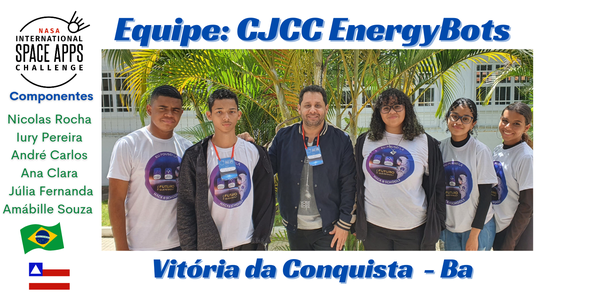
We would like to thank the NASA Space Apps team, the Youth Science and Culture Center, and all the collaborators that made it possible to participate in this event.
References
1 - DBpediaAssociation. available in -https://dbpedia.org/page/Radioisotope_thermoelectric_generator. access in: 30 sep . 2022.
2 - Governamental (EUA). NASA. NASA’s DAVINCI, available in: https://www.nasa.gov/feature/goddard/2022/nasa-s-davinci-mission-to-take-the-plunge-through-massive-atmosphere-of-venus. access in: 01 oct . 2022.
3 - Governamental (EUA). NASA. BATTERY FOR VENUS MISSIONS, available in: https://techport.nasa.gov/view/92914. access in: 01 oct . 2022
4 - Youtube. How was this PHOTO on VENUS taken?. available in: https://youtube.com/watch?v=21BP8sETrEo&feature=share&si=EMSIkaIECMiOmarE6JChQQ . access in: 01 oct . 2022.
5 - Youtube. NASA's Return to Venus. available in: https://youtube.com/watch?v=Rf-nOV9LCRM&feature=share&si=EMSIkaIECMiOmarE6JChQQ . access in: 01 oct . 2022.
6 - Youtube. Ten Mysteries of Venus in: https://youtube.com/watch?v=MAwtM_aq-1U&feature=share&si=EMSIkaIECMiOmarE6JChQQ. access in: 01 oct . 2022.
7 - Governamental (EUA). NASA. Venus, available in: https://www.nasa.gov/venus. access in: 02 oct . 2022.
8 - Governamental (EUA). NASA SCIENCE. Solar System Exploratinon, available in: https://solarsystem.nasa.gov/news/1519/venus-resources/?page=0&per_page=40&order=created_at+desc&search=&tags=Venus&category=324. access in: 01 oct . 2022.
9 - Autodesk. Tinkercad. 2020. available in: https://www.tinkercad.com/things/gKHoWCuugCt. access in: 02 oct. 2022.
Tags
#DalvaProject #Venus #Exploration #Space #Universe #NASA #Brazil #Rover #Hestia #Bahia #VitoriaDaConquista #cjccconquista #CJCC #NasaSpaceApps #SpaceTerra