Awards & Nominations
Equipe Saturno has received the following awards and nominations. Way to go!
Global Nominee

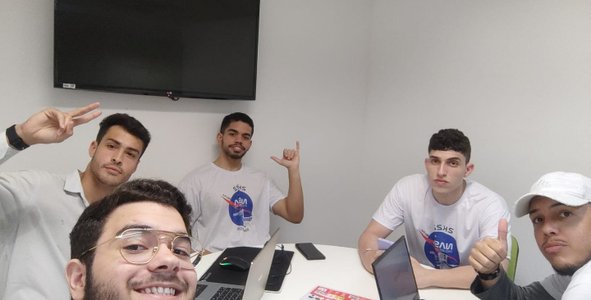
Equipe Saturno has received the following awards and nominations. Way to go!
The Project consists in a eficient energy storage system of a surface lander with the switch of the semiconductor from the photovoltaic plates to graphene, plus the addition of the FlyWheel tecnology associed with the insercion of thermocouples in a determined location, as well as the implementation of batteries Li-AlCO2 for, that way, obtain greater energy use (storage and supply) and superior resistence to the hostile conditions of Venus. This enabling, the colect and transmission of data and resources in a good time range (60+ days), positively impacting in the researches, explorations and studies pertinent to the constitution and physiochemical conditions on the planet.
Step 1: First, shortly after the launch of the energy module and stabilization of speed, the two solar panels would go into action to start capturing energy and charging the Li-AlCO2 batteries that will be used for the first operations on the ground of Venus . With this time to obtain power, it is expected to keep the module ready for operation.
Step 2: Before the module actually enters the atmosphere of Venus, the solar panels that were being used will begin to be stored back so that the mechanism does not break. Now, an important factor comes for our module to work: it will be necessary to land on an inactive volcano or the highest possible mountain with a volcano that can later be used to produce electrical energy through thermal energy through one or more thermocouples. After this successful landing, the module would need to start its activities to remain self-sustaining on the ground of Venus. After verifying the functioning of your devices, we would start the process of reopening the solar panels for an eventual need. From that moment on, we want to become independent of solar panels in case any of these events happen: mega volcanic eruptions and/or a thicker than expected atmosphere. These events would likely prevent us from using the sun's rays for energy production, as they would block the passage of the sun's rays.
Step 3: In order to become independent of the panels, it will be necessary to use thermocouples, which is why we chose to land in the places indicated above. We would use a kind of rod to take one end of the thermocouple to a place as high as possible and the other end to the place closest to the ground in the direction of the volcano so that, in this way, there is a considerable difference in temperature between the two points, from there, a temperature difference would be generated which, consequently, will generate a potential difference, then, electrical energy. In addition, flywheel technology will come into force, where there will be the use of the electricity provided, so that more energy is stored and produced for the surface lander components, becoming another complementary element in case of partial loss of some power module.
Basically, after the power module lands, the solar panels would be used to direct solar energy to the flywheel that would transform the movement of its compartments (kinetic energy) into electrical energy for the operation of electronic components intended for observation and research. However, due to the high volcanic activity of Venus, it is very likely that a vast cloud of gases coming from the volcano or even the atmosphere being thicker than expected will hinder the obtaining of solar energy, this would cause the flywheel overtime lost its strength by 20% or 50% in 2 hours without power supply, which would make the module vulnerable to power outages and, consequently, operation.
That is why there are a necessity to use another energy production system. Through research, then, it was decided that we could use one of the most common on Venus: heat. It was with this idea in mind that the conclusion of the use of thermocouples was reached. In addition to being cheap and relatively easy to produce and use, they are extremely light, as they are practically wires that can use the temperature difference at their ends to, in this way, obtain a potential difference and then use this potential difference to feed the electrically powered system. In this sense, it would be necessary for the surface lander to operate in places with characteristics similar to those mentioned above. If the conditions are right, then a kind of rod would be raised that would take one or more ends of the wires as high as possible, because, in this way, the temperature would be lower than the temperature of the soil, thus a second way of obtaining energy has been acquired.
With this project, the group hopes that, firstly, the energy module conceived and developed will be able to operate for at least 60 days on Venus or even longer. It is also expected that, with this module, missions to planets that have characteristics similar to those of Venus will begin to become increasingly possible. It is important that it works, as it will be possible to study the characteristics of Venus more closely and understand why Venus is Venus. Why is the atmosphere 97% CO2? If Venus, in the past, was similar to the Earth what went wrong? Is it possible for life to exist in a strip of Venus' atmosphere? Is there an underground sea? We hope, basically, to be able to answer questions that have been on the minds of scientists for a long time.
We used this link to think and develop the idea of which battery we could use:
<https://ntrs.nasa.gov/api/citations/20210023447/downloads/NASA%20Battery_Projects_Nov2021_Sandia.pdf>
<https://sbir.nasa.gov/SBIR/abstracts/21/sbir/phase1/SBIR-21-1-S3.03-3308.html>
<https://techport.nasa.gov/view/92914>
We used this link to analyze the composition of Venus and its atmosphere:
We used these links to see how other Mars rovers worked and compare them to the Venus environment:
<https://mars.nasa.gov/mer/mission/rover/>
<https://mars.nasa.gov/mars2020/spacecraft/rover/electrical-power/>
<https://mars.nasa.gov/msl/spacecraft/rover/power/>
We used these links to see futures NASA missions to Venus:
<https://www.nasa.gov/feature/goddard/2022/nasa-s-davinci-mission-to-take-the-plunge-through-massive-atmosphere-of-venus>
<https://www.jpl.nasa.gov/missions/veritas>
The journey was very hard throughout its process, but invigorating in the sense of mission accomplished. As situations experienced were of great value to the entire team. We learned to value teamwork, think and develop different ideas in a short period of time, understand the importance of scientific foundations for a good argument, as well as discipline and organization to overcome the adversities of the challenge. The choice of the challenge had as main focus to force us to explore areas of knowledge that we had not mastered until then, but that caused us a feeling of being challenged. Through research sources provided by NASA and mentoring from professionals from different areas, we managed to acquire the necessary knowledge to complete the project.
Special thanks to: Thays Barreto, José Vicente, Ronilson Lobo, Time Cafeína and the entire structure and staff of the local event.
1. MDPI and ACS Style Amiryar, M.E.; Pullen, K.R. A Review of Flywheel Energy Storage System Technologies and Their Applications. Appl. Sci. 2017, 7, 286. Acesso in: 01 out. 2022. available in: https://doi.org/10.3390/app7030286
2.Flywheel energy storage. Acesso em: 01 out. 2022. Available in:
https://en.wikipedia.org/wiki/Flywheel_energy_storage#General
3. Grafeno. Acesso em: 30 set. 2022. Available in:
https://pt.wikipedia.org/wiki/Grafeno
4.Vénus. Acesso em 30 set. 2022. Available in:
http://www1.ci.uc.pt/iguc/atlas/04venus.htm
5.FLYWHEEL ENERGY STORAGE SYSTEMS (FESS). Acesso em: 01 out. 2022.Available in:
https://energystorage.org/why-energy-storage/technologies/flywheel-energy-storage-systems-fess/#:~:text=Flywheel%20energy%20storage%20systems%20(FESS)%20employ%20kinetic%20energy%20stored%20in,using%20the%20same%20motor%2Dgenerator.
6.O que é um termopar? Qual sua importância na indústria?. Acesso em 01 out. 2022. Availale in:
https://www.alutal.com.br/br/termopar
7.SITE INOVAÇÃO TECNOLÓGICA. Baterias de lítio com alumínio. 30/10/2002. Online. Acesso em 30 set. 2022. Available in:
www.inovacaotecnologica.com.br/noticias/noticia.php?artigo=010115021030. Capturado em 02/10/2022.
8.Grafeno. Acesso em 01 out. 2022. Available in:
https://mundoeducacao.uol.com.br/fisica/grafeno.htm
9.Tecnologia de grafeno em painéis: o que é e quais suas vantagens?. Acesso em 01 out. 2022. Availale in:
https://canalsolar.com.br/tecnologia-de-grafeno-em-paineis-saiba-o-que-e-e-quais-suas-vantagens/
10. Inaugurada a primeira usina solar do mundo com painéis de grafeno – perovskita. Acesso em 01 out. 2022. Available in:
https://clickpetroleoegas.com.br/inaugurada-a-primeira-usina-solar-do-mundo-com-paineis-de-grafeno-perovskita/
11.Types and Applications of Thermocouple. Acesso em: 01 out. 2022. Availale in:
https://www.precisionmass.com/types-and-applications-of-thermocouple/
12.Images used on Prezi from unknown source (taken from google images), except for the conceptual art from the surface lander and energy system, that was made by our friend: Ronilson Lobo
#venus #energy #graphene #solarenergy #thermalcouple #flywheel #batteries #surfacelander #improvement #enovation #salvador #brasil
Your challenge is to design an energy storage system that will power a surface lander or rover on the surface of Venus for at least 60 days, so that there is a viable energy storage capability for long-duration exploration missions.