Awards & Nominations
Homebrew Eclipse has received the following awards and nominations. Way to go!
Global Nominee

Homebrew Eclipse has received the following awards and nominations. Way to go!
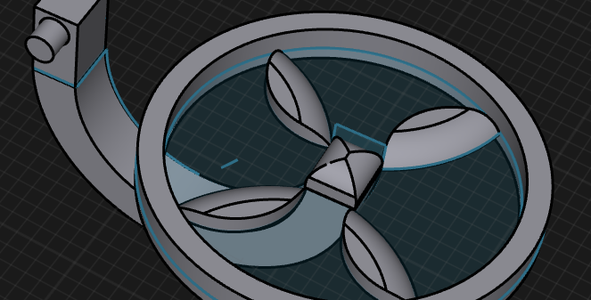
After going through a large amount of research and historical data on this topic we decided to avoid reinventing the "wheel" but we actually invented a propeller that doubles as a wheel and turbine. In short, we wanted to present a design approach that is generic and can be reused for other use cases. The key element is a component that can act as a propeller in case we want to control the flight or landing , as a wheel in case we want to travel on the surface and as a turbine in case we want to use it to generate energy from the wind to charge a battery or other energy storing solution(flywheel, spring, gas pressure, etc)
Since it's a design project, we focused mainly on reviewing existing solutions/proposals and looking for new ideas that will provide different alternatives and potentially a novel way of exploration by combining land operation with limited flight operation.
The idea is simple, coming from the LEGO world, where different components can be reused for different purposes.
We propose a wheel that is also a propeller and turbine, including the engine/generator attached to it and a mechanism to rotate it from 0 to 180 degrees.
Each rover could have typically 4 such wheels and configure them depending on use case:
In addition, the rover will have a small landing gear (like a helicopter) that will allow it to remain static while recharging.
For design we used Shapr3D tool on the iPad and today was the first day we used it, as such the design should be looked more as a concept.
Regarding the Technology maturity used, most of the aspects are technologies NASA already has some experience with as follows:
We assume the other high temperature sensors/communication solution/control/ are being developed under various programs and will be available in next several years
We also make the assumption that the rover/lander will be between 200 to 400 kg and an average total surface area (on one side) to be 1.5m^2
Rover main material we propose Zirconium since we researched that Titanium starts to loose strength at 430 degrees Celsius that is below the approx 470 degrees Venus surface
Since all components are designed for high temperature, we see little need for any thermal insulation to be added. Also in order to avoid corrosion, preference is to use Zirconium for all surface/atmosphere contact components.
For conducting the electricity and commands we prefer to use Gold metal due to keeping decent conductivity at high temperature.
Design can be improved by adding a small solar panel once the technology matures in order to have a redundancy option for cases where wind power might not be available for a period of time
Also the shape of the payload can be changed to be more aerodynamic in case we want to "take off" from time to time to explore surface faster (density is much higher so it should be easier to take off for periods of 30-60 minutes from a 14h charge.
some estimation about power requirements :
https://ntrs.nasa.gov/citations/20190034022
info about Venus drag coefficient:
https://ntrs.nasa.gov/citations/19800061707
we are using previous research data done on this topic or related aspects such as :
Overall we used a lot of data from either NASA or ESA to review what other approaches were taken.
Dad:
My son(Andrei) is always curious about space related topics and when this event was announced at his school he really wanted to explore this challenge and I joined him (as I was passionate about Physics in the past)
Son:
I guess I just liked the idea that I could contribute in a space exploration mission. In the Hackathon, I learnt all about the harsh environment on Venus, and I also learnt how to 3D model (sorta) in order to try and give a visual of what we were trying to achieve/demonstrate and was actually the one that proposed the idea of using the fans as wheels and turbines for recharging the batteries. Guess I play too many video games.
In the beginning we made a list of conventional and non conventional approaches of what we could investigate and during the 2 days we eliminated some and had to give up others as not enough time to research. The initial idea we had was to create a magnetic shield between Sun and Venus at a significant distance from Venus in order to require less energy to deviate the charged particles. This is why we called the team HomeBrew Eclipse, as to make an artificial magnetic eclipse of Venus, so that in the long term temperature will decrease and we can explore as easily as Mars/Moon.
Below was the initial list of directions:
Conventional:
- high temperature batteries
- high temperature conducting materials
-insulation options
-collecting energy from atmosphere
-design of landing approach
-research pressure resistant materials
-high resistant corrosive materials/alloys
-flywheel usage
non-conventional:
- solution for "eclipsing" Venus from sun
- use quantum entanglement for communication
- shield solutions for heat using superconductors
https://solarsystem.nasa.gov/system/downloadable_items/716_Energy_Storage_Tech_Report_FINAL.PDF
https://iopscience.iop.org/article/10.1149/MA2020-022227mtgabs/meta
https://mars.nasa.gov/mer/mission/rover/energy/
Flywheel comparison vs other energy sources:
https://iopscience.iop.org/article/10.1088/1757-899X/643/1/012106/pdf
https://www.calnetix.com/sites/default/files/12.pdf
https://www.sbir.gov/sbirsearch/detail/355873
Status of novel all solid state batteries for Venus financed by NASA:
https://sbir.nasa.gov/SBIR/abstracts/21/sbir/phase1/SBIR-21-1-S3.03-3308.html
In progress solar solution design financed by NASA:
Venus fact sheet
https://nssdc.gsfc.nasa.gov/planetary/factsheet/venusfact.html
research into small weight Venus probes:
#design #spacedrone #Venus #wind #reusable
Your challenge is to design an energy storage system that will power a surface lander or rover on the surface of Venus for at least 60 days, so that there is a viable energy storage capability for long-duration exploration missions.