
High-Level Project Summary
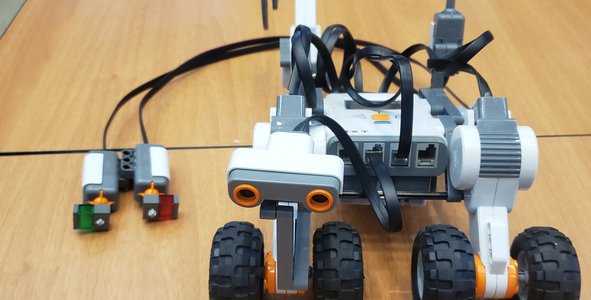
Our team developed a probe to explore the far lands of the inhospitable planet, Venus. Our group filtered through the multiple challenges we would encounter on the surface of venus, and we came up with these: Temperatures, wind and irregular terrain. To solve all of this issues we came up with this attributes to the probe: Ultrasonic sensor, to detect how far are the obstacles in relation to the craft so it is able to dodge them; Thermometer, it controls how much power goes into the engine(the higher the temperature, the higher the throttle so it escapes heat ); And finally an eolic turbine so the probe is able to take advantage of the high wind speed, and transform energy through it.
Link to Final Project
Link to Project "Demo"
Detailed Project Description
As additional information and description of our project we would like to state the following:
On the mission that conducts RAO-V to Venus, the probe needs to land on the part of the planet that is not facing the Sun, this is a logical solution to the heat problem we had.
The tools we used were all from the LEGO Mindstorms set, all of the sensors as well. The probe was coded with the own LEGO Mindstorms coding program, although the language is a little limited, our group was able to stretch the capabilities and take the best we could out of the program.
We hope to achieve a good understanding of Venus, RAO-V is a craft that has the purpose of exploring Venus's surface, so it would have a camera attached to it. Adding to the list of attributes of our probe, we prototyped a mechanical arm, similar to the one on the ISS, that cleans the rover. We included that because it is distinct the fact that the human race is not suitable for going there and repairing the probe.
Why is our probe important? RAO-V may not bring world peace or cure cancer, but it may bring us knowledge of our vast and colossal solar system. as NASA stated “Humans are driven to explore the unknown, discover new worlds, push the boundaries of our scientific and technical limits” and we believe our mission follows those principles as well, exploring is part of being human.
Space Agency Data
In Space data, our main source was NASA.gov, we used the information provided by nasa to find the temperature of Venus both on the part of the surface that is exposed to the Sun, and the one that is not. We also used NASA.gov to see previous probes that were launched to scorching hot places to inspire our project since this was a challenge we had in common, and we would like to thank NASA for providing us with this extremely useful information.
Hackathon Journey
The Hackathon journey was amazing and the atmosphere was inspiring, every group had amazing projects and I believe we were all driven by the amazing feeling of being there. Our whole group learned a lot of mechanical and digital skills, but I believe most importantly, we all learned how to co-work in search of solving problems. The main thing that inspired us to go for the challenge was our unambiguous love for robotics, programming and the immense grandiosity of space.
Our approach to the challenge happened like this: We started by searching about Venus, then, we filtered what we would have to solve and started brainstorming ideas and prototypes. After narrowing down our problems and solutions we decided to develop each of them to its full potential.
References
- NASA.GOV
- www.gov.br/aeb/pt-br