
High-Level Project Summary
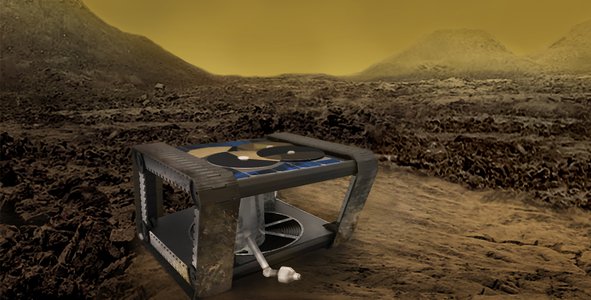
A power system was developed with a sodium battery that has a redundant recharging system, using a solar panel and a vertical wind turbine. It also has a simple cooling system to keep the battery at an optimal operating temperature. It is important because it contemplates the possibility of failure and therefore redundantly ensures that the battery is charged.
Link to Final Project
Link to Project "Demo"
Detailed Project Description
Firstly, it was decided to choose an RPS (Radioisotope Power System) reactor, which uses GPHS (General Purpose Heat Source) modules as a highly stable source. The modules have a mass of 1.5 kg and contain inside 600 g of plutonium dioxide 238 (238PuO2), with which temperatures of 1500 ° C can be reached. By placing said heat source inside a chamber thermally isolated from the environment of Venus, a clear temperature difference is produced which is used by an arrangement of thermoelectric materials of the silicon-germanium type connected in series and parallel to achieve transform, through the Seebeck effect, the temperature differences in a difference of electrical potential.
Beyond being a stable and durable power source, it was ruled out for being too heavy, for the risk of radiation affecting the electronics and for the risk of transporting radioactive material, in case something goes wrong during launch and the rocket explodes this material would be spread over a wide area of our planet.
For this reason, it was decided to use sodium and sulfur batteries as the main power source, since they are rechargeable and highly durable.
The main power source to recharge the battery is an inverted metamorphic multijunction solar panel. The use of different materials allows for a broader use within the light spectrum, plus it has a wide enough energy gap to function at the high temperatures of Venus. The energy provided by the panel is measured by the rover's electronics. In the event that the panel stops working or its productivity drops due to clouds, dust or being at night, the battery has a backup system to recharge itself which is a vertical wind generator 50cm high by 20cm in diameter. The wind turbine is in a horizontal position inside the rover, when its implementation is necessary it is positioned vertically allowing the wind to move it. Although the winds of Venus are not fast, the formula for calculating the wind thrust takes into account the density of the gas, therefore, being a highly dense atmosphere, wind speed is not a problem.
Since the temperature on the surface of Venus exceeds the operating temperature of the battery, a cooling system will be used. The heat will be pumped out using a Stirling cooler, which works by compressing and expanding a gas with a piston. When the gas expands it absorbs energy (heat) from its surroundings and thus cools it. So when the gas is compressed it releases energy (heat), this heat is dissipated into the atmosphere through a radiator.
Space Agency Data
Information was sought from the Space Agency on the GPHS, the RPS and the Zephyr rover.
Hackathon Journey
The experience of participating in the hackathon was very good, the search for information and thinking of a solution with a group of people with similar interests was very pleasant. We are happy to have learned about topics that we did not know.
References
Venus-power_Salazar_AIAA-2014-3459
https://es.wikipedia.org/wiki/Motor_Stirling
https://www.tutiempo.net/Foro/viewtopic.php?t=3582
https://rps.nasa.gov/power-and-thermal-systems/thermal-systems/general-purpose-heat-source/
https://computerhoy.com/noticias/tecnologia/record-mundial-eficiencia-paneles-solares-nuevos-pozos-cuanticos-1064057
https://topkorae.com/wiki/es/Venus_Landsailing_Rover
https://www.youtube.com/watch?v=pSHjjt7q8Uo
https://en.wikipedia.org/wiki/Sodium%E2%80%93sulfur_battery
http://www.unido.or.jp/en/technology_db/4394/
http://es.swewe.net/word_show.htm/?57586_1&La_bater
https://en.wikipedia.org/wiki/Zephyr_(rover)#Electric_power
https://hmong.es/wiki/Sodium%E2%80%93sulfur_battery
Tags
#hardware #powersystem