Awards & Nominations
UWR - Astro Explorers has received the following awards and nominations. Way to go!
Global Nominee

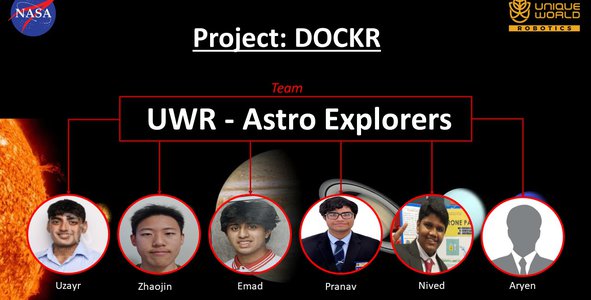
UWR - Astro Explorers has received the following awards and nominations. Way to go!
Our project aims to create an unmanned system to power a Venus rover as we traverse the extreme conditions on Venus. Our project will utilize a two-part energy system which consists of a power station and the rover it will serve and charge. The power station has been designed to utilize multiple energy sources, so that there are multiple backup options in case of any failure. A docking mechanism will be used for the charging process too. The station is programmed to follow the rover along its journey, so that it can recharge at anytime. As per our calculations, the rover and power station will be able to successfully withstand any potential threats on the Venus surface for over 60 days.
Our project, DOCKR, is a dynamic and multi-source energy storage device for Venus rovers to replenish their energy for operations. The complete energy system consists of two entities: the rover and the power station. The rover will consist of highly-advanced LiAl-CO2 batteries which operate at high temperature and specific energies, suitable for the harsh Venus environment. The batteries also have built-in capability to use the ambient CO2 at the surface of the planet to be converted into solid carbon for generating electricity. Additionally, the station has a helical wind turbine attached to it, which will utilize and harness wind energy to be used as a means for generating electricity. The station also has a set of 6 omnidirectional wheels, which allows it to be mobile and transport itself, while maintaining stability against the wind and traversing the terrain. A path planning algorithm will be programmed into the power station to calculate the shortest distance between the rover and the tower for maximum efficiency, and allow the power station to follow the rover along its mission.
The power station (DOCKR) will charge the rover using a docking mechanism, as there is a docking device attached to the back of the station. When the rover needs to recharge, it will attach itself to the power station and the energy will be transferred over to the rover. Based on our calculations, our station will generate 240W per day, which will be allocated to power the rover and the station itself, while also keeping backup power. The rover will utilize 100W a day and the station will utilize 60W a day, leaving 80W of backup power.
We have thoroughly analyzed the resources provided by NASA for the challenge. Specifically, the Venus resources, lithium battery proposal, as well as the energy storage technologies research paper built the foundation of our research. Our team also further examined and studied research papers and studies from other universities and publishers, such as government entities like the Energy Information Administration to supplement our designing process. Through the use of the data, we had finalized a conclusion on the utilization of wind turbines as a main source of power. In specifics, a paper from Tufts university highlighted the wind speed gradient of Venus, allowing us to apply mathematical formulas onto our solution to verify its feasibility, while NASA’s “Venus Resources” page and Lithium battery proposals provided us with critical supplementary background information to develop our solution. All our sources are presented at the references page.
The NASA Space Apps challenge has allowed us to delve deep into the inner workings of space rovers, and how they’re powered and built. The experience allowed us to learn a lot about various energy production and storage methods, as well as allowing us to explore new technological advancements in these fields, and their true applications. We were greatly inspired to choose this challenge because it provided a tough problem we had to solve, which was dealing with the harsh conditions of the Venus planet, which was very interesting to all of the team members and motivated us to research and design a great solution. We initially approached the project gathering as much information as possible to gauge the difficulty and necessary requirements of a successful solution, considering the planet’s conditions and environment, as well as the potential capabilities of a rover and its energy storage and production requirements. Approaching the challenge with a remote team, solely communicating online also served as a great learning opportunity in terms of tangible collaboration and leadership skills, that we can all take away from this project. As a team, we faced various challenges communicating online and balancing our work for the project with other arrangements we had such as school work. Ultimately, we are able to manage our time well by setting goals and working to achieve them over time, and setting aside time on weekends to devote our full attention to the project.
#space #venus #nasa #spaceappschallenge #rover #energy #60daysmission
Your challenge is to design an energy storage system that will power a surface lander or rover on the surface of Venus for at least 60 days, so that there is a viable energy storage capability for long-duration exploration missions.