
High-Level Project Summary
Our mission is to find a way to produce and store energy in the Venus planet for 60 days. we decide to use a very productive way we use in the earth but deferent is we going to protect it from the high temperature , high plusher and toxic gases and it is the soler cells .we going to use a very old way ancient Egyptian used it in the past to make ice in the desert by using something called clay pot which the temperature in it become in minis but we going to deal with temperature by the thickness of clay .so our mission is to make a soler panel station and make it deal with the Venus environment .
Link to Final Project
Link to Project "Demo"
Detailed Project Description
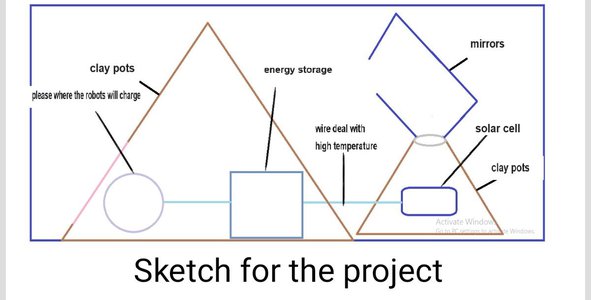
The project is to find a way produce and store energy to be use during 60 day in Venus. The idea is make a energy station in the Venus planet and what made it different from those we have in the earth that it going to be highly protective and have the ability to deal with the Venus environment . we going to use solar cells as we going to but it inside the clay pot to protect it from high temperature and we going to make a hole in the top of the clay pot and we going to use mirror to reflect the sun light in side the clay pot toward the solar cells .then the power will transfer in another clay pot that have a energy storage device and the place that robot is going to be charged.when was working in this idea we faced a bout 3 challenges (how we could transfer the clay pot to Venus ,the kind of solar cells, how much energy did we going to store and dose it going to be enough , how to protect the solar cells before the clay pot going to build and the place we going to build the station in) First how we can transfer of build the clay pot:
the way we going to use is the NASA concert and clay 3d printer. that it was used to build the station in Moon and Mars. but the different is the materiel that 3d printer going to be made from can deal with high temperature so it not going to be melted .
second the kind of solar cells :
we going to use a normal solar cells and we going to use nano paint to or protective cover to protect it from high temperature until the 3d printer build the clay pot around it and the average time that going to take about 3houre .
the third challenge is how much energy the solar cells going to produce :
we going to calculate the average dose every solar cell going to produce depend in it (size in miter square ,efficiency ,and how much time dose it going to be in sun )
for example : lets say that we have a 1.6 solar cell and it efficiency about 20% and it deal with sun for 4.5 hours
so the amount of energy it going to produce is :
1.6x1000=1600
1600x20%=320 wat per hour
So it going to produce about 1440 wat during the 4.5 hours.
We made some research in how much energy dose the robot going
To need during the day and we find that the robots in moon and mars need about 450-1000 wat per day but we can not find any information about the robot that sent to Venus 1978 how much energy did it need so we going to use average 1500 wat per day . so depend in these statistic the solar station will going to be so helpful as it going to gave a lot of energy because the Venus move slowly a one day in venus =169 day in the earth so the solar cells will face the sun for long time .
Space Agency Data
Automaton Rover for Extreme Environments (AREE)
Last Updated: Aug 7, 2017
Editor: Loura Hall
https://www.nasa.gov/feature/automaton-rover-for-extreme-environments-aree/
Venus recourse
those the reference I used in my project and it was very helpful for me to know about Venus planet and know about the robot that send to it and know about it environment
Hackathon Journey
It was the first time for us to join a hackathon and a we were so happy when we know that my idea got accepted and getting invitation to attend the hackathon .we learn a lot and the mentors were so help full and they gave us a lot of advice to improve our project and ask us to care about the prose and cons for our project .we love every thing in the hackathon (the organization team ,the work shop ,how they were dealing with us and huge amount of the information that we learn .it was very helpful experiment and we hope that we can made it again
References
Automaton Rover for Extreme Environments (AREE)
Last Updated: Aug 7, 2017
Editor: Loura Hall
https://www.nasa.gov/feature/automaton-rover-for-extreme-environments-aree/
Venus recourse
NASA Looks to Advance 3D Printing Construction Systems for the Moon and Mars
Last Updated: Oct 1, 2020
Editor: Lee Mohon
https://www.nasa.gov/centers/marshall/news/releases/2020/nasa-looks-to-advance-3d-printing-construction-systems-for-the-moon.html
Tags
# venus conquer, venus ,we come to stay , hardware, 3d printer