
High-Level Project Summary
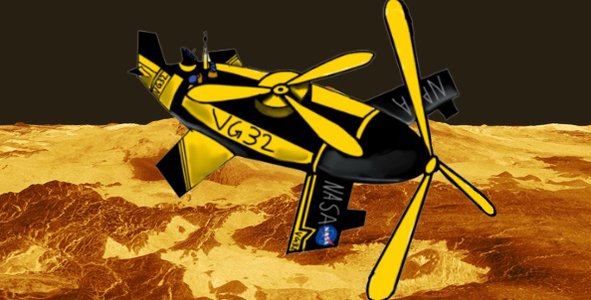
Our invention, VG.32, and the SOV energy system are expected to sustain Venus's extreme temperatures and atmospheric pressure for 60 days. They are both made of polybenzimidazole, which has exceptional thermal and chemical stability. It contains a flywheel battery inside of a partial vacuum, in which the battery transfers electricity through magnetic induction and stores it in the form of kinetic energy. Venus used to be a temperate land like Earth, with oceans and perhaps some life. However, a runaway greenhouse effect eventually created what Venus looks like today. Venus provides a cautionary model of how climate change can lead to dramatic disasters and the potential destruction of Earth.
Link to Final Project
Link to Project "Demo"
Detailed Project Description
https://docs.google.com/presentation/d/1-WPs4w3KkkVDEULeMsV2X_X28Z9e4AK_tF_nItYorx4/edit#slide=id.g7ed2db2611b2e8e8_3


Our glider, VG.32, stands for Venus Glider, 2032. 2032 meaning it will be launched in 2032. We plan to make this glider out of PBI (Polybenzimidazole) because it's light, resistant to sulfuric acid, and can withstand the heat on Venus. The glider will survive on Venus by flying and gliding in a repeated cycle. The three parachutes will slow the glider down but won't allow it to land. The glider will be made of 3 main parts, The power cell, the electronics, and the body.
The main part of our glider is the battery, but it's not a standard battery; it's a flywheel. It will be a tungsten flywheel that is mechanically charged through wind power. It uses kinetic energy as a storage system because the caustic atmosphere and high temperature are unsuitable for standard batteries. To avoid further damage, a mechanical vacuum pump will pull the airtight enclosure to a near vacuum. This is especially important to reduce friction on the flywheel to improve efficiency. It also is used to protect the few electronics we do have. Attached to the flywheel is a clutch, so you can choose to convert it to electrical energy or speed up the flywheel. A stator is also connected to convert the kinetic energy into electricity to power the radio communications and scanning equipment.
The few electronics we have on board are necessary for communications and scanning. We will equip it with 3 antennas, an Ultra high frequency, X-band high gain, and an X-band low gain. These communicate to satellites and Earth over a large angle coverage. We also have sensors to scan the landscape, such as radar and other terrain mapping equipment.
The glider's body will have a PBI shell with fiberglass insulation to prevent overheating. It will have wings and 2 rotor blades for easy flying and altitude adjustment. With the extremely high air pressure, flying becomes much easier and is likely a preferred method of transport.
This project's benefit is collecting data from Venus and eventually colonizing and harvesting resources from Venus. We hope to achieve a successful glider that can complete its mission of surviving on Venus for 60 days. We used Procreate, Canva, and Tinkercad to develop our project.
Space Agency Data
https://solarsystem.nasa.gov/news/1519/venus-resources/?page=0&per_page=40&order=created_at+desc&search=&tags=Venus&category=324
This site helped us know what challenges we would face on Venus and, what we should prepare for, precisely what materials we would need to build the exterior of our glider and the energy system. For example, we researched what challenges we would face on this planet and the caustic chemicals we would encounter.
https://www.nasa.gov/feature/automaton-rover-for-extreme-environments-aree/
https://www.nasa.gov/exploring-hell-venus-rover-challenge
We took inspiration from the mechanical nature of these robots and used them to design our glider. We learned to prioritize mechanical systems over electrical systems. The high temperature and acidic environment prove to be very hostile to electronics.
Hackathon Journey
We would describe our Space Apps’s experience as unique but challenging. For all members, the NASA Space Apps Hackathon was our first ever. The NASA Space Apps Hackathon experience has given us valuable experience in space engineering, designing, animation, video production, art, etc., and made us appreciate having a team with different perspectives.
Our team decided to choose this challenge because of the lessons we can learn by studying Venus. We identified the critical temperature and air pressure issues related to surviving on Venus for 60 days. We realized that we would need to do extensive research online and refer to NASA open source data to resolve these two issues.
Our team resolved setbacks and challenges by maintaining a positive attitude and open communication. After listening to each other, we tried to be flexible and find creative solutions to ensure ongoing progress. We would like to thank Coach Grant for being a responsible and helpful mentor. We would also like to thank Irvine Magikid, as they provided us with the space and the materials we needed to solve the challenges we met throughout the NASA Space Apps Hackathon.
References
Venus Surface Area, Dangers, Facts!
https://solarsystem.nasa.gov/planets/venus/overview/
https://coolcosmos.ipac.caltech.edu/ask/43-What-is-the-atmosphere-of-Venus-like-
Heat resistance for all materials we listed.
www.Americanelements.com
Material's resistance to sulfuric acid
https://www.tungsten.com/blog/chemical-resistance-of-tungsten
https://www.youtube.com/watch?v=dgQf8trgDGY
https://www.titanmf.com/alloys/applications-of-
https://www.titanmf.com/alloys/applications-of-titanium/#:~:text=Titanium%20is%20corrosion%20resistant%20to,solution%20can%20effectively%20inhibit%20corrosion.
https://www.fiber-line.com/uploads/pdf%20US/fl.us.datasheet-zylonr-pbo.pdf
https://www.science.gov/topicpages/t/tantalum+carbides#:~:text=They%20were%20found%20to%20be,their%20excellent%20performance%20and%20reliability.
https://polymerdatabase.com/Fibers/PBI.html
The density of each material
https://www.sciencedirect.com/topics/engineering/carbon-fibre-reinforced-polymer
https://www.britannica.com/science/tungsten-chemical-element
https://www.mt.com/se/sv/home/products/Laboratory_Weighing_Solutions/jewelry-scales-and-balances/weighing-diamonds-and-gemstones.html#:~:text=Diamond%20is%20an%20extremely%20hard,times%20as%20dense%20as%20water).
https://www.rsc.org/periodic-table/element/22/titanium#:~:text=Its%20density%20is%204.5%20grams,important%20in%20the%20aerospace%20industry.
https://www.americanelements.com/tantalum-carbide-ta2c-12070-07-4
https://www.aramid.com/zylon-pbo/
https://www.matweb.com/search/datasheet.aspx?matguid=938d31c764144f8c8b0c606761297899&ckck=1
Fiberglass Insulation:
https://www.buildwithrise.com/stories/fiberglass-insulation
https://homeefficiencyguide.com/can-fiberglass-catch-fire/
https://www.retrofoamofmichigan.com/blog/fiberglass-insulation-material-ingredients
Antenna:
https://www.britannica.com/technology/UHF
https://www.techopedia.com/definition/26056/high-gain-antenna-hga
https://www.qrg.northwestern.edu/projects/vss/docs/communications/2-what-are-high-and-low-gain.html
Flywheel Battery:
https://www.youtube.com/watch?v=yhu3s1ut3wM
https://www.azocleantech.com/article.aspx?ArticleID=911
Rate of Energy Lost When Not in Use:
https://www.researchgate.net/figure/Flywheel-standby-discharge-rate-in-24-h_fig6_343930266
Mechanical Vacuum Pump:
https://www.rheinmetall-automotive.com/en/systems-products/passenger-cars/pumps/vacuum-pumps/
Music in Demo-Video:
Champions Day-Lupus Nocte
https://www.youtube.com/watch?v=7frZrIlrTWs
Tags
#60 days on Venus #energy #parachute #materials engineering #innovation #insulation #NASA #Magikid