Awards & Nominations
VIM (Venus in mind) has received the following awards and nominations. Way to go!
Global Nominee

VIM (Venus in mind) has received the following awards and nominations. Way to go!
We propose the use of gravitational batteries: a mass rises mechanically, storing energy. When descending a mechanical system converts the vertical movement into rotation, which drives the generator. The stored energy is proportional to the mass and height, using simple mechanical elements. In addition, a vertical axis wind turbine will recharge our battery, using surface winds, weak and erratic, but useful due to the high atmospheric density. The final design is a 4000 kg lander, the majority corresponding to the weight of the batteries, with autonomy of 3 hours without winds and a power of 10 W, ideal for continuous meteorological and geological observation.
Previous missions have shown that venus surface winds are erratic and weak, but a windmill would be able to generate power under these conditions thanks to the high atmospheric density of 67 kg/m3, which is 55 times 1, 2 kg/m 3 of the earth's atmosphere. Vertical axis windmills are most efficient with low wind speeds, regardless of the direction from which it comes or the speed with which it varies. In fact, a wind of only 1.5 m/s is equivalent in terms of energy to a wind of 6 m/s on earth.
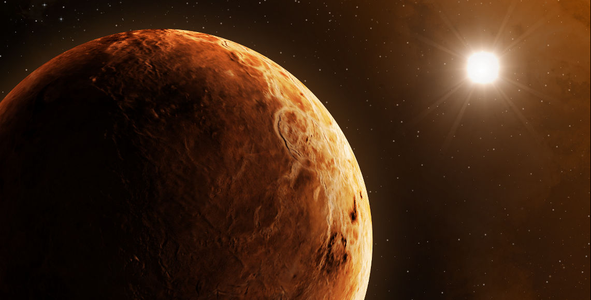
Venus has a thick, toxic atmosphere filled with carbon dioxide and it’s perpetually shrouded in thick, yellowish clouds of sulfuric acid that trap heat, causing a runaway greenhouse effect. It’s the hottest planet in our solar system, even though Mercury is closer to the Sun. Surface temperatures on Venus are about 900 degrees Fahrenheit (475 degrees Celsius) – hot enough to melt lead. [1]
We chose to design a fully mechanical system due to the high temperatures and corrosive atmosphere. Analyzing the following table, we propose to use the titanium material for its melting point.

The main structure of the lander consists of a 4 m wide hexagon with 2 m sides, where the wind turbine, the platform with instruments and the gravitational battery system are located. This hexagon is supported by a tripod-shaped landing system, with telescopic legs that allow it to adapt to irregular terrain and also reduce the space needed during the interplanetary travel stage. When the lander is folded, the height is about 2.4 m and and occupies a space of 30 m3. Unfolded, the total height of the lander on the surface of Venus will be 6.4 m, of which 4 m correspond to the useful lenght of the gravitational battery system.

The gravitational battery is a simple system consisting of three main components:
When the mass is at the top of the structure, the stored gravitational potential energy is maximum: E= mgh. When it is necessary to use this energy, the mass is slowly allowed to fall by the action of its own weight through the guides of the structure. The mechanical system transmits this movement to a vertical axis that drives the generator converting gravitational potential energy into useful electricity. If the mass reaches the base of the structure, the stored energy has been completely consumed. At this point, the excess energy generated by the wind turbine when the winds blow should be used to lift the mass again, transforming and storing electricity in the form of gravitational potential energy.

To improve the phase adjustment that must be meshed between the input and output rings in a planetary gear set, we propose to use Gear Bearings (GSC-TOPS-12) [3] In addition, we opted for a planetary roller screw given the adverse conditions of the planet with a guide for the load and considering the experience prior to its positive operation on Mars. [4]
At its maximum capacity, using a mass of 4000 kg raised at 4 m, the system is capable of storing 141.9 KJ of energy on Venus (surface gravity of 8,87 m/s2), without loss while the system is not being used. By varying the rate at which mass falls we can alter the rate at which the stored energy is used.
For reference, since it is necessary to accurately determine the losses associated with friction, the system is capable of providing:
The system have 3 gravitational batteries, each one with its own generator, so It is redundant in case of failures
We were inspired by previous missions to Venus, both the spacecraft that landed and the ESA and NASA orbiters. We also consider detailed information on the operation of NASA components that stepped on Martian soil.
Our experience in Space Apps was enriching, since we learned many new things.
Energy storage is a problem both on Earth and on Venus, so proposing a system that takes into account adverse conditions was interesting. Our approach was to develop a lander with mostly mechanical parts and environmentally friendly construction, as well as renewable energy.
To resolve setbacks, we delegated tasks according to each one's experience and we had constant communication.
I would like to thank my partner, Emanuel Rebot, who joined me this weekend in this engineering adventure.
[1] NASA Science, Solar System Exploration <https://solarsystem.nasa.gov/planets/venus/overview/#:~:text=Surface%20temperatures%20on%20Venus%20are,and%20thousands%20of%20large%20volcanoes>
[2] Energy Vault, EVRC Energy Vault Resiliency Center
<https://www.energyvault.com/gravity>
[3] NASA, Mechanical And Fluid Systems Gear Bearings (GSC-TOPS-12)
<https://technology.nasa.gov/patent/GSC-TOPS-12>
[4] Matthew Redmond NASA Jet Propulsion Laboratory, Thermal Testing of a Planetary Roller Screw for the Mars 2020 Rover Sample Caching System, California Institute of Technology, 03/28/2017
#NASA #Energy #Venus #GravitationalBatteries #EnergyStorage