
High-Level Project Summary
Our aim was to create a habitable environment on Mars and develop long-term solutions to challenges. We efficiently used Mars resources and our own scrap materials. We printed a rover wheel, multifunctional furniture, tools, an electric generator, a water filtration system, and an exercise running wheel for astronauts. Our main innovation was a so-called "thermo-ball". We explain its features better in a detailed summary. This technique gave us more water and energy to then build a greenhouse and further develop the civilization on Mars. We believe we managed to fulfill our goal.
Link to Final Project
Link to Project "Demo"
Detailed Project Description
We think that the Mars Outfitting challenge is quite important for each of us since the colonization of Mars will be one of the ways of survival and, at the same time, the greatest achievement of mankind. The more we learned, the more problems we faced, which we worked hard to solve creatively and efficiently.
First, we're going to 3D metal print the rover wheel that broke. We will use aluminum to make the wheel, and it will be reinforced with metal tubes from the inside, the diameter of the wheel will be 0.5 m. Our wheel will be built according to the principle of a Lego toy since the metal printer can only print small-size elements. The repaired rover will help us identify fossils on Mars.
We will create multifunctional tools. This would be a set of plastic handles and metal heads attached to either side. For example, to make flat-nosed pliers, an astronaut would combine two handles with the corresponding heads.
We will use a similar approach while printing small household items (forks, spoons, etc.).
Next, we print the shovel. We use a metal printer for the head and a plastic printer for the handle. Thus, we will save metal resources. And we dig the surface of Mars up to the ice cover, which in some places starts at a depth of 2 cm. Our rover will help us with the precise determination.
After, we make a "thermo-ball" to receive liquid water. In Landing Craft, we have rubber that we will heat and shape into a ball. We will fill it with lithium. We get lithium from the battery, which we also have in the landing craft. We will mix lithium with a type of hydraulic fluid(fuel) that we will extract from the spacecraft or the landing craft. We fill a ball with this mixture and immediately drop it into the ice cover that has already been dug up. The fuel will cause the rubber to melt, after which the lithium will spill out and immediately explode the ice cover. If we manage to find potassium, then this process will be more efficient. We will be able to remove the water only during the course of the reaction, which lasts only a few minutes. For this, we will have already printed a kind of sealed container. The reason for this is that as soon as we bring the water to the surface, it evaporates immediately. Or we can convert the gasified water into energy. After accumulating water, we can convert it into both energy and gas. We will use it in many ways. For example, in growing hydroponics, for heat, to create better-living conditions.
We will build a greenhouse for plants, for which we need glass that the rover will detect. As we know, glass particles have been discovered on Mars. By collecting them and generating energy, we can melt them and transform them into large glass pieces, thus building a greenhouse. In the greenhouse, we will use special soil and plant plants with the vegetable seeds that we took from the earth. Accordingly, we produce a small amount of oxygen. We will heat hydroponics using energy. NASA has discovered special stones where hydrogen molecules are found. With a special device, which will have a structure similar to a vacuum, we will extract the molecules and combine them with oxygen with the accumulated energy. We will get water that we will use to grow the plants. So, we will have another source of food.
Moreover, we will print a simple electricity generator which we will connect to our navigation magnet.
In addition, we will perform urine filtration, a technology that has already been developed. We will print this filter.
Consequently, we will have 3 new resources: water, food, and heat.
As to waste management, NASA's competition: Waste-to-Gas winners will hopefully find an efficient solution and we are willing to use their methods.
Another factor we considered is that the astronauts will need to exercise on the planet Mars. Therefore, we decided to build a human-sized running wheel by combining small metal materials (like a Lego).
After we have a sufficient habitat, we will print large cement blocks that will be like houses.
Space Agency Data
We used lots of resources available on the NASA webpage. It helped us learn more about Mars and its resources, plans, and ideas for colonization, and overall, it inspired most of our solutions.
https://nasa.com/
https://mars.nasa.gov/
https://www.nasa.gov/feature/jpl/nasas-treasure-map-for-water-ice-on-mars
https://www.nasa.gov/press-release/nasa-releases-plan-outlining-next-steps-in-the-journey-to-mars
https://www.nasa.gov/trash-to-gas-challenge
https://www.nasa.gov/ideas-for-handling-waste-future-mars-missions
https://mars.nasa.gov/mro/mission/spacecraft/parts/electricalpower/
Hackathon Journey
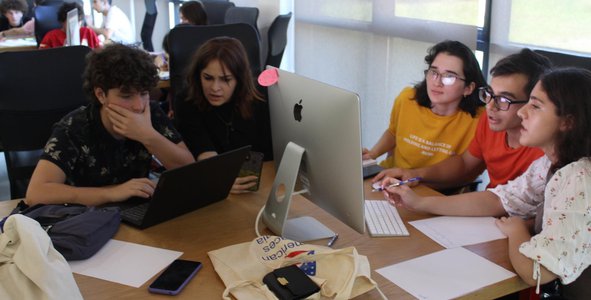
The challenge we chose was extremely interesting to every member of our team. We recognized its importance and therefore, were much more motivated to come up with valid solutions. After all, Mars is one of the ways of survival and, at the same time, its colonization might become the greatest achievement of humankind. The more we researched, the more problems we faced, which we worked hard to resolve creatively and efficiently. Together, we spent many hours and so, the NASA Space Apps brought us closer as friends. Moreover, we met lots of new people while working at theTechnoPark Batumi. All in all, this experience was fun, informative and definitely unforgettable.
References
https://l.messenger.com/l.php?u=https%3A%2F%2Fwww.nasa.gov%2Ffeature%2Fjpl%2Fnasas-treasure-map-for-water-ice-on-mars&h=AT21paiSJtkIyqIAvcn5kzNAOQ0qdeqoWC2x4dKacFXFRP2ybIfYluupSq1TPGeCY25PZplIZ4i0mtMBpNbPRPo8I4jPRwTE_DiG1-P-2i-YmCEGkNenz4illvxljF7kkbv9Fo73w-86MD0
https://l.messenger.com/l.php?u=https%3A%2F%2Fsketchfab.com%2F3d-models%2Felectric-generator-c1c16b25d18a4451a6f5cd7e8ed43527&h=AT3kqEZjmcyO74qXbfWaB5zMN7OWLyc5HyAeCrdqPp4SY05OjBF4L3xodEn3V7_ACEQcowwIivp9DXUnSEAAK8h6DtkkJyCHb9Dez2reh6kGgEslEt12tnqH35QTI5Q5sMfX
https://l.facebook.com/l.php?u=https%3A%2F%2Fyoutu.be%2Fu20yy-CycGU&h=AT2FFpitGWF2nkoXJJyTWyPgi6meKyjCy8vW5LGc3qii4CSy0mmz7ijzwzJ7hVzyikwtIh7HvXMpHhYUbI0hU0VXBxRAgO3lI9rkYMqy5D3RWALpuKwUXq8iy4rjmE8_8-LRo6foTyyEEdc&s=1
https://l.facebook.com/l.php?u=https%3A%2F%2Fdocs.google.com%2Fdocument%2Fd%2F1l0G-t_Ayc38VZiLIyqyvZCsiFVOOjw69HJxKrssn1Ns%2Fedit%3Fusp%3Dsharing&h=AT04HZzHBNZnYiWc8h7rZ3O5Rx4dvsoUp5OfxWr8cZE8m45Laaz1LzFvHWlZ0D2VSh-o2LilmxC81U_Eg0GQ2bQabhTFg0rw-ZiyOH02Z5BvPf0Cwa-L-N8zZLIOP640t2cqFbNNtV13w4A&s=1
https://l.facebook.com/l.php?u=https%3A%2F%2Fwww.quora.com%2FWhat-would-happen-if-I-mixed-liquid-oxygen-with-liquid-hydrogen&h=AT00BbFBWrudOLNWCRPunk9Pu78mxl9WwrqvsutcZP-hIfO7gTjWKRt8nTT98AQcJKdfi7EfzJ8iD-El4QBJiHgIAi30XIWrL92Ql7efvIybERn8LWlrWq5t9UHUq1RHui-dV2lXAxTziaI&s=1
https://l.facebook.com/l.php?u=https%3A%2F%2Fwww.nasa.gov%2Ffeature%2Fjpl%2Fnasas-treasure-map-for-water-ice-on-mars&h=AT0vHVysSHT1r_x8Oy1wBA63r68XNtTq3Kt0hPwFIDajGAcDa4bpjGqRRtdvvjwiILvuGcqFhMwpM83UnbKxi1nIsNfAZOEng2BMk2mXRk2iZb1zQJzJleLZcvVu9qroKQ2eKPC4Kzmcxhk&s=1
https://l.facebook.com/l.php?u=https%3A%2F%2Fmarsed.asu.edu%2Fmep%2Fice%23%3A%7E%3Atext%3DMore%2520than%25205%2520million%2520cubic%2Caway%2520in%2520the%2520deep%2520subsurface&h=AT0XqilzSUb_hjIvtL9YIqTtpPvFXk3_CdbgZQKodsrNuedNtxjhGdpOfEHmVKuve_O2Thp7W0rvr-EFGLF2vDOUGwXojZeSSjP5t9KSFMyXff2Nx3f88LODiBFzOm_U4vmvi3D61dKEaHs&s=1
https://sketchfab.com/3d-models/electric-generator-c1c16b25d18a4451a6f5cd7e8ed43527
https://www.applerubber.com/blog/rubber-in-the-aerospace-field/
https://marsed.asu.edu/mep/ice#:~:text=More%20than%205%20million%20cubic,away%20in%20the%20deep%20subsurface
https://www.hq.nasa.gov/alsj/LM15_Portable_Life_Support_System_ppP1-5.pdf
https://www.readersdigest.co.uk/lifestyle/technology/can-we-survive-on-mars
https://cults3d.com/en/3d-model/game/mars-curiosity-rover-wheel-assembly
Tags
#Mars #3D #Outfitting #3D Models #Colonization #Mission #Rover #Space #Landing