Awards & Nominations
MARS 3D HOME has received the following awards and nominations. Way to go!
 Best Mission Concept

The solution with the most plausible concept and design.

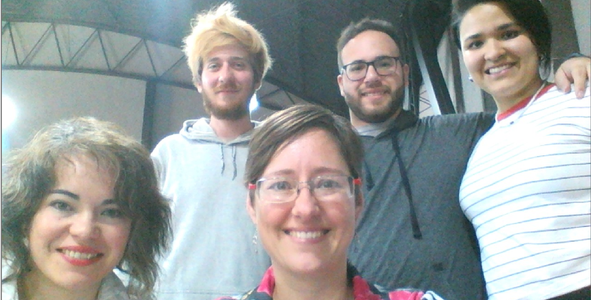
MARS 3D HOME has received the following awards and nominations. Way to go!
The solution with the most plausible concept and design.
The main goal of our challenge is to design 3D printed elements to equip a habitat on Mars,facing different tasks such as the design of a rover wheel and the beds where the astronauts rest.We analyzed the Martian environment to detect the available resources and then propose the basic needs of four astronauts so that they could survive on Mars for a year.We formed a team of five people with backgrounds in industrial design,electronics and 3D printing, so we researched about materials to be used to build 3D models.After hard work and using the resources provided by NASA, we managed to design the interior of the habitat and several multifunctional tools and gadgets to live comfortably on Mars.
The main goal of the selected challenge is to design 3D printed elements to equip a habitat on Mars. We start from the fact that the astronauts have had a forced Mars landing, as a result of which tools have been lost and a wheel of the rover has been damaged thus they all must be rebuilt in 3D. For this task we have three printers using different materials (metal, plastic and concrete), with certain limitations in terms of print size and amount of supplies.
To face the challenge, we began by analyzing the Martian environment, in which we were able to detect the available resources and propose the basic needs of four astronauts so that they could survive on the red planet for a year (we consider a Martian year, equivalent to 687 Earth days). We formed a team of five people with backgrounds in industrial design, electronics and 3D printing, and we started planning the project and dividing the work in terms of research on 3D printing technologies, materials to be used and the design of 3D models, among other issues.
Rover's wheel
For the design of the wheel we followed the recommendations of the challenge, taking as a basis the 3D model designed by NASA, which can be found in the Challenge Resources.
We decided to make the wheel using titanium (Ti), because according to our investigation, the wheels of other rovers designed by NASA are made of this metal, and it is an element present in the soil of Mars. Titanium has great mechanical strength and durability, and is also resistant to corrosion and radiation (which is much higher than on Earth).
We made some modifications to the original wheel model, which are intended to adapt it to the using conditions on Mars, but keeping its external dimensions. The wheel was segmented into three parts to be printed on the metal printer, since due to its size it could not be printed in one piece. On one side the central part, where the axle goes, is printed, while the part of the tread plus spokes was modeled to be printed twice and thus complete the wheel.
The design contemplates that the outer part of the wheel is closed to prevent sand from entering, and also presents an increase in the depth of the tread so that it can better traction on the Martian surface, and the morphology of the same was modified so that the footprint left by the rover is able to indicate the direction taken by the vehicle.
Mars habitat furniture
Within the Resources we found a habitat blueprint, which we implemented using SketchUp software to dimension the rooms and thus be able to design the necessary furniture.
We designed 3D models for a modular bed printed in concrete; a modular matress made of polymer; a complete workstation (chair and desk); crop containments; a first aid kit.
Tools and gadgets
We designed an electric stove with a calculated resistance that generates 150 W. We used concrete for the base and Ni/Cr wire for the resistance. The base model may also be used as a game: this is a maze of balls, using a metal printed little ball.
We designed a lot of multipurpose tools such as hammers, gardening tools, hygiene stuff and more.
!!!!!!!!!!!!!!!!!!!!!!!!!!!!!!!!!!!!!!!!!!!!!!!!
VERY IMPORTANT:
All our designs may be found here:
https://drive.google.com/drive/folders/1n71nCXgj9bHv5rRrmb6zvcvUUAvtzVDP?usp=sharing
Our renders may be found here:
https://drive.google.com/drive/folders/1X3V0rP36AiDeQmxDO4lBubkNj4pBI0lh?usp=sharing
!!!!!!!!!!!!!!!!!!!!!!!!!!!!!!!!!!!!!!!!!!!!!!
Software used to developed the project:
Solidworks
Keyshot
Blender
SketchUp
CURA
Tinkercad
Canva
Google Workspace
We used open data from NASA:
Information about Mars habitat CHAPEA, missions and rovers on MArs (Perseverance and Curiosity).
For the design of the wheel we followed the recommendations of the challenge, taking as a basis the 3D model designed by NASA, which can be found in the Challenge Resources. We made some modifications to the original wheel model, which are intended to adapt it to the using conditions on Mars, but keeping its external dimensions.
The bases of the challenge recommended reusing elements to save material. When designing the tools, we took this premise into account. In addition, we researched the resources provided by NASA and found numerous 3D models already designed. To design our multifunction tool, we started from a model that we downloaded from these resources, which has several functions, to which we made some modifications.
The experience was optimal to meet people from different professions or fields, at the same time exchanging knowledge and ideas with mentors or people from other groups helped us a lot to learn more about different topics.
We formed a team with people from two different cities of our country, Argentina, and this was a very possitive experience
The team would like to thank NASA for the creation of this challenge and the members of The Mars Society of Mendoza for the organization of this beautiful event, which gave us the opportunity to meet people with exceptional interests and abilities.
We would like to highlight the willingness of the Universidad Nacional de San Luis, which made possible the dissemination of this event in San Luis and the participation of teachers and students.
Also thanks to mentors and our families!
We used these resources:
Info about Mars habitat: https://www.nasa.gov/feature/nasa-is-recruiting-for-yearlong-simulated-mars-mission
https://www.nasa.gov/chapea/habitat
Images used in the project:
Habitat Blueprinthttps://images.ctfassets.net/lfyy09oi3n0b/2U3YmF4j6i6vkEo211qt8n/02321bf355e88deb90ac8005f8af01a7/ICON_NASA_CHAPEA_Mars-Dune-Alpha-010-WM.png
Info impresión 3D: https://www.sculpteo.com/es/materiales/slm-materiales/
Mars surface composition: https://www.cristalljoia.com/Blog-Cristall/Buscando-minerales-en-Marte
https://www.quimiclan.com/cual-es-la-composicion-de-marte-la-quimica-del-planeta-rojo/
https://es.wikipedia.org/wiki/Suelo_marciano
Heating resistances: https://www.jmi.com.mx/resistencias-calefactoras#:~:text=No%20obstante%2C%20la%20generalidad%20es,que%20con%20esta%20aleaci%C3%B3n%20se
Resistivity Ni/Cr: https://www.buenastareas.com/ensayos/Resistividad-Aleaci%C3%B3n-N%C3%ADquel-Cromo/5494675.html
Electrical stove (our design in Tinkercad): https://www.tinkercad.com/things/7ixKJTDIqtY
3D model NASA tool: (we modificated later) :https://nasa3d.arc.nasa.gov/detail/mpmt
CHAPEAhttps://www.nasa.gov/chapea
NASA 3D model wheel https://nasa3d.arc.nasa.gov/detail/Mini-Perseverance-Rover-Wheel
Multipurpose precision maintenance tool https://nasa3d.arc.nasa.gov/detail/mpmt
#living on Mars, #3D printing, #3D furniture, #rover, #3D home, #tools, #home, #space home, #Mars habitat
Imagine you’re an astronaut who has newly arrived on the Red Planet. Your habitat has been pre-constructed for you, but, other than three 3-D printers, it doesn’t have most of the things you need to live and work. Your challenge is to design tools, furniture, and other items to assist you on your one-year mission.

