
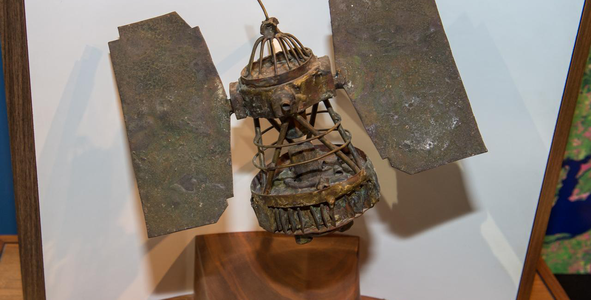
NASA has a long and successful history of developing, launching, and operating Earth-observing missions that have contributed significantly to our understanding of the planet. Your challenge is to create an engaging multimedia depiction of all NASA’s Earth-observing missions that also demonstrates how the mission set evolved over time to include new technologies and meet science-driven needs.
The Challenge
Background
Did you know NASA has been building and launching satellites and instruments to observe Earth from space since the agency was established in the 1950s? A plethora of past, current, and future Earth-observing missions have NASA’s name on them! Although various pictorials of Earth-observing satellite fleets and individual mission posters and animations exist, it would be beneficial to visually depict these missions using a multimedia approach that appeals to a broad audience. Such a visualization could be utilized to promote science, technology, engineering, and mathematics (STEM) and help students (K-12 and at universities) and the public at large understand how NASA’s missions contribute to Earth science.
Objectives
The focus of this challenge is to showcase NASA’s long history of observing Earth from space to a broad audience in an engaging manner. Your challenge is to create a multimedia depiction of all NASA’s Earth-observing missions that also demonstrates how the mission set evolved over time to include new technologies and meet science-driven needs.
How will you engage your audience? Perhaps you could develop an interactive timeline or a 3-dimensional cube that represents past and current Earth-sensing missions and could be viewed from different perspectives. For example, various sides of a cube could reveal all the satellites that launched out of Vandenberg or Cape Canaveral; all the instruments that were deployed on the Space Shuttle or the International Space Station; or all the data sets that contain passive or active remote sensing information, measurements at a particular frequency, data with spatial resolution less than 100 meters, and/or data that offer global coverage in under a few days.
Be creative! Can you develop an imaginative multimedia solution to easily convey information about NASA’s long history of observing the Earth to a broad audience?
Potential Considerations
When developing your solution, you may (but are not required to) consider the following:
- If you are not sure where to start, browse the websites in the Resources tab at the top of the page to learn more about NASA’s past, current, and future Earth-observing missions.
- Don’t forget that users will want to learn important information about each mission depicted, such as the mission name, launch date, where it launched from, orbital location, how long it operated (if it made it to orbit), the main observables/science objectives, key partners that helped achieve the mission, and whether the mission has ties to any other NASA Earth-observing missions (e.g., previous or successor missions, instrument heritage, etc.).
- Your solution could also provide other data including, but not limited to, the spatial scales of the observations and length of time required by the mission to map the whole globe (or its maximum coverage).
- Your solution should be something people of all ages can use (e.g., it could be web-based) and understand. Think of your audience as the general public—i.e., people who do not have an in-depth science or engineering background.
- You may include any missions launched by NASA’s preceding agency, the National Advisory Committee for Aeronautics (NACA). (Hint: Nimbus may not have been the first one!)
- NASA’s Earth-observing fleet changes over time, so it would be valuable if your solution could be updated accordingly.
- Have fun with it! This is a creative challenge as well as an opportunity to learn, so don’t limit yourself.
For data and resources related to this challenge, refer to the Resources tab at the top of the page. More resources may be added before the hackathon begins.
NASA does not endorse any non-U.S. Government entity and is not responsible for information contained on non-U.S. Government websites. For non-U.S. Government websites, participants must comply with any data use parameters of that specific website.