
High-Level Project Summary
NEOM is an app with the purpose of ease the understanding of NASA's Earth-Observing Missions through an interactive, free and accessible space. NEOM has a simple interface aimed towards young people interested on the achievement of knowledge. We aim to facilitate the access to information provided by NASA and thus bring science and technology closer to people and inspire them to be game changers.
Link to Final Project
Link to Project "Demo"
Detailed Project Description
NEOM is a mobile application made up of several screens that contain some of the most important exploration missions to Earth, this application integrates the information provided by NASA and shows important data of each mission to the user, in addition, it allows to visualize the missions in a three-dimensional format, seeking to promote a fun and interactive space for anyone who uses the application, this is achieved through the realization of models of the missions carried out in 3D design software, together with a viewer that allows the user to make zoom, rotate, hide pieces to visualize the interiors, change colors, among other functions.
This app has many benefits, since it has a friendly interface designed so that any user can use it, so people will be able to interact with the app in a simple way while they acquire knowledge about earth observation missions and have fun viewing the models of three dimensions, with this app young people will develop in a healthy, fun and learning space.
With NEOM we hope to sow the seed of knowledge and foster a love and passion for science and technology by providing knowledge of Earth missions so that people can learn about the advancements that these missions involve while having fun, if we create a way of engage young minds into NASA’s Earth-Observing Missions, we could increase efforts into satelites programas that will improve reaction time in cathastrophes, radiation, contamination and weather measurment, our goal is to inform and engage to CREATE FUTURE FULL OF AWARNESS. To develop NEOM, several digital tools were used to develop 3D models; Solid Edge and Solid Edge Viewer, for the application we used Andromedo, App Inventor and Canva among others.
Why are we different? Usually the information is technical, boring and extense, our app is the antithesis of these words, being interactive, entertaining, but overall trascendant.
What it could be one day? we have the plan for the future to have interaction modules because the best way to achieve interaction and engagement is to stablish modules in universities and museums, where the youth can be informed an amazed by the techonlogies and uses of satelites.
Space Agency Data
At the time of including the information, our team was very careful to choose only information from NASA and the Mexican space agency and only use copyright-free images and multimedia content that we own. The research process was based on extensive exploration to find a way to include it in our application in a simple and clear way.
The amount of information that we have at our fingertips to be able to carry out complete and detailed investigations was impressive, however our objective with our application was based on making this information even more accessible and understandable for young people.
Hackathon Journey
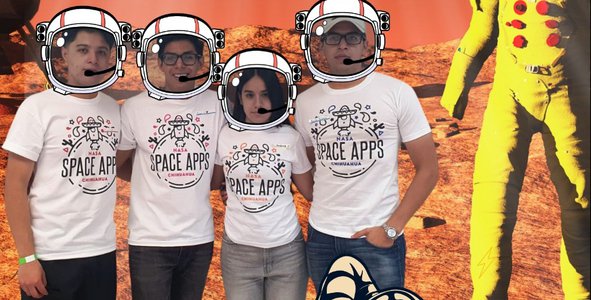
Our experience in Space Apps has been exciting, inspiring, of personal growth because it has been a good opportunity to put into practice our skills to strengthen them and work on our weaknesses, in this time we have been able to develop a project that seeks a real impact, because as a team we have as a priority that our project can become a reality, that is why we chose the challenge "NIMBUS TO NOW: THE HISTORY OF NASA'S EARTH-OBSERVING MISSIONS", a challenge that allows us to carry out a project to facilitate access to the information provided by NASA about its Earth observation missions, our team sees this challenge as a great opportunity to bring science and technology closer to young people, to inspire them to continue learning about space.
We thank our mentors for their advice and we appreciate that they shared their knowledge with us, we are sure that with them and their advice, our project will be better.
References
NASA. (2012, November 26). NASA's Earth Observing System. eos.pso.nasa.gov. Retrieved October 2, 2022, from https://eospso.nasa.gov/content/all-mission
SIEMENS. Solid Edge (2022) version 222.00.00.132 x64
NASA. (2014). Orbiting Carbon Observatory-2 (OCO-2) Watching the Earth Breathe. . .Observing CO2 from Space. eospso.nasa.gov. Retrieved October 2, 2022, from https://eospso.nasa.gov/sites/default/files/publications/OCO-2MissionBrochure_final_508_0.pdf
UPAEP. (2022). AZTECHSAT-1. upaep.mx. Retrieved October 2, 2022, from https://upaep.mx/aztechsat
NASA. (2021, February). GOLD - Mission Overview. nasa.gov. Retrieved October 2, 2022, from https://www.nasa.gov/content/goddard/gold-mission-overview
NASA. (2014b, July 7). Solar Radiation & Climate Experiment (SORCE). nasa.gov. Retrieved October 2, 2022, from https://www.nasa.gov/directorates/heo/scan/services/missions/solarsystem/SORCE.html
NASA. (2015). Jason-1. jpl.nasa.gov. Retrieved October 2, 2022, from https://www.jpl.nasa.gov/missions/jason-1
NASA. (2022). Earth Observing Dashboard. eodashboard.org. Retrieved October 2, 2022, from https://eodashboard.org/
Tags
#Earth, #App, #3Ddesign, #STEM