
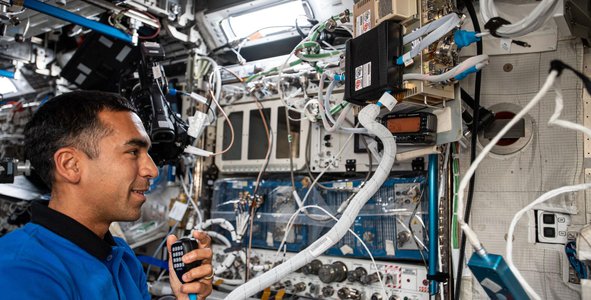
Data from the amateur radio International Space Station (ISS) broadcast and reception systems and networks of ham radio broadcasters can be utilized for applied Heliophysics research. Your challenge is to develop an application that uses these datasets to construct and display images of Earth’s ionosphere.
The Challenge
Background
Earth’s ionosphere is an envelope of ionized gas surrounding the planet. Interactions between the incoming solar ultraviolet radiation (and shorter wavelengths) and the neutral atmosphere of Earth separate electrons from ions and produce the ionosphere. The free electrons in the ionosphere oscillate relative to the ions at frequencies ranging from 2.0 MHz to 20.0 MHz. This frequency range—also called the electron plasma frequency—overlaps with operational radio frequency bands, creating opportunities for applied Heliophysics research, specifically to probe the Earth’s ionosphere.
For example, the amateur radio ISS broadcast system and the networks of ham radio broadcasters overlap with the electron plasma frequency of the Earth’s ionosphere. Therefore, information collected from the interaction of these radio broadcasts with this electron plasma frequency can provide a powerful diagnostics tool to study Earth’s ionosphere.
Objectives
Your challenge is to develop an application that uses information from amateur radio ISS broadcasts and ham radio broadcasts to construct and display high-temporal and high-spatial resolution images of Earth’s ionosphere. How can these images provide vital information for space weather research and forecast applications?
Note that this challenge involves development of computer algorithms to perform data ingestion, inversion, and mapping. The process involves converting raw radio propagation information obtained from amateur radio ISS and ham radio broadcasters into scientific quantities such as ionospheric electron density.
Potential Considerations
When responding to this challenge, you may (but are not required to) consider the following:
- The following technique can enable generation of the ionospheric density profile: The ham radio high-frequency broadcast can probe the ionosphere up to the peak electron density of the ionosphere, and the amateur radio ISS broadcasts can measure density above the ionosphere peak.
- Consider building software that invites citizen scientists and amateur ham radio operators to provide radio propagation data, both station-to-station and ISS-to-station. Your application could ingest this data, convert it into physical quantities, and/or display imagery of the Earth’s ionosphere.
For additional resources you could conduct an internet search to gather relevant information that may be useful. Potential search keywords could include:
- Amateur Radio on ISS
- Radio citizen science
- Atmospheric research
- Ionospheric sounding
- HF sounders
- Geospace plasma observations
- Ionosphere and upper atmosphere research
For data and resources related to this challenge, refer to the Resources tab at the top of the page. More resources may be added before the hackathon begins.
NASA does not endorse any non-U.S. Government entity and is not responsible for information contained on non-U.S. Government websites. For non-U.S. Government websites, participants must comply with any data use parameters of that specific website.