
High-Level Project Summary
"Cuestión de Espacio" is a card game that showcases the dangers of outer space and how different organisms and lifeforms have adapted or could adapt to the aforementioned.The game is played by atleast 2 players, taking turns playing up to 3 cards, one of each unique type (creature, condition, trait). Creatures can fight each other, and when one is exterminated, the winning player is awarded a trait. The first player to get 5 traits on a single creature wins.
Link to Final Project
Link to Project "Demo"
Detailed Project Description
What the game is about
Cuestión de espacio is a card game about altering kown lifeforms to make them fit for hostile ever-changing enviroments.
The rules
At the start of the game, 3 card piles are set on the table, one for each card type.
The card types are:
Conditions
Card text: "Low gravity"
"All creatures have 1 extra action per turn"

Condition cards alter the battlefield, sometimes providing a stable enviroment for plants, bipeds and bacteria to grow, sometimes turning it into an unhospitable ocean unfit for anything but the strongest tardigrades.
There can be up to 3 conditions in play at a time. When a condition is played while there's 3 in play, the player chooses which one it replaces.
Creatures
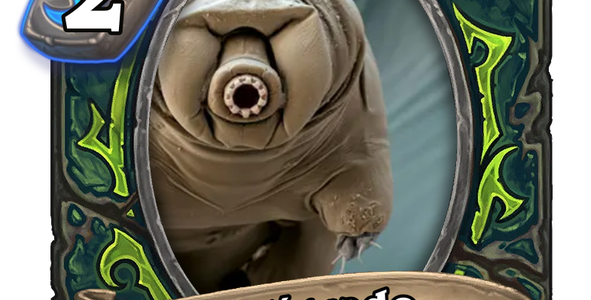
Card text: "Tardigrade"
"Immune to negative conditions"

Creature cards fight against each other and the threats of space. Each one has a short description of their effects, and they all have a number to the left, representing their "Power", and a number to their right, representing their "Population". These are used during combat. When a creature is played and at the start of its owner's turn, it can perform an "attack" against an opponent's creature, reducing the target's population by the offender's power, and the offender's population by the target's power.
Traits
Card text: "Sapience"
"Draw an extra card at the start of your turn"

Trait cards are powerful cards used to alter the biology and qualities of the creatures on the battlefield. If a player destroys an opponent's creature, they draw a card from the trait pile and draw again for each trait on the opponent's destroyed creature.
The first player to have 5 traits on a single creature, wins!
There's a unique QR code on each card, that can be scanned to lead the user to a page where they'll find more information on the creature, genetic trait, or condition. This helps teach players about space, the threats it poses, and how some animals and microorganisms have adaptations that might help them out there.
Link to the drive with all the cards.
Feel free to print, modify and use them!
Space Agency Data
Hackathon Journey
Nicolás from the team here, the experience was, above all, exciting. There were a lot of mishaps, unfortunate events and whatnot.
At the beginning, there was noone but me. Then I gathered a small group of people to join the team, yet almost all of them left when we chose this challenge because they wanted to do a different one and were unwavering about it. We went our separate ways, and Juan stayed. He brought a friend, though; Fabián.
When Juan left for the night, Fabián decided to spend the night at the hackaton, together we slashed away at the design issues, card templating and art recquisitioning, Juan had done research beforehand, so we had time to make a makeshift deck for testing, and the game worked relatively well.
Fabián and I sat restless on our chairs, nearing 4 am I succumbed to my snores after finishing the cards. He did not sleep though, he sat trough the whole night setting up the QR backend for the cards.
Day two, went a lot better than the first one, almost all of our setbacks were behind us, and with Juan back and the real deck on our physical hands, we felt unstoppable. But time was of the essence, for we had only a few hours away the grand show-and-tell of our projects, and we were a couple yards away from the finish line. In the end, Juan had to leave again before the show, and Fabián felt the stage-fright as we saw other groups go through.
Our time came, and we stood up, tall and proud. Ready for all.
...
Our pitch went far, far better than we both had expected. I cleaned up, printed and cut the cards, Fabián helped with the initial design and template, and both Fabián and Juan did the entire back and front-end part of the project. We all made the initial rules, concepts and cards together. After a small round of judge suggestions, we went back to our seats, and gave each other a small fist-bump, knowing we'd done good. For with the hand we were dealt, we made the best play, and went home with a full house.
References
Evans, David H.; Piermarini, Peter M.; Choe, Keith P. «The Multifunctional Fish Gill: Dominant Site of Gas Exchange, Osmoregulation, Acid-Base Regulation, and Excretion of Nitrogenous Waste». Physiological Reviews85 (1): 97-177.
«Weird Science: Cryptobiosis». manoa.hawaii.edu.
Panikov, N. S. Microbial Growth Kinetics. Springer Science & Business Media.
Arena, C.; De Micco, V.; Macaeva, E.; Quintens, R. «Space radiation effects on plant and mammalian cells». Acta Astronautica104 (1): 419-431.
Card art:


.jpg)
Tags
#game #education #fun #cards