
High-Level Project Summary
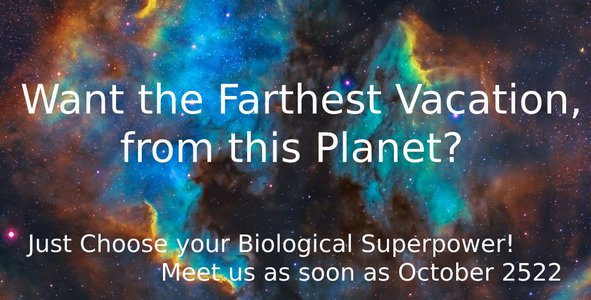
We are trying to use science fiction stories to bridge a crucial gap. Obsession with space exploration is still a hot topic 500 years later in our fictional world. Protagonist 'Fitrus' can modify the human bodies for deep space travel, but it comes with limitations and inter-dependencies.This section of our story presents an artifact from the future where such a sales pitch is being presented. The idea has the potential to become a grand platform for imagination to run wild. Thinkers and storytellers can use this medium to upgrade the general mindset of the audience, while everyone actually has a lot of fun!
Link to Final Project
Link to Project "Demo"
Detailed Project Description
Our approach towards the challenge brings attention to the limitations that exist in human bodies. It works by telling a story that engages the audience and makes them want to perceive the true limitations that may arise from pursuit of limitless challenges.
Such a story can open up doors for more writers and thinkers to solve problems before they occur. They have the potential to wake people up and make a real paradigm shift happen with ease.
Our approach was actually quite simple and interesting. We researched a lot in the hackathon and then brainstormed it all together. We then went on to write a few sections in plain engaging English, given the time constraints. The mind mapping during this hackathon can easily be developed not only into a story, or a novel, but an entire sci-fi universe by a Pakistani writer!
Now that would be quite a launch!!!
Space Agency Data
We utilized the datasets from NASA ans CSA and tried to spot connections or patterns that could be grouped together and delivered in a short, simple, and engaging story.
Nature of different datasets, and more importantly how they have been perceived and arranged was one end of the challenge. Finding the suitable data to be quickly packaged as interesting to consume in a story might sound difficult. But towards the end we actually had to leave a multitude of points out, just to keep things simple.
We can identify the specific observations, used for the solution, in the following datasets:
To identify a set of problems on the body with actual data and their likelihood and consequences as a matrix of time and distance:
https://humanresearchroadmap.nasa.gov/risks/
To identify the sources of where the solution might lie in trying to enhance the human body by any means possible:
https://science.nasa.gov/biological-physical/programs/space-biology
To identify the common problems that can be added as a basic feature to all the plans:
https://www.asc-csa.gc.ca/eng/astronauts/space-medicine/concerns.asp
Hackathon Journey
This really was an unforgettable first hackathon of my life! I got to engage with so many experts and creative geniuses. So many of my peers are working of truly diverse technologies and ideas. Getting to witness their excitement and sharing mine with them was truly remarkable.
I had to learn how to just adapt the crude idea in my head, and shape it, rather evolve it at the speed of a launching rocket! That was taxing on my sleep, but a beautiful set of memories and skills.
Presenting in front of my fellow Pakistani audience was a deeply fulfilling experience. The roar that went up on seeing a Pakistani astronaut in space will always be cherished. Thank you so much Dalle-2 for taking me off off the 6 month wait list just at the right time! the perfect time!!!
Every team working to make the event happen was super-helpful at various steps of the way! I am sorry, we are terrible at remembering names but... Arham, thanks for the quick thinking right at the end, and very clear and truly concise answers at all the right moments! Hasan Zaki was just wow at making things so smooth for our team! Ahsan Khan really knows how to think on his feet and make stuff happen in probably less than an instant! Sannan Ali, I mean like, okay, maybe a colonel vibe, or maybe a brigadier, who felt like a friend my age I have known for ages. He was repeatedly telling me to be calm on day 2, but maybe he should have seen me in the night between day 1 and 2!
Well, I have never met, or even had any direct online interactions, with any of these incredibly talented individuals, but the hackathon just opened up so many new memories and perspectives that... phew! Thank you everyone!
Also, there was this one manager/volunteer that 'saw a winner' in us at the introductory session, and then went out of her way to help our team get things done in time for the global submission! I am sorry I didn't catch your name, but the entire team of 'Flight of Fitrus' shall always be thankful to you!
Okay, okay.. this is getting too long. But we need to acknowledge one last, and probably the most crucial fact! This hackathon has personally opened up so many doors in the future that can't really be counted at this point in time. The teamwork under time constraints, that too creative visualization and formation of ideas, leading to an effective delivery, as a single unit of our team... That, is truly priceless!
Thank you NASA! and everyone who helped our team, or any team in the 180+ territories!
Already waiting for the next year!
References
https://openai.com/dall-e-2/
https://wasi-rizvi.medium.com/
https://www.iftf.org/what-we-do/artifacts-from-the-future/
https://unsplash.com/photos/qtRF_RxCAo0
https://www.photopea.com/
DATA:
https://humanresearchroadmap.nasa.gov/risks/
https://science.nasa.gov/biological-physical/programs/space-biology
https://www.asc-csa.gc.ca/eng/astronauts/space-medicine/concerns.asp
Tags
#scifi, #storytelling, #fiction, #futuresthinking, #future, #hazards, #distant_stars, #Space_exploration, #Biology #Space_Travel