
High-Level Project Summary
Supernova presents “Nova’s superspace journey” a video series that tells the story of Nova, a young astronaut with exceptional software that allows her to pick abilities from organisms in order to survive hazardous situations during her time in space. We want to foster the interest of people in space exploration, give recognition to astronauts and learn interesting facts about organisms. As an educational platform with social media presence, audiences will use our videos to learn more about the dangers astronauts encounter in space, how NASA solves these problems with modern technology and interesting facts about Earth’s life forms
Link to Final Project
Link to Project "Demo"
Detailed Project Description
What is it?
The idea of Supernova came to be, after brainstorming about the various difficulties astronauts face in space exploration while doing missions. Thus, as a team, we have built an educational network in order to reach all types of audiences through social media, youtube series, and website.
How does it work?
Our proposal has the objective of raising awareness about not only the physical but also the psychological aspects an astronaut has to experience while being in space by telling the story of Nova, a young girl traveling through space with assistance from artificial intelligence, which will allow her to morph and change her characteristics in order to survive in space.
The platform will include videos, interesting facts, pictures, links, and other media that will help people understand each situation better, explaining how the different abilities of each organism on Earth can be helpful to prevent difficult situations or potentiate astronauts' characteristics in space to make their mission easier.
Video Series: Nova’s Superspace Journey
The story revolves around Nova, a human young lady just like many of us. She won an International Space Apps Challenge and now she has the chance to travel to space with the assistance of artificial intelligence. She will have the opportunity to change her skills and characteristics depending on the different obstacles and situations she will experience while being in space.
In every episode Nova faces a challenge astronauts face on a daily basis but she has the help of ASO-D3, an artificially superintelligent quantum computer developed by NASA engineers with groundbreaking technology. This allows space travelers to modify their genes in order to adapt to the rough environment conditions that space exploration involves.
Therefore, according to that episode’s challenges, ASO-D3 will explain to her the characteristics of organisms and how she can use them to fix certain problems.


Youtube channel link: https://www.youtube.com/channel/UC8tAAAjEZ5zuvRRMNF6tvWw
SuperNova’s website:
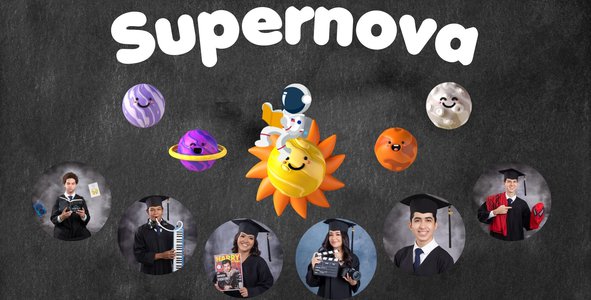
The website has three sections, the first one is "meeting the team" where you can find a picture of each of the team members, and the second one is the "video series" where you will find a link to our Youtube Channel, and the third one is "Home" where you will find a lot of information about problems astronauts face. On our webpage, you can also find more scientific articles related to the video series, so it can reach older audiences and will include links to information used to promote users to dig even deeper into the space-traveling difficulties astronauts face.


Social Media accounts:
It is really easy for kids as well as teens and adults, to use and learn with this platform. Having social media like Tik Tok and Instagram helps expand the knowledge among our teen audience too. On our social media, it will be posted sneak peeks or teasers of our video series to invite users to watch our videos and also, fun facts about space travel including their corresponding references. Since everyone communicates and processes information through social media, there is no better way to foster knowledge about space exploration than through Social Media accounts.

Instagram page: https://www.instagram.com/novasjourney_/?igshid=YmMyMTA2M2Y
What benefits does it have?
What makes our project unique is that we have built an educational network, that can be always updated, edited, changed, and more. We live in a society where things are always changing and adapting, so every educational tool should be the same.
What do we hope to achieve?
We hope that our network generates an impact and that users of all ages including children and adults take advantage of our resources so they can learn from them about space traveling difficulties. As high school students, many of our friends and close family members use social media and watch youtube videos on a daily basis, and considered crucial to use those habits in a learning experience.
What resources did we use?
We animated our video series with https://app.animaker.com/.
We used photos from https://www.freepik.com/ https://www.pexels.com/ and more listed in the references.
For our video edition, we used Adobe Premiere. For our Instagram Posts, we used Canva. For our website, we used WordPress with the Brizzy plugin.
Space Agency Data
As an educational platform, all of our videos, website articles, and fun facts are based on several safe web pages and most of them are included in the resources tab of the “Building a space biology superhero” challenge. The main inspiration for our educational platform is NASA’s publication called “5 Hazards of Human Spaceflight” which describes five obstacles humans have when they go to space. They mention aspects like radiation, isolation, and space exploration, the three main topics we discuss on this platform.
We also used an article published by NASA, called “How does spaceflight affect the human body?” It talked about the problems that astronauts are exposed to when taking the challenge of completing a space mission. This page talked specifically, among other things, about how microgravity and smoke inhalations affect the human body by raising the risks of getting cancer or any neuronal permanent condition.
We can certainly affirm that behind every video series, article, IG post, Tik Tok video, and every content coming from our project has been put through a lot of research through NASA’s resources, other secure websites, revision, and more importantly, dedication.
Hackathon Journey
Our journey in the 2022 NASA Space Apps Challenge has been a hell of a ride. From the moment we decided to enter the competition, we were very excited, especially because we had already worked together and won a previous local Innovation Rally and we could see the creativity, hard work, and perspectives of different people in just a couple of hours. We chose the challenge “Build a space biology superhero” because we always found the topic of space travel, and the preparation this activity requires, so what better than raising awareness about the subject? That was how this idea came to be, an interactive platform where all audiences can find information about it. During the development of this project, we also had a handful of difficulties, one of them being our lack of familiarity with animation, a skill we tried to master along the way. We’d like to thank our caring teachers from Colegio Centro América, who were always supporting us during this new experience.
References
Data:
Agency, C. S. (2006a, August 18). Effects of space on the body. Www.asc-Csa.gc.ca. https://www.asc-csa.gc.ca/eng/astronauts/space-medicine/concerns.asp
Agency, C. S. (2006b, August 18). Using exercise to help prevent decompression sickness. Canadian Space Agency. https://www.asc-csa.gc.ca/eng/astronauts/space-medicine/pre-breath.asp
Agency, C. S. (2006c, August 18). What is decompression sickness? Www.asc-Csa.gc.ca. https://www.asc-csa.gc.ca/eng/astronauts/space-medicine/decomp.asp
Agency, C. S. (2021, December 2). Health Beyond - Report of the Advisory Council on Deep-Space Healthcare 2021. Canadian Space Agency. https://www.asc-csa.gc.ca/eng/publications/health-beyond-report-advisory-council-deep-space-healthcare.asp#appendix-b
Goldbaum, E. G. (2015, July 10). Deep-Diving Dolphins Avoid “Bends” with Powerful Lungs. Livescience.com. https://www.livescience.com/51504-dolphins-compressible-lungs.html#:~:text=When%20dolphins%20dive%20deep%20below
Henneguya Salminicola - A Non-Oxygen Breathing Animal Species. (n.d.). BYJUS. Retrieved October 2, 2022, from https://byjus.com/current-affairs/henneguya-salminicola/#:~:text=A%20team%20of%20researchers%20at
HRR - Risks. (2019). Nasa.gov. https://humanresearchroadmap.nasa.gov/Risks/
Michael, N. (2017, June 2). El problema de los astronautas para dormir en el espacio: un nuevo amanecer cada 90 minutos. CNN. https://cnnespanol.cnn.com/2017/06/02/el-problema-de-los-astronautas-para-dormir-en-el-espacio-un-nuevo-amanecer-cada-90-minutos/
NASA. (n.d.). Space Biology Program | Science Mission Directorate. Science.nasa.gov. https://science.nasa.gov/biological-physical/programs/space-biology
NASA Human Research Roadmap. (2022). Risk of Adverse Health and Performance Effects of Celestial Dust Exposure. NASA Human Research Roadmap. https://humanresearchroadmap.nasa.gov/Risks/risk.aspx?i=82
Whiting, M., & Abadie, L. (2019, May 8). 5 Hazards of Human Spaceflight. NASA. https://www.nasa.gov/hrp/5-hazards-of-human-spaceflight
Resources:
https://www.istockphoto.com/es/vector/fondo-de-paisaje-marciano-gm827511944-134865007
https://www.freepik.com/free-vector/tiktok-app-interface-template-set_7943524.htm
https://www.vecteezy.com/video/3316275-cartoon-background-space-ship-animation-paralax
https://www.pexels.com/video/a-video-footage-of-a-starry-night-8443332/

https://upload.wikimedia.org/wikipedia/commons/thumb/e/e5/NASA_logo.svg/1200px-NASA_logo.svg.pn


https://cdn-icons-png.flaticon.com/512/2001/2001750.png
Tags
#videoseries #nova #space #socialmedia #network #supernova