
High-Level Project Summary
A mobile game is developed to educate children regarding solar system and the issue related to climate change. This game introduced the concept of space, the arrangement of planets in solar system and some environmental issues in very simple game form to the children. The targeted age group is children of 3-8 years old. The displayed image of the mobile apps are designed by the team members, in the form of pixel drawing, as a way of art presentation. Gamification is always a good choice to attract the attention of children in learning. We are hoping children get attracted to the content of the game, by the same time, raising their interest in space related knowledge.
Link to Final Project
Link to Project "Demo"
Detailed Project Description
Description of project in video: https://youtu.be/GHwZukReECM
Song link: https://youtu.be/2RC4oPsWgIM
Our team is taking the challenge “TURNING STEM INTO STEAM”.
Nowadays, we find kids lacking initiative to learn about science through books, especially something they are not familiar with, something they can’t see with naked eyes. Some may find it boring or difficult to learn the knowledge through books.
What we decided to do is to create a game. Gamification is a technique we imply in this game design to engage the children in learning space related knowledge. We named it as INTO SPACE. The purpose of developing this game is to raise the interest of children towards learning space related knowledge through playing games. The target age group of children is 5 to 12 years old.
OVERVIEW ON THE GAME CONTENT
Scratch 3.0 is the programming language we used to develop the game. In this game, we created a storyline to engage the children into the game, while learning about space-related knowledge.
In chapter 1, the theme is related to space. We want kids to learn about the planets in the solar system.
- Level 1, children have to name the planets, and through this level, children can know about more detailed information about the planet through songs.
- Level 2, children can know about the positions of the planets by rearranging them.
In chapter 2, the theme is climate change. Through chapter 2, kids get to know about the effects of climate change to Earth.
- In both level 3 and 4, we teach children about the effects of climate change and also ways to overcome it. There are games such as drag-and-drop game, sorting rubbish etc.
TURNING STEM INTO STEAM
In this challenge, we have incorporated the ART element while presenting a scientific result. There are two main elements of arts we applied in this game:
- pixel art
- lyrics writing
For the art aspect of this challenge, we use "piskel" to draw all the image in the game. With this, children can recognize the colours and shapes much more easily as the planet images were in simplified form. We decided to use pixel art in our game simply because we find it to be more time efficient and pixel art in game is a nostalgia.
Our group has also written a song about planet. This music is actually found from youtube. But we wrote the lyrics based on the information we gather from the NASA website.
We actually decided to write this song quite last minute because we find that song is one important section to help and educate children to learn the planets in an easier way. We try out best to make this song catchy enough with the memorable beat to the children.
Space Agency Data
NASA SCIENCE SOLAR SYSTEM EXPLORATION
https://solarsystem.nasa.gov/solar-system/our-solar-system/overview/
- We get inspiration from the image of planets in the website to create the planet in pixel art form.
- Description of planets are gathered for the design of game and lyrics writing
NASA GLOBAL CLIMATE CHANGE (VITAL SIGNS OF THE PLANET)
https://climate.nasa.gov/effects/
- Causes and effects of climate change is taken from this website
Hackathon Journey
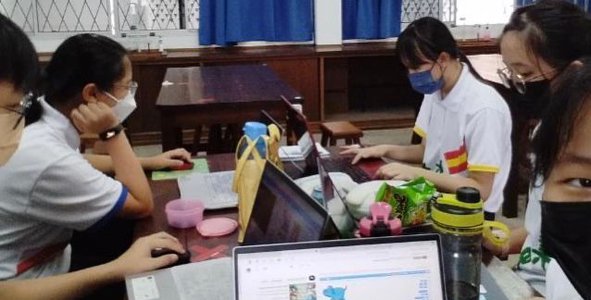
The journey was full of ups and downs.
There were conflicts yet there were also laughter.
During the development of the project, we understood that compromise is a key ingredient to teamwork.
We were attracted to this challenge immediately when we saw the "Art" aspect of this challenge and we thought about how it would be really nice to teach kids about planets and ways to prevent climate change through it. We combine the gamification technique with some arts elements in this game design.
One of our hugest setbacks was when a bug appeared in scratch, preventing the game from being played.
This had an immense impact on us as no one had any idea on how to fix it.
In the end, we are really grateful that we succeeded in remaking the project in time, improvising it in the progress.
We'd like to thank the lab assistant for always opening the door for us to the location of where we work on our project,
- our teacher for guiding us,
- the ones who created this NASA space app challenge who gave us the chance to work on this project,
- our supporting parents that had to transport us everyday and our friends that generously gave encouraging words (especially our siblings who offered to help out e.g. being a product tester),
- all the members of our team.
Overall, it was a wonderful experience that will be worth looking back to when we reach the future.
References
Tools:
- Scratch3.0- coding
- Piskel- pixel art
- YouTube- music
- Capcut - creating music video
Reference:
- https://solarsystem.nasa.gov/solar-system/our-solar-system/overview/
- https://climate.nasa.gov/effects/
- https://youtu.be/6N5p8ct5U5k
Tags
#art #pixel #code #scratch #spaceapps