Awards & Nominations
Astro Miro has received the following awards and nominations. Way to go!
Global Nominee

Astro Miro has received the following awards and nominations. Way to go!
Miro and Oliver want to assemble a legion of protectors of planet Earth, making a worldwide call for all earthlings to help protect the human race by becoming an IASC/NASA citizen scientists.So we developed the project to create a website to inspire people and facilitate access to knowledge about the Astrometrica software, a professional astronomy program to detect new asteroids using images from telescopes specialized in detecting objects close to Earth. It is part of the Asteroid Hunt program of the IASC. The website will support the extensive social media work done by Miro’s club to make NASA’s programs more accessible to kids of all ages.
For too long, citizen scientist programs have not been accessible to some of the most curious and creative members of the scientific community: Children.
Our team has made it a mission to break down the barriers of science and to inspire current and future generations, kids and adults of all ages how they can become defenders of the planet.
Our team was inspired by team member Miro Lantasio Tsai, who at 5 years old used NASA's Astrometrica program to discover 25 asteroids.
During the Coronavirus Pandemic, Miro Latansio Tsai, then 3-years-old, was watching a cartoon that depicted an asteroid falling on earth and killing dinosaurs. The cartoon sparked a curiosity in Miro that has never died down. How, he wanted to know, are we protecting the earth from another asteroid that could wipe out the human race?
Miro’s mother explained that NASA, the world’s largest space agency, together with astronomers from around the globe, monitored Near-Earth Objects in space. Miro immediately wanted to help. With his mother’s aid, he participated in the Asteroid Hunt program, in partnership with the IASC (International Astronomical Search Collaboration), NASA and Pan-Starrs (a network of telescopes located in Hawaii that aims to monitor objects close to Earth that may pose a risk to the planet).
Pan-STARRS1 (PS1) is a 1.8-meter diameter telescope located near the summit of Haleakala on the Island of Maui. It is equipped with the world's largest digital camera of 1.4 billion pixels.
Shortly after Miro turned five, he was able to participate in its first campaign, having detected numerous provisional asteroids and becoming the youngest person in the world to identify a new provisory asteroid, 2021TE29, located in the Main Belt Asteroid. Today, he has detected 25 provisional asteroids registered on the Minor Planet Center website (www.minorplanetcenter.net), which is the largest repository of information and studies on minor bodies in the solar system in the world.
 21TE29 Asteroid orbit.
Source: NASA Jet Propulsion Laboratory .

Asteroid 2021 TE29
Source: NASA Jet Propulsion Laboratory.
Miro proved that, with the right tools, kids of all ages can be defenders of the earth. He created an astronomy club that uses playful language and social media videos to explain how anyone can become an asteroid hunter and protect our “pale blue dot” for future generations. Because in science, there’s always space for one more.
Our astronomy club already has thousands of followers across social networks and messaging apps, having already taught dozens of people to hunt for asteroids and participate in other NASA Citizen Scientist projects, such as the Globe, a project that helps monitor clouds and the proliferation of mosquitoes, among others. The club counts on kids, teenagers, students, teachers, parents, and doctors as members. People from the most diverse areas and locations are learning about the asteroid hunt and other NASA citizen science programs, including the NASA Space Apps Challenge.
The NASA Space Apps Challenge program has allowed us the opportunity to spread this knowledge to an even greater number of people and to make a website with all the details of the Asteroid Hunt program in a fully accessible way. Anyone who has access to a Windows computer and internet can participate. We used NASA images to create a step-by-step guide with images and illustrations on NASA's citizen science programs. The process is described using artistic and audiovisual resources that are appealing and digestible for anyone with an internet connection.
In the Solar System there are numerous asteroids mainly located in the Mail Belt Asteroid, as can be seen in the image below the NASA gallery:

Source: nasa.gov. Main Belt Asteroids.
NASA reorganized its Near Earth Object Observations Program and established a Planetary Defense Coordination Office in January 2016 in response to the NASA Office of Inspector General’s 2014 report, “NASA’s Efforts to Identify Near-Earth Objects and Mitigate Hazards.”

Source: nasa.gov.
One it identifies NEOs and determines their orbit, NASA's Department of Planetary Defense can divert any asteroid that could pose a risk to our planet.
On September 26th, NASA's Department of Planetary Defense together with the European Space Agency, in the DART (Double Asteroid Redirection Test) mission, made the first attempt to deviate the course of an asteroid, successfully hitting the target in a very exciting, historical moment for all of humanity.


DART Team Celebrates Successful Collision
In this image from Sept. 26, 2022, the Double Asteroid Redirection Test (DART) team, Dr. Thomas Zurbuchen, and guests at Johns Hopkins University Applied Physics Laboratory cheer as they receive confirmation of DART’s collision with Dimorphos.
It is this feeling that moves us, the belief that if we unite together, we can achieve a better future and protect our planet.
At the II SIASTRO/MCTI (International Astronomical Symposium) Dr. Kelly Fast, NASA's Planetary Defense Specialist, Dr. Patric Miller, Director and Founder of IASC and Silvana Copceski, coordinator of Caça Asteroides no Brasil/MCTI, spoke about the importance of this work of identification and monitoring of asteroids where Miro was cited as an example that anyone can become a citizen scientist.
Miro has become a reference for thousands who believe that they can also be citizen scientists and participate in projects that help protect the planet.
About the Asteroid Hunt program.
The Asteroid Hunt Program was created by Dr. J. Patrick Miller, to spread science and make it accessible to as many people as possible.
Dr. Miller is a professor of mathematics at Hardin-Simmons University in Abilene, TX, where he teaches introductory astronomy and astronomical research methods. He founded IASC in October 2006 and serves as the Vice-President of the Permanent Council of the Global Hands-on Universe Association.
The IASC works in partnership with NASA and the Pan-Starrs telescope complex, located in Hawaii, United States. Its objective is to identify near-Earth objects that may pose a risk to the planet.
Through this project, people from all over the world will learn to use the Astrometrica software, provided by the IASC and which can be downloaded from the website, to analyze images from the Pan-Starrs telescope network and send a report to the IASC.
The IASC team analyzes each report that detects an asteroid. It registers this detection on the MPC (Minor Planet Center) website, so that the preliminary asteroid continues to have its orbit studied, until its status as an asteroid is confirmed or tossed away.
With the objective of popularizing science, the IASC establishes partnerships with educational institutions and governments, to help disseminate and training people in the process of asteroid hunting.
The Astrometrica software only runs on computers with a Windows operating system and to download the telescope images from the IASC website and later send the reports, internet is needed, as well as to register in the program. Therefore, a computer with access to Windows and internet are required.
Astrometric with an image of Pan-Starrs 2 for training the IASC/MCTI Asteroid Hunting program.
Images from the space agencies were inspiring because they were able to give a real-life perspective on the risk posed by Small Bodies Near Earth.
Images from the DART project illustrated the science in action on November 24, 2022, when NASA's Department of Planetary Defense together with the European Space Agency, in the DART (Double Asteroid Redirection Test) mission, made the first attempt to deviate the course of an asteroid, successfully hitting the target.
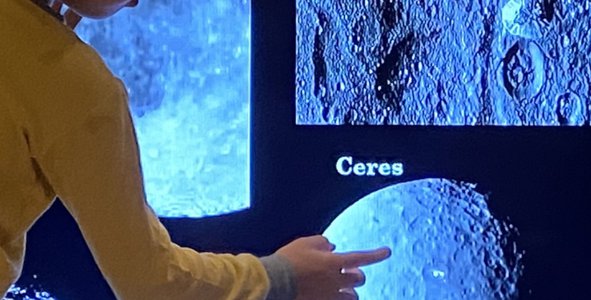
Similarly, we used images of planets in the middle of the Mail Belt Asteroids to demonstrate how our space neighborhood is full of asteroids and illustrate the risk we run.
We were also able to pinpoint where exactly the Mail Belt Asteroid is in our solar system, and how the department of planetary defense at NASA works and how it came about.
Using an asteroid detected by our team member Miro, we were able to demonstrate how asteroid detections are monitored by NASA and how to find information on these small bodies on the NASA Jet Propulsion Laboratory website, including the asteroid's orbit.
Showing photos of NASA experts at Planetary Defense in the aftermath of the success of the DART mission, we can get an idea of the size of the work that dozens of people put into a single mission: saving the planet. The children get a taste of how exciting it is to feel that we are better protected now against external asteroid threats.
We used Astrometrica images to demonstrate the process of detecting unknown asteroids and how the Hunt Asteroids program works.
We used images from NASA's Jet Propulsion Laboratory to explain NASA's defense department role, the DART mission, and to illustrate the orbit of the asteroid detected by Miro.
Images from the European Space Agency the Pan-Starrs telescope were also used to demonstrate how asteroids are visible in the Astrometrica program.
The inspiration to develop this project came from Miro, who at age five detected 25 provisional asteroids registered on the Minor Planet Center website. Miro's passion for science influenced thousands of people to become citizen scientists including our team member Oliver, who, at age five, is one of the first members of the club living on the other side of the planet. We tackled the need to have better mechanisms for scientific dissemination and to make science more accessible to everyone.
The project taught us how to better navigate NASA's citizen scientist programs, the shortfalls of the current explanations for children, and how to illustrate and describe science in a language that kids can understand.
We would like to thank Miro's father, Jack, who helped us make the website, edit the videos and support the development of the project by participating in brainstorms.
And also to Marco Linhares, head of NASA Space Apps Challenge Campinas, and his entire team from Campinas/SP, Brazil, who were sensational in the elaboration of this project.
We would also like to thank all IASC staff, in particular Dr. J. Patrick Miller and the MCTI team, especially Silvana Copceski and former minister and former NASA astronaut Marcos Cesar Pontes for the fantastic opportunity, and to Marco Linhares, head of NASA Space Apps Challenge Campinas, and his entire team from Campinas/SP, Brazil, who were sensational in the development of this project. Finally, we would also like to say a big thank you to the inspiring NASA Space Apps Challenge team, for actively helping to make the world a better place for everyone.