
High-Level Project Summary
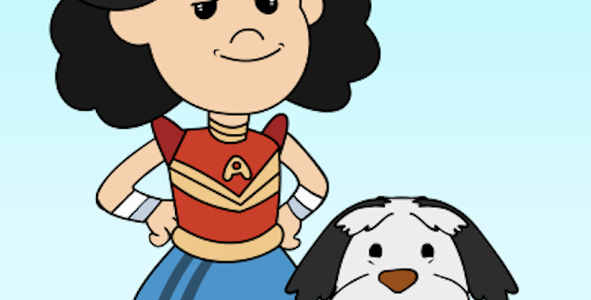
Problem: The gifts of one of the greatest astronomers of all time are only known by a fraction of humanity. Those that comprehend the secrets unlocked by Kepler's laws mirror the socioeconomic profiles of those most likely to take a calculus class in high school.We built an editable lesson plan disguised as a YouTube game in two days. It uses Kepler's face and body to convey the essence of Kepler's first and second laws to anyone that knows how to read.
Link to Final Project
Link to Project "Demo"
Detailed Project Description
Problem: The gifts of one of the greatest astronomers of all time are only known by a fraction of humanity. Those that comprehend the secrets unlocked by Kepler's laws mirror the socioeconomic profiles of those most likely to take a calculus class in high school.
Unfortunately, the entry-level math vocabulary of astronomy is a barrier to understanding Kepler's first two laws.
Solution:
We built an editable lesson plan disguised as a YouTube game in two days. It uses Kepler's face, name and body to convey the essence of Kepler's first and second laws to anyone that knows how to read. Faces, names and bodies are learned long before words, symbols and numbers, so we believe that support our approach..
Background: Wikipedia states, "Johannes Kepler's The three laws state that: The orbit of a planet is an ellipse with the Sun at one of the two foci. A line segment joining a planet and the Sun sweeps out equal areas during equal intervals of time. The square of a planet's orbital period is proportional to the cube of the length of the semi-major axis of its orbit."
(Wikipedia)
Although this is an excellent summary by Wikipedia, it is not approachable by the vast majority of children, grandparents, and others in the US based on participation rates in STEM classes. We validated these statistics through interviews with a handful of parents, children, aunts, and others.
Here's a copy of NASA's description of Kepler's laws. NASA's language here seems approachable by many based on based exploratory research.
- Planets move in elliptical orbits with the Sun as a focus.
- A planet covers the same area of space in the same amount of time no matter where it is in its orbit.
- A planet's orbital period is proportional to the size of its orbit (its semi-major axis).
https://solarsystem.nasa.gov/resources/310/orbits-and-keplers-laws/
Kepler's Laws can be simplified, in our opinion, sufficiently to allow a first or third grader to get a grasp on the first law within 5 minutes. Kepler's Second law can be explained with three sessions of 5 minutes, 15 minutes total.
The third law requires at least some knowledge of areas and volumes, so multiplication (squares/cubes) helps but can be overcome with manipulatives. Examples of manipulatives are:
- Wooden cubes in a box.
- Water in a vase.
- Cutting a pizza in various unconventional ways.
Space Agency Data
https://www.jpl.nasa.gov/edu/pdfs/exoplanets_answers.pdf
Hackathon Journey
We are grateful for the opportunity to make something useful in 48 hours that we believe can make science accessible to a broader range of families. We learned the most by testing our YouTube baed game on parents, their children and adults.
The background music is from an original composition by me and my six year old daughter (the voice over performer in our YouTube STEM Game), We used it previously in a math song with vocals, but edited the background music to highlight the "mi-fa, mi-fa" frequencies of Earth's journey mentioned in Kepler's writings.
We designed the videos so they could be cut, chaptered or otherwise incorporated into software. We tested a chatbot and a voice bot that accepted user input and advanced to the next clip/chapter accordingly. But given the time constraints of all hackathons we were not able to get the logic to work sufficiently for presentation.
We recognize that our six year old team member isn't a typical use case.
Here's a video of her factoring a polynomial at 4.
Reading six grade sight words fluently at the same age.
https://bspray.me/6thGrSightWords
Reading and counting at two years old.
But we also know that if we hadn't tried to teach her those things, it's unlikely she would have learned them before school. We hope others are inspired by our efforts here to learn things earlier and faster than most experts believe possible.


References
https://www.jpl.nasa.gov/edu/pdfs/exoplanets_answers.pdf
Tags
#art, #steam, #stem, #games, #kepler, #music, #brainsprays, #algegirl, #isabellacarveryi