Awards & Nominations
Nasantara has received the following awards and nominations. Way to go!
Global Nominee

Nasantara has received the following awards and nominations. Way to go!
We, young Indonesian educators, are enlightened by NASA's Next-Gen STEM. It inspired us to design learning materials to motivate students and teachers holistically. Hence, NASANTARA is born.NASANTARA (short from NASA Nusantara) is an Open Educational Resources (OER) of Hybrid Traditional Games-Based Instructional Design for Teachers in Indonesia. Teachers will have access to teaching materials about NASA’s mission & research that have been transformed into engaging traditional games for EFL/ESL learners. It amplifies science with art of representations to act as a medium for learning. NASANTARA will bridge NASA findings to teachers in Nusantara to teach students about space in a fun way.

Figure 1: https://www.science.org/doi/10.1126/science.338.6107.592
Ideally learning should be made accessible for teachers as the instructor and engaging for students to learn. However, in the status quo, teachers from several districts in Indonesia are having limited access to instructional design for materials related to STEM. According to World Bank (2020) materials for Learning in Indonesia are lacking: fewer than half (47,4%) of the students in schools had a textbook for the subjects observed.
Indonesia lack of access is also widely spread in all across different districts which affects students' learning. Around 70% of children in Indonesia are struggling to showcase basic literacy competency on the Program for International Student Assessment (PISA) 2018. Indonesia ranked 73th in math, 74th in reading, and 71 in science out of 79 assessed countries (PISA report, 2018).
Underprivileged students and teachers, such whose families socioeconomic fall below poverty line, live in remote areas (World Bank, 2020). The vast resources on the internet are layered by language barriers as English as a Foreign Language (EFL) learners hinder educators from accessing and adapting materials from the internet to the classroom. A new accessible platform with authentic multi-modal is needed.
Figure 2: P2G (Association for Education and Teachers) utilizing Indonesian MoE initiative in 3T regions (62 districts in Indonesia lacking of infrastructure & technology)
NASANTARA is an Open Educational Resources (OER) which bridges the current research to teachers and schools. It opens opportunities for accessible STEM instructional design materials for teachers to use for free while authentically embedding folk arts elements in the activity with the traditional Indonesian games. The instructional design to update STEM content derived from, including but not limited to, NASA or partner space agency science research projects, and other open resource research. We transformed STEM into STEAM through traditional games and the possibility of easier access for teachers to use. According to UNICEF survey and ISEAS – Yusof Ishak Institute research review (2020), the main modalities used by teachers and students in Indonesia are online learning and printed materials. Hence, we accommodate the teachers' needs for materials design through NASANTARA.
For our pilot project and first iteration, we foreground our materials based on traditional games that are existing collectively within these sample districts derived from the World Bank (2020) report.
Figure 3: Map of sampled district
First a teacher goes to https://nasantara.github.io/nasantara to choose the content and materials needed for them to teach. Once they download the materials, the teacher could prepare the materials needed for teaching.
Teachers could review the lesson sequence, adjust for their learners if needed. Open the content, use it right away if they are new teachers, or download and modify if they are experienced teachers.
The space slide - warm up questions to familiarize students about space since space are away from their daily live.
Teacher might wanna ask questions that students generally ask such as:
The answer slide (this is also to help teachers gauge students elicitation and how to direct them to the learning objective). This answer will also invoke curiosity from students. Perhaps doing more mini research before continuing to the next activity.
What about the moon? - this slide is aimed to invite meta-cognition and invite students to talk in the classroom. Initial engagement to the course.
Next slide - We aid teachers with info to scaffold: jump. This is relevant to all students since everyone might have known the notion of “jumping” as an activity before
We go back to earth as a thinking framework to compare jumping on the earth and on the moon.
Brief mention of gravity : essential questions. Explain concept of gravity.
Then we go back to the question about what if we jump around the moon. Funny clips about Astronaut jumping on the moon - to visualize.
Comparing the earth and the moon again. Now with gravity!
Essential question is asked. Teachers will explain formula - surprising element for students is embodied.
Connect to the traditional game: Engklek!
Back to comparison: how to play engklek on the moon?
Conclusion as reflection activity and homework to extend students learning
We hope that teachers find our OER useful and students will be motivated to learn more about STEAM. For a non-educators audience, we hope that our project will highlight that STEM could intersect with ARTs, especially Folk Arts such as Traditional Games. Hopefully this will inspire more people to have interdisciplinary collaboration for STEAM related projects.
We developed the prototype using various tools
In this pilot we took one NASA mission, but our project is applicable to other subjects. The nature of the OER as basis of NASANTARA project also makes it possible to receive contributors for the translator that might help to translate it into other local languages in Indonesia. We are planning to include more content from NASA and other Space Agency Partners to our instructional design materials. In the future iteration, we are planning to make materials adjustable through staging options based on teachers and students needs based on initial needs analysis assessment.
Our project is hosted in Github which is open for collaborations. Visit our development at https://github.com/nasantara/nasantara
As educators who are looking forward to the long overdue educational development in Indonesia, looking into the archives of the researches & data in Apollo Missions intrigued us to utilize NASA's work over decades to spark interest in STEM (and STEAM) education & how we can simplify the research and convey it to teachers who can later spread it to a greater breadth of students who are still unaware of the implications & potentials of STEM in the betterment of their future lives holistically; career, advancements and innovations in medical/health (artificial limbs, lasik, insulin pump, prescription lenses), natural disaster protections (shock-absorbers, fire fighting equipments), environment conservation (solar cells, climate change & pollution awareness, convenience (weather forecasts, internet & interconnectedness, and so on. Scientific discoveries and efforts put in by NASA along with other space agencies have helped us built the secure & comfortable lives we're living right now
The OER is inspired by the vast amount of data & subsidiaries of NASA directory, how it has innumerable factors that are helpful to a wide range of audience and we want Indonesians to be part of the audience. As a young developing country, we have a lot to work on, and have yet to tackle educational issues that inevitably comes with it; accessibility, disparities, as the largest archipelago it's to be expected that this is a monumental hurdle that we are trying to address through our project.
Here are some of the Space Agency Data we use for our project:
spaceplace.nasa.gov/what-is-gravity/en/
nasa.gov/mission_pages/apollo/videos
history.nasa.gov/spacesuits.pdf
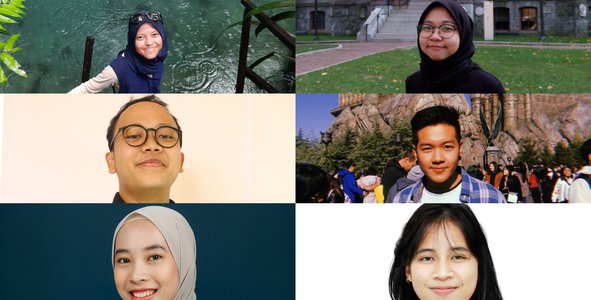
In 42 hours, we integrate ideas from six passionate people. Thanks to technology, we can work in 3 different time zones for the SpaceApps challenge! NASA's Next-Gen STEM and Indonesia's education inspired us to transform STEM into STEAM through embedding folk arts: traditional games. As former education activists, we aim to provide open and free access for teachers to use the learning materials. We hope that transforming scientific research through Games-Based Instructional Design will engage students to learn more about STEM, even further integrating arts in their learning. Having Traditional games in the learning hopefully will make students and teachers wander through space yet also still feel STEAM is something that is closer to home.
During the process, we changed our product several times. Still, it's always grass rooted in our goal to open opportunities for accessible learning materials for a teacher and now here we are with Nasantara!
Thanks to Penn GSE as our local host and the mentors for making this possible! Also thank you to all the open resources research, icons, website template, and tools providers which without them, our collaboration across continent would not be possible. <3
BPS Persentase pendulum miskin Indonesia
https://www.bps.go.id/indicator/153/1238/1/persentase-penduduk-miskin-di-daerah-tertinggal.html
NASA Apollo
NASA Spacesuits
history.nasa.gov/spacesuits.pdf
NASA ALSJ
https://history.nasa.gov/alsj/a11/video11.html
NASA Timeline
https://www.nasa.gov/specials/timeline/
NASA Apollo Mission Videos
nasa.gov/mission_pages/apollo/videos
PISA Report 2018
https://www.oecd.org/pisa/publications/pisa-2018-results.htm
Science.org
https://www.science.org/doi/10.1126/science.338.6107.592
SPACE Place - Gravity
spaceplace.nasa.gov/what-is-gravity/en/
Syawaluddin, A., Afriani Rachman, S., & Khaerunnisa. (2020). Developing snake ladder game learning media to increase students’ interest and learning outcomes on Social Studies in Elementary School. Simulation & Gaming, 51(4), 432–442. https://doi.org/10.1177/1046878120921902
UNICEF East Asia Pacific. UNICEF. (2022, September 28). Retrieved October 2, 2022, from https://www.unicef.org/eap/
World Bank Group. (2020, December 1). The promise of education in Indonesia. World Bank. Retrieved October 2, 2022, from https://www.worldbank.org/en/country/indonesia/publication/the-promise-of-education-in-indonesia
UN SDG
https://www.un.org/sustainabledevelopment/sustainable-development-goals/
Yarrow, N. B. (n.d.). Measuring the quality of Mora's education services. World Bank. Retrieved October 2, 2022, from https://documents.worldbank.org/en/publication/documents-reports/documentdetail/249751605564818092/measuring-the-quality-of-moras-education-services
#oer #education #STEAM #STEM #SDG #indonesia


