Awards & Nominations
SpaceFord has received the following awards and nominations. Way to go!
Global Nominee

SpaceFord has received the following awards and nominations. Way to go!
I-Space is a computer game that helps people of all ages to learn about the characteristics of the planets, orbits, origin, temperature, structures, atmosphere, distance from the sun, of each planet, and space as a whole, while traveling long distances in the space and visiting all 8 planets. Travelers (players) will learn and have fun while driving the spaceship, visiting the planets, opening the boxes, and passing the tests. I-Space is an application of gamification that applies educational approach and conveys real information in attractive designs and colors that can motivate curiosity in people - especially children - about space and the Solar System.

I-Space is a computer game, in which a player drives a spaceship through space and navigates the Solar System, while driving the player finds boxes with questions about space or the planet being visited, if the player gives the right answer he, she can go on to the following box and discover more about the space and planets, if the answer is wrong the space ship is getting self distructed. Eventually the game is encouraging some research and self study since this is the trend in international education, besides increasing the awareness of using STEAM in conveying useful and important information in an attractive way.
First, the user appears near the Earth planet, all 7 other planets have their boxes around their orbits, and the user aims to open these boxes and collect the disks that contain information about space and bring disks back to the Earth, however, to open boxes user needs to pass a test. The difficulty of which depends on which planet the user is visiting. By collecting disks a user can get points, which helps them to boost their spaceship. It enables them: to increase speed, increase space for disks, increase volume for fuel, and buy new skins. So the purpose of the game is to collect all disks and learn about space along the way.
Our users potentially can get the next benefits:
We hope that we can bring helpful information to the general public in an accessible way. Most importantly, we hope that this game will encourage people, especially young children to enjoy studying space and extend their knowledge about this field.


We used the data that NASA offers information about Solar System, how the planets move around each other, what properties they have, also what makes them special, and other information.
Data obtained from NASA provided us with valuable information that it presented understandably. We used this information to show it in the game in the boxes that appear in space while the player is traveling among the planets. So that the player would not feel that information is difficult, and players won't get bored while playing, we designed it so that it gradually becomes harder, which is all based on official NASA website data.
For example, we provided tests about Earth in the little boxes that appear in the orbit of the Earth ploanet.
https://www.nasa.gov/sun/
https://www.nasa.gov/content/stars-and-galaxies/
https://www.nasa.gov/feature/jpl/nasa-s-juno-will-perform-close-flyby-of-jupiter-s-icy-moon-europa/
https://www.esa.int/Science_Exploration/Space_Science/Solar_Orbiter/The_Sun_as_you_ve_never_seen_it_before/
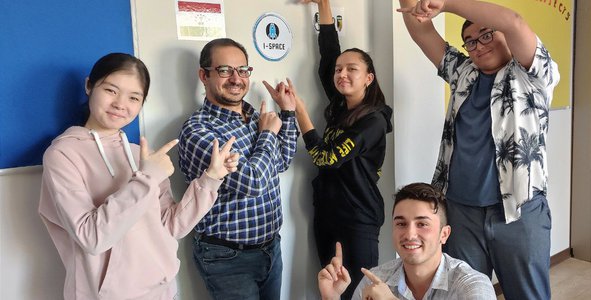
If we described Space Apps experience in 3 words, we would say: "Productive, Overwhelming, and Funny" :)
Even though we were friends, during these 2 days, we became more close to each other and enhanced our friendships. We faced a lot of obstacles and problems along the way but still our curiosity and desire to win helped us to cointinue working and finish the project. We learned a lot about space and about the Solar System as our project is related to that sphere.
We thank orginizers, American Space Dushanbe and NASA to be precise for helping us during this challenge providing us with neccessary information and designs for our game.


https://solarsystem.nasa.gov/planets/mercury/overview/
https://spaceplace.nasa.gov/all-about-mercury/en/
https://solarsystem.nasa.gov/planets/mars/overview/
https://solarsystem.nasa.gov/planets/neptune/overview/
https://solarsystem.nasa.gov/planets/uranus/overview/
https://solarsystem.nasa.gov/planets/saturn/overview/
https://solarsystem.nasa.gov/planets/jupiter/overview/
https://solarsystem.nasa.gov/planets/mars/overview/
https://solarsystem.nasa.gov/planets/venus/overview/
https://www.youtube.com/watch?v=_T8cn2J13-4
https://www.youtube.com/watch?v=zXYrHB86Kg0
#SpaceFord #space #computergame #spaceship #SolarSystem #STEAM #STEM #NASA #coding #game #gml