
High-Level Project Summary
The objective of Universe in Sight is to spread the importance of the James Webb Space Telescope in the research of the origin of the universe and its extraordinary capacity to capture light, which allows it to observe remote events, like the formation of the galaxies. The ultimate purpose of this tool is to generate amazement in the user.The starting point of this project were the concepts of “free tour” and “treasure hunt”, on which we have based to develop a game that will allow the user to learn in a fun way important facts that demonstrate the importance of the telescope for the progress of astronomy and cosmology.You can't love what you don't know much about. - David McCullough.
Link to Final Project
Link to Project "Demo"
Detailed Project Description
Universe in Sight develops in the John F. Kennedy Space Center headquarters. The player starts by choosing a language (English/español), avatar and name. Then, James Edwin Webb welcomes the user to this tour around the space center.
The player will receive a list with seven parts of the JWST. These parts will be hidden in the headquarters and the player will have to find them and assemble them as a puzzle.
The user will have to click on the elements of the list to get more information. Notice that the clues to find each part will be hidden in the information provided, but the user will not know this. Instead, he will have to discover it while interacting with the different objects in the four rooms. As he discovers the objects, they will be crossed out.
The purpose of this playful learning tool is to inform and provoke enthusiasm in the users, as we believe that games are powerful pedagogical resources.
This is the list that the user will get:
a) Primary mirror:
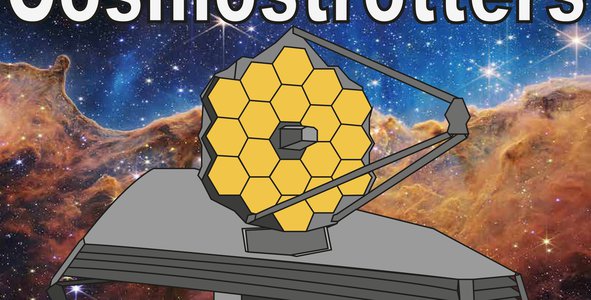
The most emblematic and important part of the telescope. The 18 hexagons made of beryllium and covered with gold allow the James Webb to collect enough light to detect remote events. It has the power to perceive infrared wavelengths, allowing it to capture images of events mysterious to science, such as the formation of the first stars and galaxies. In addition, the primary mirror allows the telescope to collect information about the atmosphere of exoplanets (planets that do not belong to the solar system), which will in turn let the scientists analyze other sources of essential resources, such as water.
b)Secondary mirror:
The mission of the secondary mirror is not secondary at all. This mirror has a diameter of 0.74 meters and is responsible for receiving the light reflected by the primary mirror and bouncing it back to the Science Instrument Module. For its deployment to be successful, two precise conditions had to be met: the presence of a microgravity zone and an extremely low temperature. In addition, there was only one attempt to carry out a display of extreme accuracy, with a margin of error of one and a half millimeters. What a challenge!
c)Sunshield:
This diamond-shaped shield is the size of a tennis court and has five hair-thin layers made of a kapton membrane coated with aluminum and silicon. Kapton is a material highly resistant to extreme temperatures, which allows the shield to provide ideal protection to keep the telescope at an optimal temperature and thus capture the infrared light emitted by stars and galaxies. After being folded like an accordion, the great feat of its deployment was successfully carried out in January 2022.
d)Star tracker:
This instrument allows the telescope to "fix" its orientation on a particular star. To accomplish this, the tracker identifies and measures the apparent position of a star and compares it to the absolute position recorded on a star catalog.
e)Antenna:
A small but powerful antenna is located at the bottom of the telescope. This is perhaps one of the most important parts of the telescope: without the antenna, the James Webb would just be a great piece of engineering lost in space with no possibility of sending data back to earth. The three receiving antennas are located in the United States, Canada and Australia.
f)Solar panel:
A six-meter long solar panel powers the Science Instrument Module and the antenna. This folding panel ensures that the satellite has continuous source of electricity.
g)Spacecraft Bus:
This module is the brain of the telescope. It has computers and communication, propulsion, navigation and structural systems.
The rooms of the game are:
- Lounge: the player will find the object #2.
- Museum: the player will find object #3, 5 and 7.
- Control room: the player will find the objects #1 and 6.
- Cosmodrome: the player will find the object #4.
In the "Museum" there will be an interactive picture with the image of the folded telescope. When the user clicks, the display of the JWST will be shown as well as a caption explaining how much time and distance it has traveled.
As a humorous device, we will use a Twitter post by Etienne KLEIN, who uploaded a photo of a slice of salami commenting that it was a photo of a planet taken by the JWST.
Other features:
- All pixel art was designed by the team.
- We used C# and Unity game development engine.
Space Agency Data
We took information regarding the JWST from various sources.
Hackathon Journey
We have learnt to reach an agreement and we have really enjoyed this opportunity to learn and develop our coding and design abilities.
References
All pixel art has been designed by the team.