
High-Level Project Summary
We developed a game that allows the player to see the power of JWST by comparing its images to old telescope photos in an interactive and fun way. In the game, you take on the role of a Nasa Data Scientist / Director and with the launch of JWST, there is a lot of old data about galaxies that needs sorting and updating. For this purpose, you are prompted with documents containing old data about galaxies in a short document template, and using JWST and data provided through other means you compare the document to the truth and judge whether the data is accurate enough to proceed or if it needs updating according to JWST
Link to Final Project
Link to Project "Demo"
Detailed Project Description
Technical Specs:
- Language: Python
- Data format: JSON
- Programming Tools: Pycharm, Visual Studio Code
- Design Tools: Photopea, Canva
- Version Control: GitHub
Description and how it works:
Galaxies, Please! is a short game where you are continuously prompted with documents bearing the Name, Old Picture, size, distance, constellation, and type of galaxies using old data gathered from previous telescopes. You can use JWST and other data provided by the game to check the validity of the document before you. Some documents will contain the correct information, some simply outdated data, but others might be completely wrong so you must make sure to not let any incorrect data slip through or not to reject any document that is fully correct, as making 3 such mistakes will see your character fired from NASA, while if you do manage to sift through all documents you will win.
Benefits and Goals:
Galaxies, Please! gives a fun and interactive way for players to learn not just about JWST but about galaxies as well, it turns data and science, which are often boring to the general public, into fun variables and a sort of implied quiz that allows a person to check their skills and knowledge in a fun way which requires little to no prior training or tools due to what data is presented and how. In addition, it provides a good first step into the world of stellar bodies and can serve as a good ice breaker for school children or those simply curious about the subject, which we hope helps increase the interest and participation in the development of wonders of technology such as the JWST
Plans:
The current gameplay loop allows for only this small description of the game, but the team is continuing to work on this project and plans to add:
- Support for Nebulas
- Improved UI and Art
- Animations
- More interactive tools for measuring the size and redshift of galaxies
- A School mode designed specifically for school children
- A Reversed more where persons are prompted with the Images and create their own documentation
Space Agency Data
https://www.esa.int/Science_Exploration/Space_Science/Webb, Pictures of some galaxies
Hackathon Journey
Why we chose this challenge:
Our team members, like many children around the world, wanted to work at NASA, be it as scientists, programmers, astronauts, or other positions, we also loved exploring space through apps such as Stellarium and Space Engine and so when we saw that there was a challenge to create a game for JWST we thought that in this game we could combine our love for observing space and dreamto work at NASA into one, thus, in the end, making Galaxies, Please!
The Development Jurney:
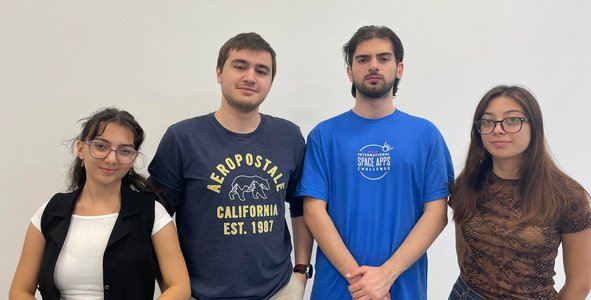
When we began development we considered several different options, one of our initial ideas was for the NASA employee that is our protagonist to use JWST to look for the Voyager space probe in a game similar to Wheres Waldo, thus the name of our team: Wheres Voyager, but we saw that this idea did not have the scalability and appeal that we wanted our game to have. We knew how difficult it can be to get into subjects like space and rocket science from an early age, something we had experienced ourselves, because of this we wanted this game to provide a gateway to the wonders of this field that lay below the surface so when we came up with the idea of turning data science and observation into a fun task inspired by a few of our own favorite games we were overjoyed and stuck right into development, dividing the tasks amongst our 2 developers and 2 artists to ensure steady and fast progress.
The Bumps in the Road:
One of our main problems was the initial lack of direction, due to many great ideas being thrown around for the first few hours we did not know what to do and were directionless. Even after we settled on the idea of Galaxies, Please! we still had some problems, mainly that we had trouble gathering the data we wanted to make the game possible at a large scale with many documents pre-prepared, but our main problems were still to come when in the final hours of development one of our developers accidentally reversed all commits they had made to the local branch of git without leaving much trace, this was devastating as rewriting those changes would have taken us hours if not more, but thankfully we managed to find a backup that had been lost amongst the mad dash of development.
Our Take Aways:
In the end, this was a very fun experience for our team, we got to spend 2 days doing what we loved: Learning about space, and programming/drawing. With this being the first true hackathon experience for some team members this event was one we will not forget and the knowledge we have gained of JWST as well as educational game design will surely aid us in our future endevours.
We would like to thank the NASA Space Apps challenge for giving us this fantastic opportunity as well as our professors and teachers that gave us the knowledge and instilled in us the love for space that helped us come up and create our project.
References
Images:
https://www.flickr.com/photos/nasawebbtelescope/ (All JWST images of galaxies) https://www.freepik.com/free-photo/beige-wooden-textured-flooring-background_17848071.htm https://pngimg.com/image/18883 https://upload.wikimedia.org/wikipedia/commons/6/6a/JWST_spacecraft_model_2.png https://www.nasa.gov/mission_pages/WISE/images/index.html https://www.spitzer.caltech.edu/news/ssc2019-15-sixteen-images-for-spitzers-sweet-16 https://www.spitzer.caltech.edu/images?subject=galaxy https://www.nasa.gov/content/stars-and-galaxies https://en.wikipedia.org/wiki/Stephan%27s_Quintet#/media/File:Stephan's_Quintet_Hubble_2009.full_denoise.jpg https://www.nasa.gov/sites/default/files/styles/full_width_feature/public/thumbnails/image/potw1036a.jpg https://cdn.esawebb.org/archives/images/screen/potm2209b.jpg https://www.nasa.gov/sites/default/files/styles/full_width/public/thumbnails/image/m74-xlarge_web.jpg?itok=CFmoryX_ https://www.nasa.gov/images/content/384667main_ero_stephan_quintet_full_full.jpg




Background Music:
https://soundcloud.com/nasa/black-hole-sonification-m87 https://soundcloud.com/nasa/lunar-descent
Fonts
https://www.spaceappschallenge.org/documents/393/2020_fonts.zip
Logos
https://www.spaceappschallenge.org/documents/694/2022_Space_Apps_Logos.zip https://upload.wikimedia.org/wikipedia/commons/thumb/e/e5/NASA_logo.svg/2449px-NASA_logo.svg.png https://upload.wikimedia.org/wikipedia/commons/thumb/a/a6/NASA_Worm_logo_%28black%29.svg/1280px-NASA_Worm_logo_%28black%29.svg.png https://www.citypng.com/photo/14001/hd-blank-empty-clear-blue-rubber-stamp-png


Tools used
Tags
#Game, #VideoGame, #Educational, #JWST, #Software, #Interactive