
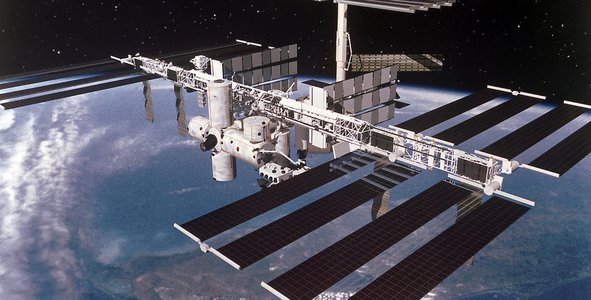
Applications that track the International Space Station are easy to find online, but their features and capabilities vary. Your challenge is to build and publish an open-source web application that tracks the space station in three dimensions.
The Challenge
Background
Many space station trackers are available online, but they often have limited features and capabilities. For example, some are bidimensional and do not provide 3D depictions. Other trackers provide some 3D depictions but show the Station as a dot or a 2D icon instead of a 3D model. Many that do provide full 3D depictions are desktop applications and are not readily accessible via a web browser. And many trackers that are fully 3D and web-based are closed-source—there's no way to access the code to learn how they work or to improve them.
Users would benefit from an open-source web application that tracks the space station and fully depicts the Earth, the space station orbit, and the Station itself in three dimensions.
Objectives
Your challenge is to use open-source software and information available from NASA to build a feature-rich web application (i.e., an application on a website that is accessible via a web browser—not a desktop application) that tracks the space station and provides interactive, 3D visualizations of Earth, the space station orbit, and the Station itself. Think about the interesting features that someone using your app might appreciate. You can be inspired by features available in existing apps (you may use NASA materials consistent with the provided guidance, but be careful not to copy or infringe upon the creative work of others), and feel free to include your own ideas, as well. Get creative!
- Your documentation should mention which NASA-produced components you utilized.
- The application should be published under an open-source license.
Potential Considerations
As you design your application, you may (but are not required to) consider the following:
- Your app can provide a wide variety of useful and fun features! For example, your space station tracker could:
- Allow users to browse the position of the space station across time (including future and past positions)
- Predict overhead passes given a geographical location
- Determine uplink/downlink connection availability by computing the line of sight to available ground stations
- Display space debris conjunction alerts in the orbital trajectory
- Display accurate representations of solar panel orientation
- Include historic visualizations showing how the space station looked at different periods in its lifetime—from launch of its first module to the last module launched in 2021
- NASA produces several components that you could use when developing your app, including software, orbital parameters, data on ground station link availability, 3D models, etc. (see Resources tab at the top of the page).
- Users may need assistance to learn how to use your app; consider providing documentation to accompany your app.
- Don’t forget to make your web application easily accessible; e.g., users click on a link and then the app runs in their web browsers. You could provide the link to your app in documentation to accompany your app. Remember to provide proper attributions for data and software components you use that come from NASA and other parties. You could list such attributions in the documentation to accompany your app or in an “About” section within the app. For instance, if you use the NASA WorldWind and TLE.js software libraries, include them in your list of attributions.
Consider using your favorite search engine to look for other existing examples of 3D space station (or satellite) tracker applications. Key words to help with your research include:
- "WorldWindLabs SpaceBirds"
- "JSatTrak"
- stuff in space
- orbit visualization
- satellite tracker
Additional search engine key words that could yield helpful information include:
- Two-line element sets
- SGP4
- TLE.js
- Satellite.js
- ISS TLE data
- ISS orbital parameters
- NASA Near Space Network
- 3D model format converter
- Free static web publishing
For data and resources related to this challenge, refer to the Resources tab at the top of the page. More resources may be added before the hackathon begins.
NASA does not endorse any non-U.S. Government entity and is not responsible for information contained on non-U.S. Government websites. For non-U.S. Government websites, participants must comply with any data use parameters of that specific website.