
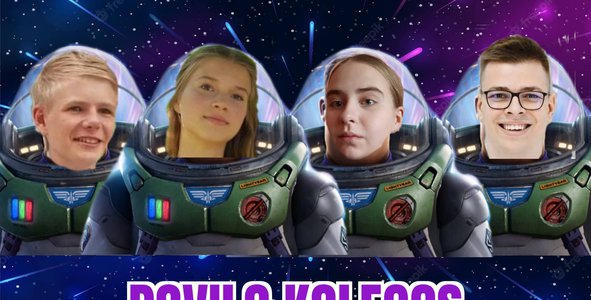
High-Level Project Summary
The 2D platform game “Starvolution“ provides children an opportunity to explore stellar variability while having fun. The game allows them to grow their own star by collecting packs of thermonuclear energy that enables transformation from one its life stage to another. The momentary transformation of the star provides youngsters with the realisation that stars are not only simple glisters in the sky. This induces extensive curiosity as to how complex and fascinating our Universe is, ultimately leading to an interest in astrophysics. This can play a pivotal role in career determination at later stages of life and simply show what it means to be able to explore the Universe as sentient beings.
Link to Final Project
Link to Project "Demo"
Detailed Project Description
The game implements astrophysics concepts concerning stellar evolution, providing a simple 2D adventure that is meant to engage youngsters on an educational level.
The player is introduced to scientific material such as thermonuclear energy, main characteristics of a star (radius, mass, age, later stages of the project would encompass chemical composition representation) and how these values change in accordance with the stage of the star. The player can navigate through the game space simply using the computer keyboard ("up", "left", "right" keys) and gather energy which grants the ability to transform the star. Different stages of the star, such as the white dwarf or the red giant, perform in different ways in accordance to specific algorithms (i.e. the shorter the radius, the smaller cavities can the star fit in, or the heavier the star, the less it can jump).
The objective of the game is to navigate the obstacles (i.e. supermassive black holes) presented in a sequence of levels of variating difficulty and to collect as much energy as possible. The game would ultimately be won when the player collects a certain amount of energy causing a supernova (this idea is not yet implemented in the prototype).
At any stage of the star the player could access real scientific information about the stage with a simple button click (key "I " on the keyboard), including its mass, age, radius and chemical composition (the prototype displays information about the white dwarf stage, excluding the chemical composition). The data provided is gathered from official NASA articles. At any given time the player can access information about the thermonuclear energy status (energy collected) on the top left corner of the screen and further information about the process by pressing the "E" key on the keyboard.
Playful animations and compelling graphics attract additional attention, thus making the main objective of prompting youngsters’ interest in astrophysics ever more attainable. The project was built using “Monogame” framework in C# programming language, IDE used was MS Visual Studio 2019. Graphical work was done using “Piskel” pixel art app and canva.com online graphic design tool. Demo video was created using Adobe Premiere Pro software.
Space Agency Data
We used data provided in NASA operated pages:
https://imagine.gsfc.nasa.gov/educators/lessons/xray_spectra/background-lifecycles.html (information about stellar evolution used for transitions in the game)
https://imagine.gsfc.nasa.gov/science/objects/dwarfs2.html (data about the mass and radius of white dwarfs gathered from this page)
https://exoplanets.nasa.gov/life-and-death/chapter-6/ (data about the age of white dwarfs gathered from this page)
Hackathon Journey
It was an extraordinary opportunity to hone game development skills as well as the perfect environment of team building and forming new valuable relationships. I gained extensive knowledge about stellar evolution as well as graphic design for video games. Our team was driven to create a video game, since it sounded like the perfect activity for a group of young enthusiastic programmers just starting university, and we saw this challenge as perfect to utilize our existing skills. Our approach was product-oriented: we strived to develop an actual working prototype of the game. We resolved any hardships with extensive communication and learned to be patient with the progress. We would very much like to thank each other for support and empathy along the way, as well as the organizers of this hackathon for creating an environment in which people can tackle real-life challenges and generate innovative ideas.
References
Scientific information gathered from these resources: https://imagine.gsfc.nasa.gov/educators/lessons/xray_spectra/background-lifecycles.html
https://imagine.gsfc.nasa.gov/science/objects/dwarfs2.html
https://exoplanets.nasa.gov/life-and-death/chapter-6/
Image depicting white dwarf used from this page:
https://www.nasa.gov/multimedia/imagegallery/image_feature_468.html
Fun fact about white dwarfs was found in this page:
https://www.spaceanswers.com/deep-space/five-amazing-facts-about-white-dwarfs/
Background image of the game from this page:
https://wallpaperaccess.com/purple-space
The project was built using “Monogame” framework in C# programming language, IDE used was MS Visual Studio 2019. Graphical work was done using “Piskel” pixel art app and canva.com online graphic design tool.
Tags
#space #stars #game #videogame