
High-Level Project Summary
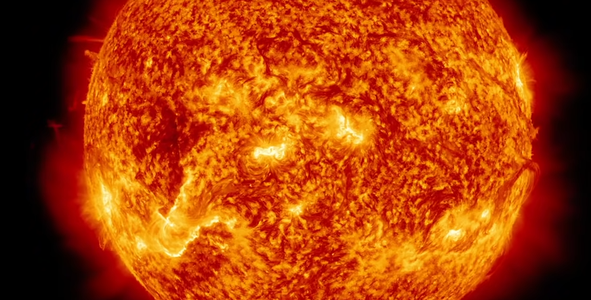
The Carrington event, which was a Coronal Mass Ejection (CME) in 1859, was one of the most intense CMEs ever recorded. With the increasing global reliance on electronic telecommunications, it is extremely important to predict such events, in order to prevent the severe damage they may cause telecommunication infrastructure in the future. With the available past data from the WIND and ACE satellites, we used machine learning (ML) techniques to create programs that could be used by predict and warn of such events by the DSCOVR satellite in the future.
Link to Final Project
Link to Project "Demo"
Detailed Project Description
The main WIND satellite hdf5 file used contained comprehensive data of several variables, which could be used to understand the occurrence of CME.
The idea was to plot the temporal variation of solar wind plasma velocity, and to identify its peaks. The higher the peak velocities, the more intense the CMEs, and hence their damage potential. If beyond a certain level, a warning could theoretically be sent from the measuring satellite to Earth before the CME hit.
We used the ACE satellite data to filter the past CME data, which was then used as an input to ML algorithms.
In parallel with the development of the basic peak detection warning system, and the production of the historical peak parameters array, and we created multiple ML models to explore the possibility of even earlier warnings, but potentially with imperfect accuracy. This involved proof of concept for their potential to predict the eventual peak velocities from the relationship between values at the start of sharp rises and a fixed short interval later.
The simpler of the two approaches we used was a linear regression model, via Boolean categorisation from solar wind speed thresholds, developed with Python Sci Kit Learn in a VS Code Jupyter Notebook. The more complex was a random forest regression model, which was also successfully able to demonstrate some learning of the relationship in the observational data.
Space Agency Data
1. ACE satellite data, from Richardson & Cane, for historical CME
2. WIND satellite data, from NASA OMNIWeb, via SpacePy, for solar wind velocity over time
Hackathon Journey
The project gave an opportunity to collaborate with a team of wonderful people from different areas of expertise. The main goal was sub-divided into several tasks, which were distributed based on individual strengths and areas of expertise. While two of us worked on the extracting and filtering the relevant CME data, the other two focused on developing ML algorithms.
References
Data
· ACE satellite data, from Richardson & Cane
· WIND satellite data, from NASA OMNIWeb
https://omniweb.gsfc.nasa.gov/
Tools
· Coding languages
-- Python
· Modules
-- SpacePy
-- MatPlotLib
-- NumPy
-- Pandas
-- Sci Kit Learn
· Software
-- VS Code
-- Jupyter Notebook
Tags
#software, #sun, #machinelearning, #prediction