- Greenhouse
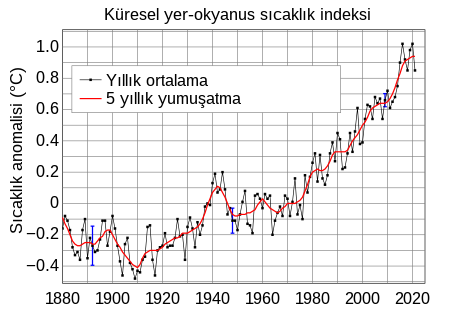
Global warming is thought to be caused by increased greenhouse gases in the atmosphere. [23] Some gases, such as carbon dioxide , water vapor , and methane , are thought to cause the earth to overheat by preventing the radiation from the Sun from reflecting into outer space on the one hand, and absorbing the heat from this radiation, on the other.

Comparative satellite images of the glacier retreat in Laguna San Rafael between 1990 and 2000 as a result of global warming.
The Earth absorbs some of the short-wave radiation from the Sun on Earth and some in the lower atmosphere. A part of the solar radiation, on the other hand, escapes into space by being reflected from the surface and atmosphere without being absorbed. The energy held on the surface and in the troposphere is dispersed to the earth by the atmosphere and ocean circulation and is given back to the atmosphere as long wave ground radiation. A significant portion of the long-wave radiation emitted from the earth is again absorbed by the atmosphere and is released at high latitudes and low temperatures, where it receives less solar energy.
This natural process that causes the earth to warm up more than expected and regulates the heat balance is called the greenhouse effect , since the gases in the atmosphere are permeable to the incoming solar radiation and much less permeable to the long-waved ground radiation that is emitted back .
Greenhouse gases other than water vapor can have an active effect on global warming as an independent variable. For example, carbon dioxide can be extensively released into the atmosphere by the burning of fossil fuels by humans. [23] This serves as a factor that can occur independently of the average temperature of the planet and results in an increase in the average temperature.
Today, it is believed in scientific circles that the main responsible for global warming is the increase in carbon dioxide ratio. Although carbon dioxide in the atmosphere
- Through photosynthesis of green plants on land ,
- In the oceans, although it is withdrawn from the atmosphere through dissolution and absorption by phytoplankton and then the collapse of the plankton to the seabed, carbon dioxide emissions beyond the capacity of these mechanisms create a greenhouse effect on the planet. In addition, the acidification of seawater due to excess carbon dioxide was a serious problem for ocean ecology, corals and shellfish.