Awards & Nominations
Earth, Wind & Flare has received the following awards and nominations. Way to go!
 Art and Technology
The solution that most effectively combines technical and creative skills.

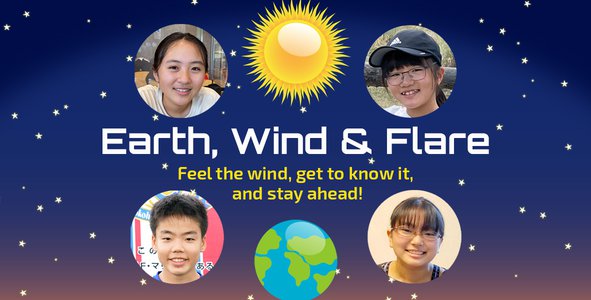
Earth, Wind & Flare has received the following awards and nominations. Way to go!
The solution that most effectively combines technical and creative skills.
We built an Internet of Things (IoT) device that publicizes space weather and its impacts on Earth in an interactive and artistic way. Our device's key elements include (1) an LED matrix board to show space weather (such as solar wind speed and geomagnetic disturbance) as well as earth weather, (2) a variety of international data sources (such as NASA, NOAA, Kakioka magnetic observatory in Japan and German Research Centre for Geosciences) and (3) visual and acoustic effects in data display, such as producing the "music of solar wind" by mapping geomagnetic disturbance data to musical elements. Our ultimate goal is to help raise public awareness of space weather.
Although space weather has significant impacts on our life, most people don’t know about it. In fact, many of our team members didn't. Most of our parents, grandparents and friends didn't either. The Sun has been more and more active these days, and geomagnetic storms will happen around 2024 or 2025, more or less. However, many are not prepared enough; some might be in panic if a storm attacks.
We are a group of 4 students who try to approach this issue by building an LED panel that shows both earth and space weather with visual and acoustic effects. It is designed to help panel viewers know and interpret space weather as they do for earth weather. It can also help them get better informed and better prepared. Ultimately, we want to help raise public awareness of space weather and its impacts on Earth.
We have diverse skills and experience: coding, Raspberry Pi hacks, music (piano and music theory) and crafting. So, we decided to use them in our project. We built an LED panel that is made up of Raspberry Pi (credit card sized computer) and a 64 pixel by 64 pixel LED matrix board. Its upper half shows earth weather, and its bottom half shows space weather. There are many LED panel products that can show earth weather on market, but we have not seen any panel that can show both earth and space weather .
We wrote Python programs for Raspberry Pi to download earth and space weather data and display that on the LED panel. Since we are an international team (three members in the Greater Boston area in MA and one in Japan), our programs use a variety of international data sources and support multiple units such as Fahrenheit, Celcius, miles and kilometers:
Earth weather data: Downloaded from OpenWeatherMap.org
Space weather data:
Our LED panel has a few visual, interactive and acoustic features to attract as many people as possible and deliver them space weather information. First, our panel can replay videos with GIF animation files. We downloaded image data of the solar K-corona that Parker Solar Probe took and configured the panel to display a few videos that are produced from those image data.
Weather icons are another visual effect that we implemented. Our panel shows different icons according to the current earth weather and space weather (geomagnetic disturbance in Kp-index). K- and Kp-index values are colored on the panel based on the NOAA scale.
Our LED panel is also motion-activated. We connected a motion sensor to Raspberry Pi so that the panel turns on when the sensor detects nearby motion and it automatically turns off when no motion is detected for a while.
For its acoustic effects, our Raspberry Pi Python program produces a piece of “music” with downloaded Kp-index values (planetary geomagnetic disturbance data) and plays it with a Bluetooth speaker. In Geosciences, Kp data are displayed graphically as an aid for scientists, and the graphical notation looks like a musical score. It is often called "Bartels musical diagrams," after the inventor of Kp-index, Julius Bartels. This motivated us to map a sequence of Kp values to musical elements, considering 3 properties of sound: pitch, duration and intensity. We also used the concepts of triads (chords), key signatures and musical scales in the mapping. LED panel viewers can listen to the "music of solar wind" and feel how solar wind sing. They can also vary it into different vibes by changing key signatures/scales.
To help raise the awareness of space weather, we plan to:
Our project web site provides hardware purchase and setup guide, circuit diagrams, Raspberry Pi setup guide, installation instructions for required software tools/libraries and ready-to-run programs. Anyone interested can immediately learn how to reproduce our LED panel. We hope you find this project interesting and useful and then learn about something about space weather. You can even join us to spread the word and data about space weather with this LED panel!
This project used the following data. Downloaded data are displayed on our LED panel and processed to produce "the music of solar wind".
When we were choosing a challenge for our project, the word "Parker Solar Probe" (PSP) caught our attention because two challenges are closely related to it. We did some research about PSP and found it is expected to uncover new findings about space weather. Some of us knew space weather, and others didn't at that time.
As we learned about sunspots, sun flares and coronal mass ejection, we were amazed at how the sun works like a blower for charged particles and how the "wind" blows in space. We were also amazed at how the Earth has a shield made from nature (geomagnetic field), which protects humans from solar wind. One of us got relieved because she had read a book about solar wind hitting Earth and deep-frying it!
We also learned how solar wind causes geomagnetic storm and how the storm can affect our daily lives. Beyond this hackathon, we are planning to research what utility companies do to protect our infrastructure from potential damage. Another plan is to study the impacts of solar wind on other planet in the solar system.
One of our team members studies piano and music theory at a local conservatory. When she saw Bartels musical score - the graphical notation for Kp-index values, she was so surprised with how similar it looks to a sheet of music. She also found that people actually had tried to play it. She really wanted to try that too.
As she applied her knowledge of music theory in mapping Kp values to musical elements, she found the knowledge worked like a fountain of ideas. It was surprising that she could use music theory for things that aren’t for music. She had a very hard time learning music theory when she first started learning about it and once thought it was kind of useless, but it came in handy in an unimaginable way and it made her feel very happy. She is thinking of producing a more musical piece with the Kp music.
All of us really enjoyed trying to make up a team name. Earth, Wind & Fire is a great band with great music, and it was funny how it perfectly fits in with our project topic! (We heard their "September" very often on the radio when we were choosing a challenge in September.)
Python programming language and its standard library
Libraries for Python programming
Data for space weather
Data for earth weather
#SpaceWeather #SolarWind #GeomagneticStorms #ParkerSolarProve #AdvancedCompositionExplorer
Several spacecraft, including the Parker Solar Probe, are gathering data about the Sun that will enable us to learn more about solar effects (a.k.a. space weather) in space and on Earth. Your challenge is to create an interactive tool to represent this data in a new and inviting way that improves public knowledge and understanding of space weather.