Awards & Nominations
Interstellar Daydreamers has received the following awards and nominations. Way to go!
Global Nominee

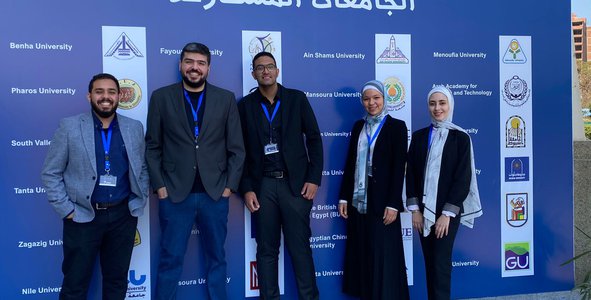
Interstellar Daydreamers has received the following awards and nominations. Way to go!
Our solution integrates Hardware and software to provide the user with an interactive yet informative tool. The hardware is a crafted model of the sum that displays the sun's atmosphere to help the user visualize the data collected from the Parker solar probe. In addition, it generates sounds and vibrations to represent the intensity of the solar wind to help the user visualize, hear, and feel the sun and the space weather. The hardware is complemented by a website to display the data in a storytelling style. The website is accessible to all users including people with different disabilities. The main goal of the project is to make an informative, interactive, and accessible tool.
This project aims to provide the public with no scientific background with an interactive tool that displays data about the sun and space weather. The data is collected from solar probes and is then displayed in a creative way. The project contains both hardware and software.
a) Software:
The project is integrated with an attractive and user-friendly website. The website displays the data collected from Parker solar probe in storytelling style to provide the user withan attractive and informative experience. The website displays images and data about space weather. It contains the most recent images of the sun, information about the aurora, data about solar wind, and information about Parker solar probe.


b) Hardware:
The hardware part helps the user feel, hear, and visualize the solar effects. The prototype consists of a model shaped like the sun that displays colors similar to images of the sun similar to the ones collected fromthe parker solar probe. Moreover, the model makes sounds to notify major space weather events like high solar wind. Since the model is a physical object, it will help the user feel the presence of the space. 


=======================================
All the data are referenced with links to provide more information about each topic. The project as a whole helps people with no scientific background at all experience the magnificent knowledge of space and space weather. In addition, the project takes into consideration people with different disabilities by not only depending on visualization but also on other senses like hearing and feeling.
Check our proposal video below : Video
Our website idea is quite user accessible as it paves the way for people with different abilities to easily use it. All the user has to do is visit the website and press START. They will be taken on a journey observing collections of solar events and sun images that displays its different states in a fun engaging story-telling form. Our approach exploits the idea of a space journey in the eyes of the Parker Solar Probe and tells its stories of the spectacular events it witnesses.
The hardware aspect is physically interactive and sensely engaging as it highlights the collected data by representing it using luring colors and dramatic sounds. Such features makes the whole experience enjoyable and can drive interests of audiences towards the sciences behind the exploration of Earth and Space.
By the end of this project, we’re hoping to achieve an informative tool that is creative and attractive to public users with no scientific background.
•Software wise:
The website will be user-friendly and accessible in a storytelling style. Users with sight disabilities will be able to use the website easily since it will be in a one-page format. Users with hearing disabilities will enjoy the visuals included on the website. All users will have a fun, enjoyable experience on the website. Moreover, they will know the journey of the parker solar probe along with the data it collected in fun and simplified ways.
•Hardware wise:
The prototype will give the user a chance to experience the sun and space weather. The prototype will display colors to imitate the sun. In addition, it will generate sounds and vibrations to indicate solar wind intensity. The higher the sounds and harder the vibrations, the higher the intensity of the solar wind. It creates dramatic effects to make the user feel they are actually touching the sun. The prototype will help them see, hear, and feel the sun.


3.Speaker 4. Male/Female Jumper Wires


5.Vibration Motor

For our project, we used the data provided by Solar Dynamics Observatory (https://sdo.gsfc.nasa.gov/data/) to retrieve the different colors of the sun and related data. This data is used to display the corresponding colors in the Programmable LEDs.
Thus providing the user with a sensible virtualization of the data.
The Scientific Visualization Studio inspired the idea of our project to create an immersive experience that provides the user with a much enjoyable experience instead of reading raw data collected from the Solar Probe
The journey was challenging yet quite fruitful. We approached this challenge with a colorful idea of implementing both hardware and software to engage with a full experience. We first started implementing the hardware on the Hackathon's first day, thinking we could finish after a full day's work. However, we faced many challenges and fallbacks during the process which slowed us down. After numerous trials and errors and different guidances we managed to pull through. Moreover the challenge nurtured our discussions and brainstorming skills, especially during the design phase. One of us even learned a new program designing tool on the spot! We certainly learnt a lot during this experience in both technical and administrative aspects. The time spent with the team and working together were the most important highlights of the journey.
[1] Real time solar wind. Real Time Solar Wind | NOAA / NWS Space Weather Prediction Center. (n.d.). Retrieved September 30, 2022, from https://www.swpc.noaa.gov/products/real-time-solar-wind
[2] Garner, R. (2017, May 30). Parker Solar Probe. NASA. Retrieved September 29, 2022, from https://www.nasa.gov/content/goddard/parker-solar-probe/
[3] Make a simple led circuit. Arduino Project Hub. (n.d.). Retrieved September 30, 2022, from https://create.arduino.cc/projecthub/rowan07/make-a-simple-led-circuit-ce8308
[4] Solar wind. Solar Wind | NOAA / NWS Space Weather Prediction Center. (n.d.). Retrieved September 30, 2022, from https://www.swpc.noaa.gov/phenomena/solar-wind
[5] NASA’s Parker Solar Probe makes second close approach to sun | space ... (n.d.). Retrieved October1, 2022, from https://www.sci.news/space/parker-solar-probe-second-perihelion-07067.html
[6]https://ar.m.wikipedia.org/wiki/%D9%85%D9%84%D9%81:Parker_Solar_Probe_spacecraft_model.png
[7] Martin, S. (2021, June 16). Solar winds travelling at 300km per second to hit Earth Today. Express.co.uk. Retrieved October 1, 2022, from https://www.express.co.uk/news/science/1449974/solar-winds-space-weather-forecast-sunspot-solar-storm-aurora-evg
[8] Waldek, S. (2022, March 13). Northern Lights (Aurora Borealis): What they are & how to see them. Space.com. Retrieved October 1, 2022, from -https://www.space.com/15139-northern-lights-auroras-earth-facts-sdcmp.html
[9] Spaceweatherlive.com | real-time data and plots auroral activity. (n.d.). Retrieved September 30, 2022, from https://www.spaceweatherlive.com/
[10] FastLED. (n.d.). FastLED/fastled: The fastled library for colored led animation on Arduino. please direct questions/requests for help to the fastled reddit community: Http://fastled.io/r we'd like to use github "issues" just for tracking library bugs / enhancements. GitHub. Retrieved September 30, 2022, from https://github.com/FastLED/FastLED
[11] Play music using Arduino Uno and a speaker. Arduino Project Hub. (n.d.). Retrieved October 1, 2022, from https://create.arduino.cc/projecthub/blackpanda856/play-music-using-arduino-uno-and-a-speaker-b94e4a
#hardware #storytelling #creative #interactive #software
