
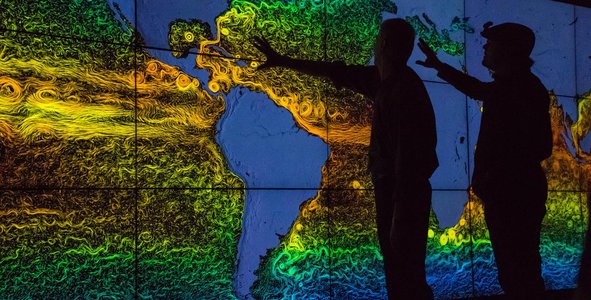
Numerous Earth visualization applications use available Earth Observation data to help us understand our planet, but some of these applications could be augmented to be even more useful. Your challenge is to select an existing NASA, Space Apps, or other open source Earth data visualization web application and improve it by incorporating one or more valuable data analysis features.
The Challenge
Background
Many outstanding Earth visualization projects have been produced by SpaceApps hackathons and other means, but what happens to these applications once they are completed? Some teams continue developing their projects, but a lot of these apps are not maintained or upgraded — even the award-winning ones.
On the other hand, there are heaps upon heaps of available data acquired by NASA Earth Observation (EO) missions such as Landsat (which has been around for more than 40 years!), and nowhere near enough data analysts and analysis tools.
Can we change these trends?
Objectives
Your challenge is to improve an existing NASA or open-source Earth data visualization application by adding one or more Earth data analysis features to it. You may choose to add features to one of the example Earth data visualization apps in the Resources section, or select another existing app to upgrade. Many different analysis tools could potentially be added to these apps to increase their usefulness — from the capability to produce general-purpose interactive charts like histograms and scatter plots, to user-interface-specific features like area selection that constrain the app's queries to a particular place on Earth, to calculations focusing on conveying information about specific domains like forest fire incidence. There is a lot of space to devise your own creative improvements!
Are you experienced with data analysis and visualization libraries that could enable one of these apps to become a feature-rich analysis tool? Have you identified a half-developed analysis feature in an app that you think you can complete? Do you have a creative idea for an analysis tool that focuses on a specific Earth data domain?
Do some investigating and think about what scientists and decision-makers would want from an Earth data visualization and analysis tool and check the listed resources for some examples of analysis features that you could potentially add.
Potential Considerations
When developing your project, you may - but are not required to - take the following into consideration:
- All three of the example Earth data visualization apps listed in the Resources section are web-based and use the NASA WorldWind planetary globe software library. They have well-written, readable code, and maintainable architecture. They are all static web applications that query external APIs. For example, How did it change? is built with the Angular framework, while the other two are written in JavaScript, HTML, and CSS.
- You may find that some existing projects have not been maintained or updated in years, and you will probably encounter errors when running them. Not only may the applications themselves have issues, the web services that they query may have changed or been taken offline. Check the service documentation if the service itself replies but the app is not producing the expected data, or consider substituting deprecated services with currently functional data sources. The Resources section contains lists of example data sources and APIs.
- Potential steps to complete the challenge could include:
- Do a brief review of existing projects, their code bases, documentation, and videos.
- Select one of the projects to work on, and download the source code.
- Try to run the project in your local development environment. Fix any issues that you may find if you don't immediately see it running.
- If at any point you decide that you would rather work on another project, go to #2.
- Add data analysis feature.
- Repeat #5 or refine the new feature if there's still time.
- Submit the updated project, publishing its source code.
- Simply providing maintenance to the original projects is considered valuable.
- Feature completeness is preferred over feature richness. Including a single, well implemented analysis feature is preferred over incorporating multiple, half-developed ones.
- Code clarity should be maintained to incentivize future hackathon participants to build upon your work.
- Publishing a live version of the project with your updates is optional, but desirable.
- If you're really confident in your work, you can submit a Pull Request with your updates for your work to be integrated into the original project. This is the spirit of Open Source!
For additional resources you could conduct an internet search to gather relevant information that may be useful. Potential search keywords could include:
- International Federation of Digital Seismograph Networks
- Web Service Specification
For data and resources related to this challenge, refer to the Resources tab at the top of the page. More resources may be added before the hackathon begins.
NASA does not endorse any non-U.S. Government entity and is not responsible for information contained on non-U.S. Government websites. For non-U.S. Government websites, participants must comply with any data use parameters of that specific website.