
High-Level Project Summary
The idea of the project is to send a lunar module to one of the poles of the planet Venus, where its temperature will be low. The module will have a graphene coating with a thin layer of porcelain, which will allow the module to be protected from ultraviolet rays and the heat of the planet. The module will have a receptacle to also receive an infrared signal and transform this signal into electrical energy, which will be used to recharge the module's batteries. The infrared signal will be sent through a laser power plant that will be installed on a photovoltaic in orbit around the planet Venus. The program will play an important role in enabling new missions to Venus.
Link to Final Project
Link to Project "Demo"
Detailed Project Description
The planet Venus is known for its high temperatures, which can reach 462 °C during the day, and can sometimes reach -190 °C at night. The planet's atmosphere is mainly composed of carbon dioxide and sulfur, which makes the planet extremely hot and dry. Due to its extreme weather conditions, the planet Venus is a difficult place for life to exist. However, the planet Venus can be an ideal place to store electrical energy. The idea of the project is to send a module to one of the poles of the planet Venus.
The module will have a graphene coating with a thin layer of porcelain, which will allow it to be protected from ultraviolet rays and the heat of the planet. The module will also have a receptacle to receive an infrared signal and transform that signal into electrical energy, which will be used to recharge the module's batteries. The infrared signal will be sent through a super-powerful laser that will be installed in a photovoltaic plant in orbit around the planet Venus.
The receptacle will be protected with a protective housing constructed so that the laser enters the receptacle through a mirror set. the battery bank and recharged according to use. the module will be equipped with a high quality cooling scheme.
Space Agency Data
https://sbir.nasa.gov/SBIR/abstracts/21/sbir/phase1/SBIR-21-1-S3.03-3308.html
https://solarsystem.nasa.gov/planets/venus/overview/
https://solarsystem.nasa.gov/resources/549/energy-storage-technologies-for-future-planetary-science-missions/
https://solarsystem.nasa.gov/news/1519/venus-resources/?
Hackathon Journey
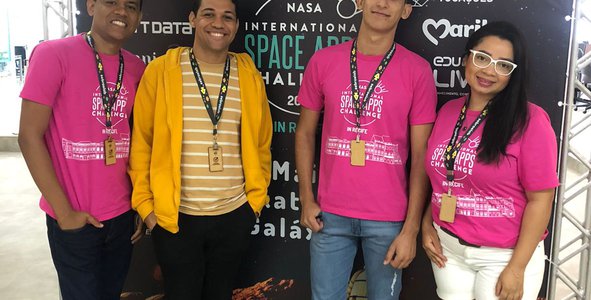
for our first hackathon, it was really surprising, lots of emotions, anxieties and fears. the biggest challenge we found was right in the formation of the group, not finding a developer and a design we had to find the "easier" challenge, that's where we got in the current challenge. the tool we used was 5w2h. we want to thank all the mentors especially stphanie grimaldi, who in the midst of a mental darkness she came with the light and gave us a north.
References
https://olhardigital.com.br/2021/08/18/ciencia-e-espaco/china-quer-construir-estacao-espacial-para-uso-de-energia-solar-ate-2030/
https://olhardigital.com.br/2019/10/28/noticias/marinha-dos-eua-transmite-energia-eletrica-usando-lasers/
https://solarsystem.nasa.gov/planets/venus/overview/
https://solarsystem.nasa.gov/resources/549/energy-storage-technologies-for-future-planetary-science-missions/
https://solarsystem.nasa.gov/news/1519/venus-resources/?page=0&per_page=40&order=created_at+desc&search=&tags=Venus&category=324
https://www.nasa.gov/feature/automaton-rover-for-extreme-environments-aree/
https://sbir.nasa.gov/SBIR/abstracts/21/sbir/phase1/SBIR-21-1-S3.03-3308.html
https://www.portalsolar.com.br/blog-solar/energia-solar/china-pretende-construir-primeira-estacao-de-energia-solar-no-espaco.html
Tags
#energy #nasa #venus