
High-Level Project Summary
Venus surface exploration is greatly challenging, due its harsh environment, with temperature of 460˚C and atmospheric pressure of 92 bars of CO2, no mission survived this conditions before. Therefore, we are proposing a developed Long-Lived In-Situ Solar System Explorer (LLISSE) which uses enhanced power source can operate and survive on Venus. This system transfers energy by a wireless transfer of power from a vehicle on Venus atmosphere to a surface lander by using a powered aircraft that harvesting solar energy in Venus upper reaches and then descend to store it in lithium carbonate high temperature rechargeable batteries which has a 723C working temperature .
Link to Final Project
Link to Project "Demo"
Detailed Project Description
- Problem summary:
The surface of Venus is one of the most challenging environments for the operation of spacecraft. With a surface temperature of around 450℃ and a surface atmospheric pressure of 92 bar of carbon dioxide, conventional power technologies are not usable. Previous missions to Venus have survived on the surface for a limited duration. Russian missions, including probes in both the Venera and Vega series of spacecraft, have successfully landed on the surface of Venus, but the longest-lived of these Venus missions, Venera 13, transmitted from the surface for only 127 min. Although the loss of transmission came because the radio-relay spacecraft moved out of range, the Venera spacecraft was not designed to operate for significantly more extended periods of time, because the electronics, power system and radio were not capable of operating after the spacecraft reached temperatures above the nominal operating temperatures. The pressure vessel containing the electronics and battery incorporated thermal insulation and phase change material to increase the thermal mass, and the electronics and battery were destroyed as the cumulative heat leaked into the spacecraft brought the interior temperature toward ambient.
In addition, Venus is a warm and dry planet. Clouds cover it in three layers (upper, middle, and lower) between the 48 km and 68 km altitude. Sulfuric acid (H2SO4) is the principal constituent of cloud particles. Also, Venus outside the Venus atmosphere is ~2622 W/m2 which is about twice the Earth AM0 extra-terrestrial solar intensity (~1366 W/m2). However, the sunlight intensity is significantly attenuated within the atmosphere of Venus.
- Problem Solution:
Our project is a service to elongate Venus’s space mission duration, by developing a Long-Lived In-Situ Solar System Explorer (LISSE) which will use an enhanced power source capable of operating and surviving on Venus surface conditions.
The LLISSE lander is conceived as a low mass (~10 kg) lander, that would support long-duration measurements on the surface of Venus (such as a seismometer) for a targeted mission of 60 days. It is anticipated LISSE would operate on approximately 10 W of power for 60 days or 14,440 Wh of total energy.
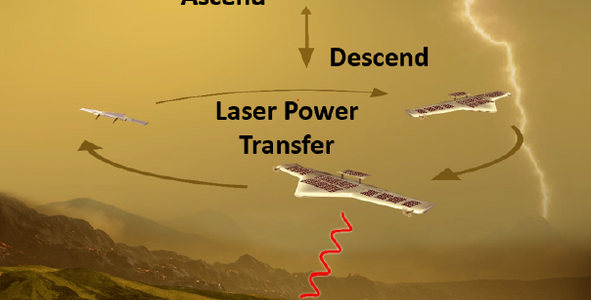
This energy system is utilizing the wireless transfer of power (WPT) from a vehicle operating in the atmosphere of Venus to a surface lander. In order to transfer energy, we are using a powered aircraft harvesting solar energy in the upper reaches of the Venus atmosphere using high-temperature solar arrays and storing this energy on onboard high-temperature rechargeable batteries. This aerial platform would then descend below the cloud deck to transfer this energy via laser power beaming, to a lander on the Venus surface. The surface lander would include a high-intensity laser power beaming (HILPB) converter for receiving the beamed light energy, converting it to electrical power, and transferring it to onboard high-temperature rechargeable batteries for use by the lander loads. Following this transfer of energy, the aircraft would ascend to higher altitudes, to initiate this cycle again.
We preferred to use a Laser for power transmitting because it has a low loss factor (20% at 1022 nm) compared to other types of waves. Short wavelength and high-power lasers in the visible and near-infrared coupled with high-efficiency LPCs derived from commercially available photovoltaic cells could enable power transfer (at least from an altitude below the Venus cloud deck) to the surface.
For the used batteries to store energy, we use lithium carbonate battery which has a melting point of 723℃ and implements ambient carbon dioxide as a reactant. By using materials available on Venus as one of the reactants in the battery, Lithium brought from Earth is effectively leveraged into a much higher amount. Also, this would allow us to produce energy by using another method; hence, the effective specific energy can be significantly increased. In addition, Lithium is a lightweight reactant and also is easily stored at Venus temperature and pressures.
Our system is designed to provide 5 W continuous power for a period of 11.6 hours (the time required for a powered aircraft to recharge and return to beam power), the stored energy and mass would be given by:
Þ Lander battery stored energy = (11.6 hours) (5 W)/(0.8) = 73Wh
Þ Lander battery mass = (73 Wh)/(120 Wh/kg) = 0.62 kg
This could be accomplished, for example, by using 12 battery cells in series and a cell capacity of 7.5 Ah.
For the aerial platform, sodium-nickel chloride with beta-alumina solid electrolyte was selected, since the aerial platform won’t be affected adversely.
In addition, we considered the acidic atmosphere of Venus, so we used fluoropolymer that can protect Venus. Altitude Maneuverable Platform and the surface lander from the Sulfuric acid (H2SO4)
Also, for the main power technology elements (laser transmitter and receiver, solar arrays, and high-temperature batteries), We are using Silicon carbide (SiC) for the laser transmitter circuit and the receiver circuit design since it can survive and work efficiently in high temperature and pressure environment, also it is mainly used in each sensor or actuator in the rover and aerial platform such as (Multifunctional sensor which measures Venus conditions and Monitors vehicle conditions),(High-temperature pressure sensor that is used for active combustion control) and (High-temperature electronic nose that is monitor engine health).
- Value Proposition
Making a long-duration mission to Venus' surface is one of the main challenges in the exploration trips and its previous solution such as Radioisotope Power Sources and conventional batteries, are highly expensive and could not survive on Venus's surface for more than two hours due to its high temperature, high-pressure carbon dioxide environment in contrary, using Wireless Power transmission combined with the battery will
- Implement the potentially ideal circumstance (abundant solar energy in the upper reaches of Venus's atmosphere) for power beaming.
- Facilitate a Venus first long mission with approximately 13 hours (equivalent to 62 days on Earth)
- Facilitate a high-temperature rechargeable battery system (Li3CO2).
- Utilize the ambient CO2in Venus’s atmosphere for the Lithium Carbonate battery reaction.
Space Agency Data
Space Agency Data:
NASA: Nasa organization sources taught us about the Russian space probs (Venera 9 and Venera 13), also we have learned a lot about the previous development of the Venus storage system such as the proposed primary and secondary batteries.
European Space Agency (ESA): The recorded data from the Russian probs provided us with information about Venus's surface conditions such as the intensity of solar energy on its surface and how does decrease as it goes down to Venus's surface atmospheric
Japan Aerospace Exploration Agency (JAXA’s Akatsuki Mission): this agency provided us with data about the dynamics of Venus's atmosphere.
Hackathon Journey
Our space apps experience opened to us a huge world to dive in it and enjoy its mysteries with the opportunities it gave us to explore a lot of things about our world that are far away. We learned about the planets and the nature in the space and specifically about Venus hostile nature which made us so curious to learn more about it and explore. So, we chose “Exploring Venus Together” to read more and develop more to make it possible that we really explore the surface of Venus. Our approach was deep research to find every information available about Venus’s surface and brainstorming to find the best idea to survive on Venus’s conditions. During the project we have met some setback, but we overcome it by discussing it and searching individually and conclude the best solution.
At the end we would like to express our excitement to be a part of this magnificent event, and would like to thank everyone, every organization and every facility that made this so easy and made us live this wonderful experience.
References
- Brandon, E., Bugga, R., Grandidier, J., Hall, J., Schwartz, J. and Limaye, S., 2020. Power Beaming for Long Life Venus Surface Missions. CALIFORNIA INSTITUTE OF TECHNOLOGY.
- NASA. 2022. Power Beaming for Long Life Venus Surface Missions. [online] Available at: <https://www.nasa.gov/directorates/spacetech/niac/2019_Phase_I_Phase_II/Power_Beaming/> [Accessed 23 September 2022].
- Bullock, M., Garvin, J., Gorevan, S., Hall, J., Hughes, P., Hunter, G., Khanna, S., Kolawa, E., Kerzhanovich, V. and Venkatapathy, E., 2009. Technologies for Future Venus Exploration. VEXAG - Venus Exploration Analysis Group, pp.3,4,5,6.
- Dorminey, B., 2019. NASA Looks into Rechargeable Venus Lander; Powered by Microwave-Beaming Atmospheric Balloon. [online] Forbes. Available at: <https://www.forbes.com/sites/brucedorminey/2019/04/13/nasa-looks-into-rechargeable-venus-lander-powered-by-microwave-beaming-atmospheric-balloon/?sh=12a8f34a5c97> [Accessed 18 September 2022].
- Del Castillo, L., West, W., Vo, T., Hatake, T., Mojarradi, M., and Kolawa, E., “Extreme Temperature Sensing System for Venus Surface Missions,” 2008 IEEE Aerospace Conference, Inst. of Electrical and Electronics Engineers, New York, March 2008, pp. 1–6. doi:10.1109/AERO.2008.4526492
- Landis, G. A. (2021). Power Systems for Venus Surface Missions: A Review. Acta Astronautica, 187, 492–497. https://doi.org/10.1016/j.actaastro.2020.09.030
- Landis, G. A., & Harrison, R. (2010). Batteries for Venus Surface Operation. Journal of Propulsion and Power, 26(4), 649–654. https://doi.org/10.2514/1.41886
- Ohring, G. (1969, September). High surface temperature on Venus: Evaluation of the greenhouse explanation. Icarus, 11(2), 171–179. https://doi.org/10.1016/0019-1035(69)90042-6
Tags
#LLISS_Explorers, #LLISS, #Venus, #VAMP, #Exploration, #Venera13, #Venera9, #NASA