
High-Level Project Summary
We conceptualize an energy storage system for the next NASA mission to Venus. To explore Venus for at least 60 days, we proposed an energy producer, storage and cooling system to power up the rover. We designed a system with no recharge time containing an mmRTG power system generating electricity. A sodium sulfur battery for storing electricity and supplying it to rover. A Stirling cooling system to maintain the operating temperature of semiconductors.
Link to Final Project
Link to Project "Demo"
Detailed Project Description

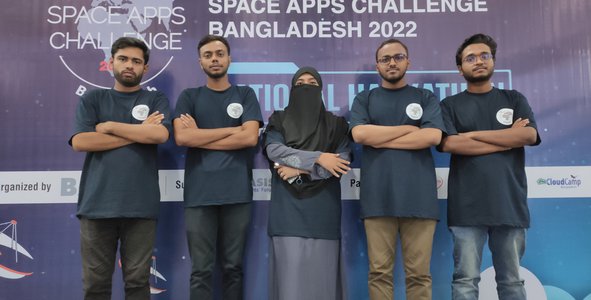
Photo: Team Venture | NASA Space App Challenge 2022
Project Scope:
Designing Energy Storage System For Venus Surface Mission
Start with a Story:
Suppose you wanna operate a mission somewhere where the temperature and pressure are too high to make the microcomputer functional, it is impossible to produce sufficient heat to power up your vehicle. What should you do then? That is the question we, the team venture, are trying to solve. Designing a powerful energy storage system for your next mission.
Milestone to achieve(Requirements)
- Operation time: At least 60 days
- Operation environment 1: Approximately ~460 °C
- Operation environment 2: Air pressure nearly 93 bar
- Battery Requirement: Required 28 Volt power system
Project Description Overview:

Fig: System Workflow
We conceptualize an energy storage system for the next NASA mission to Venus. To explore Venus for at least 60 days, we proposed an energy producer, storage and cooling system to power up the rover. We designed a system with no recharge time containing an mmRTG power system generating electricity. A sodium sulfur battery for storing electricity and supplying it to rover. A Stirling cooling system to maintain the operating temperature of semiconductors.
Project Discussion:
Designing a energy storage system for Venus mission is difficult. Because, the extreme atmospheric condition of Venus. That’s why we proposed a Radio-isotope Thermoelectric Generator(RTG) for our power source where plutonium-238 will be used for production. Then we have to store the energy. For storing, we will use NaS battery.
As Venus is very hot planet and it’s temperature is ~460 °C. Also the MMRTG will generate approximately 1200 °C, so the temperature will be so high that need to be reduce. Then we need a cooler. And, that’s why we proposed to use Stirling Cooler system which pump the heat out of the rover. The Stirling cooler transfers the waste heat to convective radiators, which efficiently reject heat to the Venus atmosphere at a temperature of 500 °C, 40 °C above the surface ambient temperature.
To operate a Rover on Venus surface, we have produce enough energy. Also we have to ensure that the production system will work on Venus harsh environment. That's why we choose MMRTG Plutonium-238 isotope. As it's a radio isotope, it generate huge heat(~1200°C), we have to cool down the inside temperature of Venus rover. And for this cooling requirement, we choose Stirling Cooling system, which can reduce temperature to 200°C. We have to consider one fact here. MMRTG generate electricity constantly. So, we need to store the electricity. For this part, we consider to use NaS battery to store the electricity. In depth discussion about these three is below:
1. MMRTG (Multi-Mission Radioisotope Thermoelectric Generator)
We have designed a system that can power up the land rover with a radio-isotope thermo-electric generator (RTG), a sodium sulfur battery to provide any shortage of power, and a cooling system in the rover. To drive a rover we need a power source that can generate or provide at least 215 watts per hour.

Video Source: NASA YouTube Channel(https://www.youtube.com/watch?v=dqBKDpfOeHc)
The RTG will provide power to the rover constantly. We proposed to use Plutonium-238 as the radio-isotope material which can provide a 0.54 watts per gram energy, at 10% efficiency it will generate 0.054 watts per gram. We have calculated 4 kg of plutonium for our system to provide 215 watts per hour energy and has an operational lifetime of at least 14 years.
RTG was used during the Apollo program to moon, in voyager 1 and 2, in Cassini to Saturn, in Curiosity, in Perseverance to mars and not a single thermocouple has failed. The plutonium 238 is an alpha emitter. Alpha particles can be very easily shielded. Even a sheet of paper is enough to protect us against alpha radiation. Its only a hazard to the human body if its inhaled or is its ingested. To prevent that we use the fuel in an oxide form as plutonium 238 dioxide. Surrounding the plutonium fuel is a material called Iridium. Iridium at these operating temperatures is very strong and very ductile. Iridium also has a very high melting point and it has a good material compatibility with the other materials found in the GPHS module. Over the last 40 years an aggressive testing campaign is engaged to prove the safety of these devices. every time they behave exactly as they were designed.
2. Battery( Sodium-Sulphur battery )
Sodium sulfur batteries can operate at 450 degree Celsius. our batteries are sized to provide 2200 Whr of energy storage and a specific energy of 220 Whr/kg (340 kWhr/m3) with an average power draw of 64.5 W. The purpose of this cooling system is to allow the electronics to be used in their functional temperature.

Fig: Sodium Sulphur Battery
The system allows a high-temperature silicon-on-insulator (SOI) micro-controller to be used in 3000C with ambient heat load of 110 W. The mass of this system is 1.6 kg with an astounding mechanical efficiency of 85%.
3. Cooling System (Stirling Cooling System)

Fig: Stirling Cooling System
The cooling requirement to keep the heat pipe cold-side temperature at 475 K is 105 W of heat pumping. As calculated using the Stirling heat-engine design tool SAGE, the configuration that was modeled effectively pumps 100 W of heat across the required 300°C of temperature differential with an operating coefficient of performance of 0.44, requiring approximately 240 W of input power, which can be provided by an isotope power system.
Space Agency Data
We made sure to make the best use of NASA Website data for designing our power storage system for Venus land rover. In some places, we used latest research data which are published in NASA Official website to design our system. Also, the information regarding Venus environmental situation of Venus, rover technology for outer space mission and the issues and challenges regarding the constructions of a high temperature materials and electronics all are taken directly from NASA and different kinds of research facilities of NASA.
Resources Used from NASA:
- https://solarsystem.nasa.gov/resources/549/energy-storage-technologies-for-future-planetary-science-missions/
- https://www.nasa.gov/press-release/nasa-selects-2-missions-to-study-lost-habitable-world-of-venus/
- https://solarsystem.nasa.gov/news/1519/venus-resources/?page=0&per_page=40&order=created_at+desc&search=&tags=Venus&category=324
- https://solarsystem.nasa.gov/planets/venus/overview/
- https://www.nasa.gov/directorates/spacetech/niac/2012_Phase_I_venus_landsailing_rover/
- https://ntrs.nasa.gov/api/citations/20050192311/downloads/20050192311.pdf
- https://science.nasa.gov/science-red/s3fs-public/atoms/files/Venus%20Flagship%20Mission.pdf
- https://www.jpl.nasa.gov/news/press_kits/mars_2020/launch/mission/spacecraft/power/
Hackathon Journey
This is for the first time all the member of our team participated in NASA Space App Challenge Bangladesh Chapter. After getting the opportunity to participate on this prestigious hackathon, we were very thrilled as we get to work with the challenges from NASA.
We believed that the challenge "Exploring Venus Together" was such a unique concept. As the previous missions regarding Venus were very much successful but not in the surface of it for the extreme environment condition. The challenges we faced designing a energy storage system for a land rover was pretty rough and forced us to our limits. But our team member supported each other and we covered our backs each time we faced any difficulty. We wish to perform our best to be the global champion in this Space App Challenge 2022.
Overall our journey up-to this point was full of excitement and adventurous. We learned a lot about so many concept, knowledge, problem solving technique during this time and much more from our respected mentor who guided us from the very beginning of Space App Challenge 2022. We thank BASIS for arranging this glorious event and their astounding hospitality to bringing out people like us and give us the opportunity to represent ourselves in this global platform.