
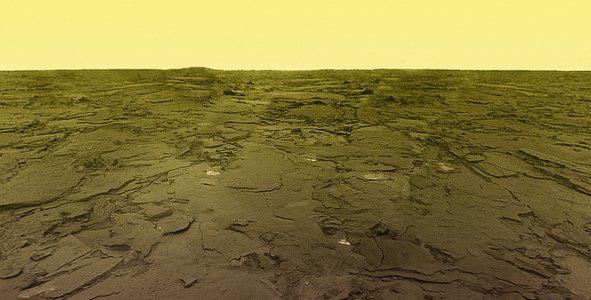
High-Level Project Summary
The lack of a long-life power source capable of operating and surviving on the Venus surface fundamentally limits the in situ exploration of this fascinating planet. An innovative mission architecture utilizing the wireless transfer of power from a vehicle operating in the atmosphere of Venus to a surface lander. The most promising architecture identified features a powered aircraft harvesting solar energy in the upper reaches of the Venus atmosphere using high temperature solar arrays, and storing this energy in on-board high temperature rechargeable batteries. This aerial platform would then descend below the cloud deck to transfer this energy via laser power beaming to rover on ground.
Link to Final Project
Link to Project "Demo"
Detailed Project Description
ew approach to support long duration Venus surface missions will be investigated, which will address the difficult challenge of surface power generation in such an extreme environment. The key mission concept centers on the use of a dual vehicle architecture—one vehicle is a high altitude platform that provides power generation in the more forgiving upper atmosphere of Venus, the other
vehicle being a lander that stores and uses the generated power to execute the mission. These two spacecraft (and spacecraft functions) are tied together via an innovative power beaming system.
Power beaming (also known as wireless energy transfer) is a means for transmitting electrical energy through various media (i.e., vacuum, air, water) via electromagnetic energy. In this case, a transmitter located on an atmospheric platform (power generation side) would beam power to a receiver (lander energy storage) through the carbon dioxide atmosphere. For a Venus mission, this would require transmitting power at radio frequency (rf) or microwave wavelengths, due to the presence of extensive cloud cover that would block optical/laser based power transfer methods. The variable altitude atmospheric platform (e.g., balloon), would descend to the lower altitudes of the atmosphere, to transmit power from its on-board high temperature batteries to high temperature batteries on the lander. On both the atmospheric platform and the lander, either high temperature molten salt or solid electrolyte batteries, or even a solid oxide regenerative fuel cell system, would serve as the energy storage medium. The transmitted rf energy would be converted to direct current electrical power on the lander via a rectifying antenna or “rectenna” constructed from suitable high temperature
materials and using high temperature SiC diodes. The specific altitude for the atmospheric platform would be chosen to optimize efficient energy transfer while minimizing exposure to the most extreme temperatures found immediately above the surface.
Once the energy from the batteries on the atmospheric platform was transferred to the lander, it would ascend to the upper reaches of the atmosphere where the solar flux is high, to recharge its batteries. Once these batteries were “topped off,” the entire sequence would repeat and the atmospheric platform would again descend to the lower reaches of the Venus atmosphere to transmit its stored energy to the lander batteries. This sequence would continue throughout the life of the lander. The landed element of the mission would continue to perform as long as its components or subsystems survived, without being limited by power. The variable altitude platform could continue a secondary science mission after the end of the landed element of the mission. During the course of the mission, the atmospheric platform could also serve as a communications relay between the Earth and the Venus lander, to support transmission of data and commands. This approach will bring together innovations in high temperature photovoltaics (which are feasible down to 20 km where solar fluxes are adequate) and high temperature rechargeable batteries (which can be used in the atmosphere and on the surface) in a new mission architecture to address the surface power challenge by separating the power generation and energy storage functions.
This aerial platform would then descend below the cloud deck to transfer this energy via laser power beaming, to a lander on the Venus surface. The surface lander would include a laser power converter for receiving the beamed light energy, converting it to electrical power, and transferring it to on-board high temperature rechargeable batteries for use by the lander loads. Following this transfer of energy, the aircraft would ascend to higher altitudes, to initiate this cycle again. The option to transfer power via microwave transmission was determined to not be technically feasible, due to significant atmospheric absorption at these wavelengths.
The LiAl-FeS2 system was developed extensively at Argonne National Laboratory in the early 1990s [43]. This battery employs a lithium-aluminum alloy anode (Li-Al), a mixed halide PAGE 16 NIAC 2019 Phase I Power Beaming for Long Life Venus Surface Missions electrolyte (LiCl+KCl) and in some cases LiBr as well, and an iron disulfide cathode (FeS2). The operating temperature range is ~375°C–450°C, with an overall cell reaction of: 2LiAl + FeS2 Û Li2FeS2 + 2Al The most advanced version employs a cylindrical, bipolar configuration with disc-shaped elements. A unit cell is comprised of discs of anode and cathode, separator, electrolyte, and intercell connectors. The anode is made from pressed powders of the alloy and some electrolyte. The cathode is made of pressed FeS2 and electrolyte.
Operating Temperature Range,⁰C 350-400 ,Open Circuit Voltage, V 1.73 Theoretical Specific Energy , Wh/kg 490 Specific Energy for
Cells, Wh/kg 90-130 Specific Energy for Batteries, Wh/kg 100,Energy Density for Cells, Wh/L 150-200 Energy Density for Batteries, Wh/L ~150 ,Cycle Life >1000. weight
Here, we will describe the development of high temperature batteries based on lithium alloy (e.g., Li-Al) anodes, molten salt electrolytes containing binary/ternary mixtures of alkali metal halides, cathodes consisting of transition metal sulfides, and designs similar to the aerospace thermal batteries.4 With FeS cathode and changes to the electrolyte composition, binder and active material ratios, we have shown improved operational life to ~20 days at 475o C in the laboratory cells. Incorporation of these design features into ~1.5 Ah prototype cells led to even longer operational life of 30 days. Furthermore, these cells have shown good rechargeability by operating continuously over 150 days at 475o C.
In order to enable extended surface missions on Venus, e.g., landers, probes and seismometers, developing advanced primary batteries resilient to the hostile conditions on the Venus surface and operational for several days with high specific energy (>100 Wh/kg) and energy density (>150 Wh/l). Here, we will describe the development of high temperature batteries based on lithium alloy (e.g., Li-Al) anodes, molten salt electrolytes containing binary/ternary mixtures of alkali metal halides, cathodes consisting of transition metal sulfides, and designs similar to the aerospace thermal batteries.4 With FeS cathode and appropriate changes in the electrolyte, binder and active material ratios, we have demonstrated the operation of the high temperature battery in prototype cells for 30 days in primary mode, and >150 days in rechargeable mode at 475oC. Further, with suitable thin coatings of inorganic compounds, e.g., Al2O3, AlF3 and AlBO3 on the cathode particles, the utilization of the cathode, and hence the operational life of the cells have been improved by another 50%.
Molten salt based batteries with Li alloys and metal sulfide cathode with optimized cell design have lifetimes of ~30 days at Venus surface temperatures. • These systems have shown good rechargeability and may be coupled with an energy generation source (e.g., wind power, solar, RTG) for extended surface studies on Venus • Strategies to improve operational life and specific energy include: • Surface coatings on FeS • New cathodes • New electrolyte with reduced cathode dissolution, may be solid electrolytes • New cell and (multi-cell) battery designs • These batteries enable new missions with extended scientific studies on the surface of Venus
For the lander energy storage, a LiAl-FeS battery was selected. Sizing was based on the following assumptions: - Operating temperature: 465⁰C - Battery-level specific energy: 80 Wh/kg - Depth-of-discharge: 60% (based on greater than 100 and less than 5000 cycles) PAGE 29 NIAC 2019 Phase I Power Beaming for Long Life Venus Surface Missions - Average cell charge voltage: 1.45V - Average cell discharge voltage: 1.30V For example, to provide 5 W continuous power for a period of 11.6 hours (the time required for a powered aircraft to recharge and return to beam power), the stored energy and mass would be given by: Lander battery stored energy = (11.6 hours)(5 W)/(0.6) = 97 Wh Lander battery mass = (97 Wh)/(80 Wh/kg) = 1.2 kg
In Conclusion we want to highlight some point as
Energy storage plays a critical role in the Venus power beaming architecture; first, to store the
harvested energy on the maneuverable aerial platform, and second, to store this energy on the
lander, as it is beamed from this platform. The lander battery supports operations, while the aerial
platform is ascending to recharge its on-board batteries. The Russian Venera series and Vega 1
and 2 Landers using conventional lithium primary batteries survived for <2 hours. in the development of high temperature primary batteries, which can provide low power levels for up to 30 days at surface temperatures [11]. For this architecture,
high temperatures rechargeable batteries are needed to support extended surface missions for up
to 60 days, at power levels of 10 W or more.
and more importantly
architectures were evaluated to enable power beaming to a lander on the Venus
surface. Calculations showed that laser power beaming from a polymeric balloon is a viable option
and is preferred over a metallic (lower altitude) balloon. Microwave power beaming does not
appear feasible from any platform. Similarly, use of an orbiting platform does not appear feasible.
Finally, laser power beaming is a promising alternative to microwave beaming, with options for
transmission from either a series of balloons, or an aircraft. Although a balloon architecture may
be possible, issues with pointing and control, combined with uncertainty over wind patterns make
this option difficult to implement.
One of the prime advantages of an aircraft is that it possesses sufficient control authority (using
standard aircraft control surfaces), to move between altitudes for alternately harvesting/beaming,
as well as to stay on target for beaming to the lander. It would be preferable to implement a type
of station-keeping flight pattern over the target, to avoid circumnavigation scenarios and maximize
the beaming time to the lander (i.e., flying in a circular path over the lander, to maintain continuous
pointing of the beaming laser to the laser power converter).
Highlighted points-
- Stored energy
- Source of energy
- Rate at which the stored energy can be used
- Self-discharge rate
- Volume
- Mass
- Operation temperature range
- Using the energy released on atmospheric entry and descent
- Use of active materials (e.g., in the case of a battery, the anode, cathode, separator, electrolyte materials)
- Whether a protective enclosure is required
- Whether the system can be operated in any orientation
- Whether the system uses in situ resources from Venus (e.g., CO2)
- Whether the system can be recharged
- Whether the system can tolerate the forces and vibrations due to launch, reentry, descent, and landing
- Whether the system can tolerate partial failure and still provide energy
Space Agency Data
https://solarsystem.nasa.gov/system/downloadable_items/716_Energy_Storage_Tech_Report_FINAL.PDF
https://solarsystem.nasa.gov/news/1519/venus-resources/?page=0&per_page=40&order=created_at+desc&search=&tags=Venus&category=324
https://ieeexplore.ieee.org/document/795965
https://www.nasa.gov/directorates/spacetech/niac/2019_Phase_I_Phase_II/Power_Beaming/
https://www.lpi.usra.edu/sbag/meetings/jan2011/presentations/day1/d1_1200_Surampudi.pdf
https://trs.jpl.nasa.gov/bitstream/handle/2014/16650/99-0040.pdf?sequence=1
https://www.researchgate.net/publication/317118709_On-Orbit_Operations_of_A_Power_System_For_Japan's_Venus_Explorer_Akatsuki
https://www.esa.int/Science_Exploration/Space_Science/Venus_Express/The_spacecraft
we used it as a reference and combined multiple ideas and research papers in order to to come up with our solution for the venus lander energy storage system.
it inspired us by giving us a direction to go in order to find our solution as the previously done research by organization such as nasa and other organizations help us in getting much need reference to the problems that any lander or rover might face on the surface of venus,it also help us in exploring different solutions and coming up with the best one according our perspective.
Hackathon Journey
WONDERFUL JOUNEY REALLY INSPIRING AND WE LEARN MANY THINGS IN THIS ULTIMATE THRILL RIDE ON THE WAY
A CHALLANGE THAT ALWAYS SEEM FAR AWAY OR IMPOSSIBLE IT ITSELF IS PROUD THAT WE FINALLY SUBMIT OUR PROJECT AND PROUD MOMENT FOR US THAT WE successfully
submit our project. we just cant believe it finally we can say its done. we have done it. thank you Nasa for giving the opportunity to all of us, For the THREE of us, this was our first time participating in Space Apps. But, with our shared interest in physics, engineering, and space, we thought the Venus challenge would be the most enjoyable and suitable for us. Only seeing the challenge for the first time on the day, may have slowed us down compared to other teams. something creative and hopefully innovative. REALLY a Wonderful experience and also we learn may things and motivate us to do something better and contribute to the mankind.
References
https://solarsystem.nasa.gov/system/downloadable_items/716_Energy_Storage_Tech_Report_FINAL.PDF
https://solarsystem.nasa.gov/news/1519/venus-resources/?page=0&per_page=40&order=created_at+desc&search=&tags=Venus&category=324
https://ieeexplore.ieee.org/document/795965
https://www.nasa.gov/directorates/spacetech/niac/2019_Phase_I_Phase_II/Power_Beaming/
https://www.lpi.usra.edu/sbag/meetings/jan2011/presentations/day1/d1_1200_Surampudi.pdf
https://www.sciencedirect.com/science/article/abs/pii/S0378775319314855#:~:text=We%20have%20developed%20new%20high,molten%20salt%2C%20and%20FeS%20cathode
https://trs.jpl.nasa.gov/bitstream/handle/2014/16650/99-0040.pdf?sequence=1
https://www.researchgate.net/publication/317118709_On-Orbit_Operations_of_A_Power_System_For_Japan's_Venus_Explorer_Akatsuki
https://www.esa.int/Science_Exploration/Space_Science/Venus_Express/The_spacecraft
Tags
#mars #venus #rover #power beam #power storage #beammin technology #storage system #battery #solar energy