
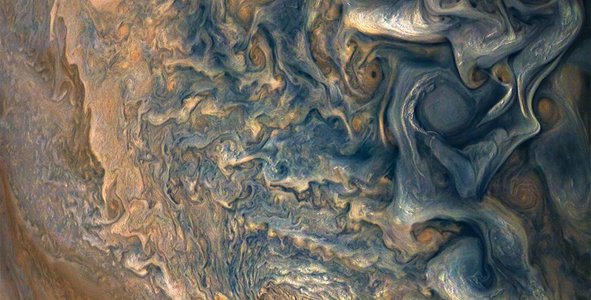
While NASA’s space probe Juno orbits the planet Jupiter and its moons, its visible-light camera, JunoCam, captures dazzling views of the Jovian system in spectacular detail. Your challenge is to create innovative ways to process JunoCam raw images for scientific, artistic, or other fun purposes.
The Challenge
Background
NASA’s Juno mission is a rotating spacecraft that is revolutionizing our understanding of Jupiter and the formation of our solar system. As part of its instrument set, the Juno spacecraft carries JunoCam—a wide-angle camera primarily used for education and public outreach. JunoCam is capturing dazzling views of the Jovian system in spectacular detail and enabling unique discoveries such as swirling, Earth-size storm clusters at both of Jupiter’s poles. JunoCam also provides the perfect opportunity to experiment with image processing and share the excitement of Jupiter’s exploration.
JunoCam takes snapshots at regular intervals as the Juno probe rotates, producing strip images representing the red, green, and blue light bands. These raw, grayscale images of the red/green/blue (RGB) bands can be downloaded from the JunoCam website and used together to produce color RGB images. The JunoCam website provides different stages of processing—raw framelets (a.k.a. raw “Venetian blind” or striped images), preliminary RGB channel images, and map-projected images (RGB channels combined).
Objectives
Your challenge is to develop an open-source image-editing application (or other free alternative) to develop color images using the three JunoCam-generated grayscale images representing the RGB colors. Experiment with image processing to generate images that can be used for scientific, artistic, or other fun activities. Some of these images may even lead to new scientific discoveries!
Potential Considerations
The strategy you develop to address this challenge may (but is not required to) include the following capabilities:
- Direct download of raw images from the JunoCam website to user computer/app
- Image processing features like brightness adjustment, color and contrast enhancement, etc.
- Instead of the preliminary RGB channel images, consider using raw framelets (striped images) to get the most useful information from JunoCam data
- Removal of any existing artifacts created by the strip acquisition process
- Alternative combinations of color channel images
- Comparison of original vs. processed images
Your application could also include the following:
- A user guide to explain how to use the app, including guidance on downloading the raw images and combining them to generate color images
- The capability to share the color images via social media and other channels
You could conduct an internet search to gather additional relevant information that may be useful. Potential search keywords could include:
- Junocam: Juno's Outreach Camera
- Junocam tutorial
- Junocam image processing
- Start processing JunoCam raw images
- JunoCam raw data processing pipeline
- Mathematica notebooks JunoCam images
- JunoCam raw image processing discussions
- Juno spice kernels
- Navigation and Ancillary Information Facility (NAIF)
- Estimating velocity information from JunoCam
For data and resources related to this challenge, refer to the Resources tab at the top of the page. More resources may be added before the hackathon begins.
NASA does not endorse any non-U.S. Government entity and is not responsible for information contained on non-U.S. Government websites. For non-U.S. Government websites, participants must comply with any data use parameters of that specific website.