Awards & Nominations
JunoGram has received the following awards and nominations. Way to go!
Global Nominee

JunoGram has received the following awards and nominations. Way to go!
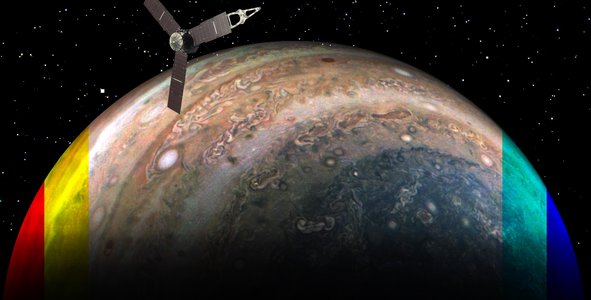
JunoGram is a site that presents processed JunoCam images and mission highlights to the public in a sharable cinematic experience. It features an interactive 4-dimensional tour of the Jovian System with the Juno spacecraft as the guide in a way that makes viewers feel like they're connected to and experiencing the Jovian System vicariously WITH Juno.Every stop on the tour is a curated rich-media postcard called a "JunoGram" (photos, videos, etc) which can be shared out on Social Media with their own commentary. Users can follow Juno on social media and it will send JunoGram messages as new data is available thereby keeping them connected throughout the life of the mission.
JunoGram takes JunoCam partially processed JunoCam images and enhances their visual appeal through a set of image manipulations and composites using native Javascript. They are then presented in a browser as a 4d simulation in the context of Juno as a guide while on its mission (using Javascript, Three.js, WebGL).
It pulls in mission telemetry from the Horizons system to render Juno's and the Jovian Systems trajectories throughout the mission.
Bright Star Catalog data is pulled in to render stars in the background of the simulation as well as to render them in the background of JunoCam images. The star coordinates and the camera's perspective are carefully matched to ensure stars are properly represented in the correct parts of the sky. Star brightness and color is also approximately rendered true to life.
It is my hope that this approach will give more context, convey more of Juno's story, and broaden the appeal and reach and awareness of the mission and its imagery.
Juno's mission overview and details (NASA / JPL) provided background and inspiration to bring more of the mission and spacecraft's story into the images and the experience of browsing them and staying connected as new images are available.
Raw and partially processed JunoCam images and metadata are used from the Juno mission web site (NASA / SwRI / MSSS) and are further processed to enhance their visual impact.
Juno and the Jovian System telemetry and orbital ephemeris are read from the Horizons System (NASA / JPL / Solar System Dynamics Group) to accurately render and animate them in 4d.
Bright Star Catalog (BSC5) are used to artistically enrich JunoCam images and provide a backdrop for the Juno's 4d trajectory simulation (NASA / GSFC / Yale).
The scope of space is vast and humbling. It has been a rewarding experience to begin contributing toward expanding humanity's perspective and awareness in that direction.
I started out working on this project with a technical focus and with grand aspirations on what I personally wanted to learn. I quickly realized that was not nearly as relevant and valuable as honing in on how I could share what I was learning with others.
Innovation in a "vacuum" will be lost to time and entropy unless it escapes that vacuum and is actively shared and remembered by all. We are all enriched through communication and media and finding as effective of a way to share it with as many people as possible is what is important.
#juno, #junocam, #jupiter
While NASA’s space probe Juno orbits the planet Jupiter and its moons, its visible-light camera, JunoCam, captures dazzling views of the Jovian system in spectacular detail. Your challenge is to create innovative ways to process JunoCam raw images for scientific, artistic, or other fun purposes.