
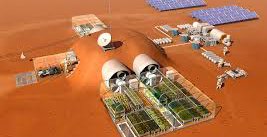
High-Level Project Summary
In the project, we deal with the integration of 3D printing technology in the creation of space habitats, based on the modern paradigm of new space, which is characterized by a growing number of initiatives to think about a sustainable space, and put in its place actions practices to be able to develop it efficiently. What are the main aspects that must be considered to design a sustainable habitat? There are three main aspects that you need to consider regarding habitat: design and development, production and manufacturing, and operation, which includes end of life and disposal. However, the main objective of this is to take the first step into life on another planet and survival.
Link to Final Project
Link to Project "Demo"
Detailed Project Description
One of the main problems is that things break over a long period of time, so the durability of the equipment will have to be substantially improved or they will have to be replaced by spare parts that will also have to be transported, which implies a greater dough. Let's keep in mind that sending more mass to Mars implies also transporting more fuel to accelerate all that cargo to Mars, slow it down on arrival at that planet, and return to Earth from there; and let's think that all that fuel (hundreds of tons) also has to be launched into space initially.
Thanks to our solutions, it was possible to replace the tools lost during the forced landing and repair the broken rover’s tire.
This is important because not only were the resources taken advantage of to have an optimal performance in the habitat but also materials were combined to provide further efficiency and practicality to the 3D printed tools and parts so that future repairs carried out on the base are carried out without major mishaps. Making the habitat a sustainable and favorable environment for off-planet development through the printing and development of new materials and techniques.
Space Agency Data
We mainly used information provided by NASA (JPL) on how to identify different types of materials on the Martian surface by means of spectrology and ultraviolet light, this was very helpful to determine what types of materials we could work with to make the impression of the objects needed in the habitat, and the open-source rover model from JPL, to take some ideas for the making of the wheel. Also we use the Canadian Planetary Emulation Terrain 3D Mapping Dataset: CSA Mars Emulation Terrain (MET) to get in touch with information about Mars terrain.
Hackathon Journey
The Space Apps event showed us that information in this era is in the palm of our hands, even with such complicated topics as a habitat on another planet and the tools that could help us form these materials such as 3D printing.
We have been inspired by this topic because of the versatility of printing and that from a design it is possible to create parts and objects from a raw material without major problems.
We resolve some of our setbacks by using FEAtools to check where our parts may fail.
References
- https://mars.nasa.gov/
- https://www.nasa.gov/analogs/media
- https://www.youtube.com/watch?v=KrtzK
- https://www.jpl.nasa.gov/edu/teach/activity/studying-rocks-on-mars-using-light/
- https://opensourcerover.jpl.nasa.gov/#!/explore
- https://accessmars.withgoogle.com/
- https://www.mdscc.nasa.gov/index.php/2020/04/07/el-rover-de-la-nasa-perseverance-obtiene-sus-ruedas-y-frenos-de-aire/
- https://astronomia.ign.es/rknowsys-theme/images/webAstro/paginas/documentos/Anuario/lasatmosferasplanetasSistemaSolar.pdf
- https://nasa3d.arc.nasa.gov/models
- https://www.nasa.gov/chapea
- https://www.coursera.org/learn/solar-system
- https://donnees-data.asc-csa.gc.ca/dataset/65376529-3z6l-6u7e-732sbzy824wa25
- https://www.coursera.org/learn/biosphere-science-future
- https://www.coursera.org/learn/newspace-access-to-space
- https://www.coursera.org/learn/astrobiology-exploring-other-worlds
- https://www.sciencedirect.com/science/article/abs/pii/S095006181630770X?via%3Dihub
- https://www.sciencedirect.com/science/article/pii/S204604302100006X?via%3Dihub
- https://www.sciencedirect.com/science/article/abs/pii/S0032591021004617?via%3Dihub
- Rull, F. & Cuadros, J. (2018). La exploración de la materia mineral extraterrestre: el caso de Marte. Enseñanza de las Ciencias de la Tierra, 26.3, 332-339. Obtained from: https://raco.cat/index.php/ECT/article/view/343193
- https://grabcad.com/
Tags
#MartianConcrete #Habitat #3DPint #Mars #Tools #NewLife #Nasa #SpaceApps