
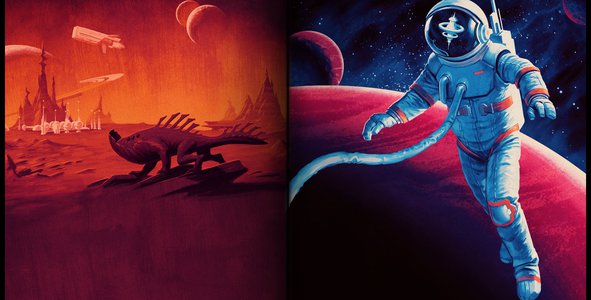
The beginning of the 22nd century marked the fifth industrial revolution focused around nano-technology. The invisible helpers of humanity have significantly increased the life expectancy of Homo sapiens, defeated most of the known diseases, opened up the possibility of the most efficient development of land, mineral and orbital resources and allowed to make many scientific breakthroughs in many areas. But every coin has two sides.
A new Malthus theorem loomed over humanity like a true sword of Damocles, but already tied to the lack of not food resources, but living space. Most urbanists and demographers predicted by the middle of the century that there would not be enough space on Earth even for a newborn child.
Such a tocsin sent a huge amount of investment into the colonization program of the Solar System. It was urgently developed and began to be implemented already in the 2110s. Due to the tight deadlines, it was somewhat risky. But along with significant finances, desperate daredevils arrived at the doors of space corporations in a real wave.
The natives of the Appalachian megalopolis enjoyed special fame. The urban agglomerations of the Atlantic Piedmont, Chipitts and the Northeast agglomeration, under the influence of the Fifth Industrial Revolution, have grown to unprecedented proportions, encircling all available space between each other with thickets of stone jungle, resembling a strange triangle from orbit.
Ashlynn Collins is a child of tens of thousands of obscure urban areas of the Appalachian, also known as the Northeast Triangle. Savvy, not picky with almost innate skills to work with electronics, she was selected for the Colonization Program of Mars.
This happened in 2127. There were only two* years left before the great confrontation of Mars, that is, the day of the maximum reduction of the distance between Mars and Earth. Due to the tight deadlines, the initial lack of training and experience, Ashlynn was enrolled in the second stream. Members of the second stream received training and courses at the Baikonur Space Center in Kazakhstan. There, each candidate received his call sign and, due to the overwhelming Kazakh-speaking majority in the contingent of the personnel of Baikonur, almost all future cosmonauts received call signs in Kazakh.
“Mariam.” Most often, this was how oblique Asians addressed her, half speaking Russian, half in their native language. They called themselves Kazakhs. During two years of living and studying, she learned to distinguish them from the rest of the Turkic peoples of Central Asia and learned a few simple words of greeting and farewell.
She said them on August 21, 2129. The head of the technical department accompanying him laughed, his eyes sparkled with deep wrinkles and his lips formed a wide smile. He answered in English already:
- We will say goodbye in three months, after the final passage of the Great Confrontation of Mars and your arrival on it. And now zholyn bolsyn.
She entered the airlock with a certain excitement. “Mariam” last saw the Earth up close for the next year and this is not taking into account the flight in two months. But she had only one way ahead, and together with ninety-nine other candidates, she boarded the Ark-3 transport shuttle. Lined up in neat rows near their cryo-capsules, the participants of the program made a roll call. Finally, after all the formalities and the accompanying speech of the commandant of the space center, they lay down inside the capsules. Ashlynn did as they were taught. She injected needles, put on a breathing mask, slowly closed her eyes and took several deep breaths…
A hazy and indistinct dream followed. It was as if she was lying in a slightly frozen coffin, looking through the ground and the lid of the coffin through a cloudy prism. The sky was grayish, one might even say dirty, but clear of clouds. At some point, the coffin lid slowly opened, like ordinary doors on hinges. Only when the double image of the gray sky cleared, she realized that it was not the sky at all, but the gray, metal ceiling of the shuttle.
She couldn't make the slightest movement, but she quickly calmed down. It was ammonia, acting like a nocturnal paralysis, in order to prevent sudden and rash decisions that could deprive a person of life. For example, torn veins in which needles are stuck. The effect passed in two minutes. She found out by gently moving the fingers of her right hand. And with them, she gently slid over the breathing mask, turning it off and then taking it off.
Clearly following the instructions, she took several deep breaths. Only after that she carefully removed the syringes, treated the injection site and sat down. After waiting out a slight dizziness and waiting for other candidates, another roll call was made and preparations for landing on the surface of the planet began.
The first month:
This month was to some extent the easiest, there was a direct connection with the Center and the main, almost the only task for this period was to arrive at the already existing, but at that time abandoned station “New Appalachians”. The station was restored by a special rover, which also filled the storages with food and water supplies for the coming year. But unfortunately, during the fearless execution of one of these flights, I got into a short-term sandstorm and was left with a broken wheel.
It was located just north of the equator, because the northern winters were 30 degrees warmer, the summer, though colder, but longer, and it was quite suitable for relief, mainly represented by plains.
Although the arrival took almost the whole month, it happened without any special incidents, she safely said goodbye to the Center's team until the end of the next month. It was attached on the eve of a four-month sandstorm and dragged the rover inside the stations.
Month two:
The storm began almost immediately after the end of the first month. Therefore, she was forced to be left alone with 3D printers, a rover with a broken wheel and a plan developed by the Center for a one-year mission. But she treated this plan for three 3D printers with a certain distrust, because, according to rumors, it was developed by a team of trainees who had only recently joined Baikonur, but what was, was. Therefore, she first set about restoring the wheel, which was easily replaced.
After that, already following the plan, she printed out a hammer for geological work with rock accumulations.
 Nurbol Myrzash
 Damir Maratov