
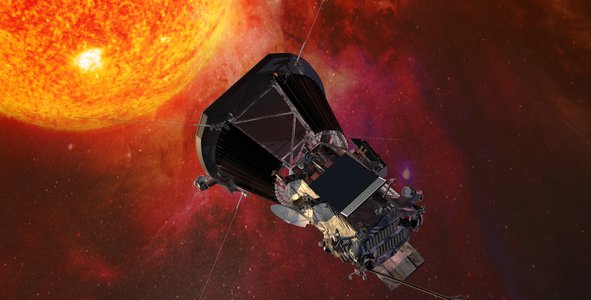
On April 28, 2021, during its eighth flyby of the Sun, Parker Solar Probe did what no other human-made object has ever done: it “touched” the Sun—meaning the spacecraft flew through the Sun’s upper atmosphere (the corona) and sampled particles and magnetic fields there. Your challenge is to develop a creative way to tell young audiences the inspiring story of Parker’s record-breaking journey from Earth to the Sun and all the perils it overcame on the way.
The Challenge
Background
Parker Solar Probe launched in 2018 to explore the mysteries of the Sun by traveling closer to it than any spacecraft before. Three years after launch and decades after its conception, Parker finally arrived.
Unlike Earth, the Sun doesn’t have a solid surface. But it does have a superheated atmosphere made of solar material bound to the Sun by gravity and magnetic forces. As rising heat and pressure push that material away from the Sun, there is a point in space where gravity and magnetic fields are too weak to contain it.
That point, known as the Alfvén critical surface, marks the end of the solar atmosphere and the beginning of the solar wind. Solar material with the energy to make it across that boundary becomes the solar wind, which drags the magnetic field of the Sun with it as it races across the solar system to Earth and beyond.
Until now, researchers were unsure exactly where the Alfvén critical surface lay. Based on remote images of the corona, estimates had put it somewhere between 10 to 20 solar radii (4.3 to 8.6 million miles) from the surface of the Sun. Parker’s spiral trajectory brings it slowly closer to the Sun and during its previous few passes, the spacecraft was consistently below 20 solar radii (91 percent of Earth’s distance from the Sun), putting it in the position to cross the boundary – assuming the estimates were correct.
On April 28, 2021, during its eighth flyby of the Sun, Parker Solar Probe encountered the specific magnetic and particle conditions at 18.8 solar radii (around 8.1 million miles) above the solar surface that told scientists it had crossed the Alfvén critical surface for the first time and finally entered the solar atmosphere to “touch the Sun.”
Objectives
Your challenge is to develop a creative way to tell young audiences the story of how Parker Solar Probe became the first human-made object to enter the Sun’s atmosphere—including all the dangers Parker Solar Probe encountered and overcame on its way to the Sun and what lessons we could learn from Parker’s journey.
You may use any medium you would like to tell the story including original poetry or spoken word, song lyrics, a short story, a comic strip, a board or video game, interpretive monologue, etc.
Think about how your story can include:
- A clear plot (beginning, middle, and end)
- Character conflict (How does the character struggle with something? For example, the struggle can be with itself, another being, nature or natural forces, technology, etc.)
- Simple explanations of space weather phenomena that Parker encounters on its journey—including extreme temperatures, dust, the solar wind, and solar storms—and how these phenomena can impact life on Earth.
- Parker Solar Probe’s interactions with Venus (gravity assists).
How can you educate and excite young audiences about this remarkable record-setting mission?
Potential Considerations
As you design your project, you may (but are not required to) consider the following:
- Other phenomena created by the Sun, such as eclipses and aurora.
- The design of Parker Solar Probe’s heat shield.
- Parker Solar Probe’s records – fastest human-made object and first human-made object to touch the Sun.
- What we’ve learned about Venus from Parker Solar Probe.
- Earth’s upper atmosphere (ionosphere) – where the International Space Station orbits.
- Earth’s magnetosphere – created by the Earth’s core and protects us from the Sun.
- Lagrange Point 1 (L1) – the place between Earth and the Sun where the gravitational pull of the two large objects precisely equals the centripetal force required for a small object to move with them.
For data and resources related to this challenge, refer to the Resources tab at the top of the page. More resources may be added before the hackathon begins.
NASA does not endorse any non-U.S. Government entity and is not responsible for information contained on non-U.S. Government websites. For non-U.S. Government websites, participants must comply with any data use parameters of that specific website.