
High-Level Project Summary
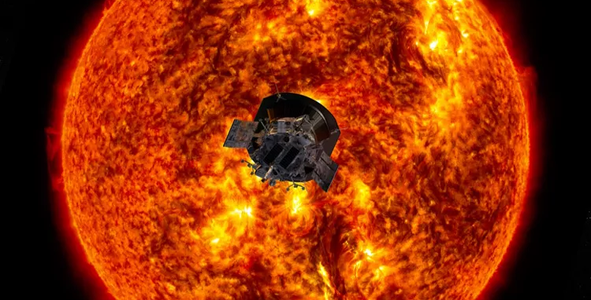
Our project aims to tell young audiences the story of the Parker Solar Probe and how it is helping science increase studies about our star, even touching the Sun.The big question we asked ourselves initially was, "How are we going to arouse curiosity in young people to hear this story?" And even more: "Where do we need to tell this story?".It was in search of these answers that we developed our platform and video series to attract and make the public curious about this journey.
Link to Final Project
Link to Project "Demo"
Detailed Project Description
Our project aims to tell young audiences the story of the Parker Solar Probe and how it is helping science make a leap in studies about our star.
The big question we asked ourselves initially was, "How are we going to arouse curiosity in young people to hear this story?" And even more: "Where do we need to talk about it to get the attention of this audience?".
It was in search of these answers that we thought of social networks. Nowadays, everyone is connected through them, and video consumption in Brazil takes up a large part of our screen time. When we thought about where the young public would be, it was impossible to escape from TikTok and Instagram. Our idea then starts with the creation of short videos that catch the user's attention through curiosities about our solar system. That directly affects life daily, bringing a connection with their reality and making them want to understand better what we are talking about. After getting the necessary attention, the video leaves a link to a platform, and it is there that we will tell the Parker probe's journey.
As we have an interested audience and also covering those with disabilities (visual and auditory), the idea is that the platform is interactive (using next.js with hosting vercel), with a brief automatic introduction a 3D globe (in space) appears on the screen for us to tell the origin, manufacture, and launch of this mission. At the end of these curiosities, the next action element appears on our screen, the orbit the mission will follow, telling us a bit about the challenges and adventures needed to reach the destination. Again, in the end, the next action element appears, and it is Venus to tell us about the probe's first passage through it and what to expect at the end of the seven that are planned. Continuing, we have the Sun, the big destination of this story. Here, we tell how it was to reach the corona and what this provides for science, and of course, for everyone!
Behold, we have reached the final point of the platform, called "We are here", a path between the orbit of Venus and the solar corona, which will repeat until the maximum approach to our star. That makes it clear that we are just at the beginning!
The platform may seem simple, but it guides the story and makes the user participate step by step in what happened, of course, briefly and in a simplified language for everyone's understanding. We can take advantage of the power of digital influencers to make this experience even more interesting for the public! Here in Brazil, for example, we have very famous streamers between the ages of 10 and 18 who, in this context, could narrate the explanatory text boxes, perhaps even make the initial video on social media, to engage a larger number of young people. Speaking of a larger number, this solution was meant to tell the Parker story, but what if it was hosting several mission stories? With an account for short videos on various topics to spark a desire to explore the universe? We would have not only a story in our minds, but the conception of the value of all space exploration, don't you think?
And as a way to mark our team's visual identity, so we created a logo using the vector image editor Adobe Illustrator, we created a logo to provide integration between the proposals parts. NASA could use this logo: NASAlturas, an agglutination of the government agency's name, and the word "Alturas" - "high" in Portuguese. Through Myriad Pro typography, the NASA element had been transcribed (regular, in 36pt, in white), as it is close to the one used by the organization in the NASA SPACE APPS 2022 event, and the heights element presented with the family SWIsop1 (regular, at 36pt, in white). The symbol was Flare Toll formatted, to resemble refractions of light seen in telescope lenses, the light of the Sun or planets. It can emulate different images depending on the interpretation and the applied look (it has a color palette involving shades of gray, brown, red, and green), adding meaning as NASA encourages creativity in the perception of things. The final version is a clean image, made to be used on black backgrounds (by contrast) to interconnect the virtual spaces used and maintain the conceptual integrity composed by the NASA emblem.
Space Agency Data
In our project, all data used comes from the NASA website (https://www.nasa.gov). In addition to the resource links provided, we also performed research within the NASA website to obtain more specific information about subjects such as: the Sun's magnetic field, Lagrange points, Gravitational Assist, and more prominent curiosities of the mission. All this information was necessary for us to really understand the magnitude of the journey and how the data collected could improve our knowledge about the origins of some phenomena that occurs in the Sun.
Hackathon Journey
We were challenged in several aspects, such as time management, leadership, teamwork and process organization. The fine line between "getting out of the box" and achieving a viable project in time with a great understanding of the public, was another learning experience.
Through a selection of projects that each person in the group identified with, we held a defense meeting, reading challenge by challenge, and we understood that this one caught everyone's attention. A priori, telling a story seems simple, but we saw that it is a much bigger challenge than we imagined, because we needed to conquer the young audience so that they hear what we have to say.
That said, we decided to divide ourselves into two groups: research and development, one complementing the other. We worked using agile methodologies and fluid communication, so that regardless of the process, everyone was aware of what was being produced. Different opinions lead to conversations and arguments regarding the time of the project. We also had moments of "relaxation" that reduced the stress, so we had an united team with great confidence to achieve our main goal. We had the help of all the mentors and people involved in this event, and to them we say thank you, for the opportunity to challenge ourselves and to believe that we could make it. We also thank the speakers, who shared their knowledge with us, and finally, the members of this team, who worked hard to follow the deadline.
References
https://www.nasa.gov/
https://www.nasa.gov/feature/goddard/2021/nasa-enters-the-solar-atmosphere-for-the-first-time-bringing-new-discoveries
https://blogs.nasa.gov/sunspot/2021/12/11/solar-tour-pit-stop-9-the-solar-wind/
https://blogs.nasa.gov/sunspot/2021/12/08/solar-tour-pit-stop-6-l1/https://www.nasa.gov/feature/goddard/2021/Parker-Discovers-Natural-Radio-Emission-in-Venus-Atmosphere
https://www.nasa.gov/sites/default/files/thumbnails/image/parker_close_to_sun.png
https://blogs.nasa.gov/parkersolarprobe/2018/08/07/launch-week-begins-for-parker-solar-probe/
Tags
#SpaceExploration #Sun #Arts #ParkerChallenge