
High-Level Project Summary
We have developed an informative video about the Parker Solar Probe sent by NASA. The main aim of developing this project is to impart knowledge about the PSP mission in a gripping way. It interestingly tells the story of the journey of the probe to the sun through audio-visual medium. It has wide variety of pictures & animations that make it worth watching. It provides all the basic information about the PSP. It also provides brief information on its sturcture & path. It also enlightens us about the objectives of this great mission. This project can be useful in making people aware about our progress in the field of space & sun.
Link to Final Project
Link to Project "Demo"
Detailed Project Description
INTRODUCTION
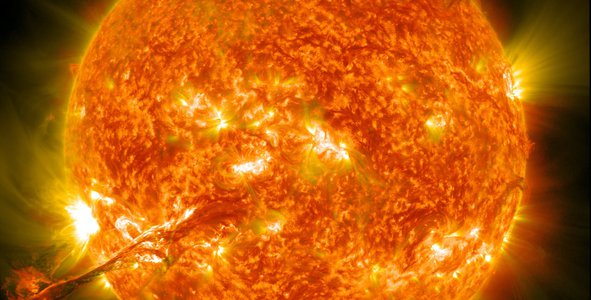
Have you all wondered about that small yellow ball in the vast sky that shines our day? About how it is so efficient for our survival? The fact that every organic & inorganic thing depends so much on this small object seems absurd, but is indeed the reality. Ever thought how it would be like to see that object in close proximity? So close that we can actually feel it, touch it.
Whether you have thought or not, anyways, the brilliant scientists of NASA did!
Under the various agencies of NASA, several space missions were undertaken. If missions could go up to Mercury, then why not even to the sun? The only factor which stopped that was the cost.
After several postponements & cancellations, finally a cost-effective solar probe: Parker Solar Probe, came into being.
This mission was named after the famous nonagenarian physics Sir Eugene Newman Parker.
It also became NASA's first space mission to be named after a living person.
OBJECTIVES
This mission was idealized to unlock mysteries about the sun, like the study of solar winds. It is expected to trace the flow of energy that heats the solar corona & solar winds. It could also help to provide a better understanding about internal structures of the Sun.
It has other far reaching benefits to society so as to protect it from the threats of space weather.
TRAJECTORY
It was launched on August 12, 2018. Its trajectory has 24 orbits & 7 venus-gravity-assist-flybys.
So, what's basically a flyby?
It is an operation carried out to compel the spacecraft into another orbit using gravitational assistance. It's basically the shifting of orbital foci.
The PSP uses a similar phenomenon to approach towards the sun, shifting its target from sun to Venus successively. This will ultimately shrink the probe's orbit & will bring it near the sun as close as 3.83 million miles. The projected time to complete the trajectory is approximately 7 years.
STRUCTURE
Now here is a million dollar question : How would a spacecraft endure the extreme temperatures of the sun & high velocity solar winds? So, to answer it, the probe is protected by a hexagonal solar shield directly facing towards the sun. This solar shield is made up of carbon-carbon composite which can endure temperatures up to 1370°C. It's because of this shield that the functional components of the probe are directly blocked by the solar radiations from getting destroyed.
A white reflective aluminum layer is initiated to minimise absorption of solar waves.
It gets its power supply from a dual system of solar panels
FUNCTIONAL COMPONENTS
The PSP has 4 main functional components for various purposes.
1. FIELDS
This part basically studies electrical & magnetic fields of solar atmosphere & conducts research based on them.
2. IS☉IS
It deals with calculations related to change in energies & acceleration of various particles of the sun.
3. WISPR
It is basically the telescopic camera for the probe & captures various images.
4. SWEAP
It counts protons, electrons & helium ions.
It also determines their various properties such as velocity, temperature, density, etc.
FUTURE EXPECTATIONS AND CONCLUSION
The PSP mission will revolutionise our understanding of the sun. It will provide new data on solar activity & make noteworthy contributions to our ability to forecast major space-weather events that impact biolife.
It would be so exhilarating to unveil every secret of the mysterious sun. It will give us a chance to attain mastery over that one celestial body which has so efficiently held our solar system since billions of years.
Space Agency Data
NASA
Hackathon Journey
It was a memorable journey. It opened the doors to great interesting facts about space missions. It was a thrilling adventure to research on the Sun. We would like to thank our teachers for their timely support and guidance.
References
References :
https://youtu.be/PGElWHGX4WA
https://www.nasa.gov/feature/goddard/2018/traveling-to-the-sun-why-won-t-parker-solar-probe-melt
http://parkersolarprobe.jhuapl.edu/The-Mission/index.php#Launch
https://www.google.com/url?sa=t&source=web&rct=j&url=https://en.m.wikipedia.org/wiki/Parker_Solar_Probe&ved=2ahUKEwjUhvWAxr36AhU1znMBHc_mBYcQmhN6BAgKEAI&usg=AOvVaw1V6sCwaVREKTmb-_Y8-sIM
Tags
#Space, #Sun